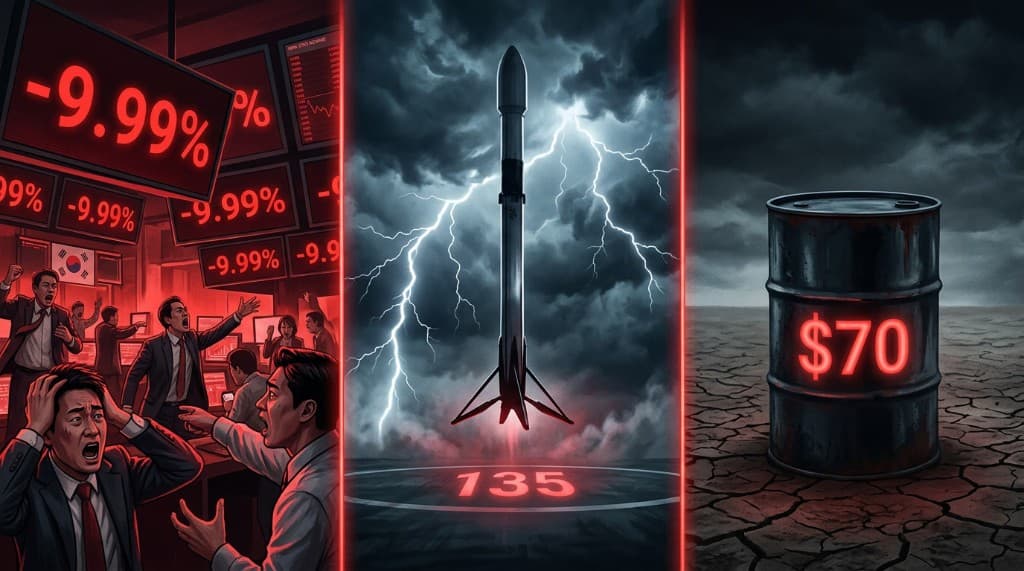
Black Tuesday in Seoul: The Algo Trap Behind KOSPI's -10%, SpaceX's Path to $135, and Why $70/Barrel Is Putin's Nightmare
José Luis Cava dissects today's KOSPI -10% collapse: not an AI bubble burst, but a textbook algo-driven liquidity sweep. He also explains why SpaceX must reach $135 before forming a bottom, and why $70/barrel Brent could be the event that finally destabilizes Putin's regime.
Seoul's stock exchange triggered four circuit breakers in 2026. Tuesday was the fourth — and the most violent since the Iran war shock of March. The KOSPI shed 9.99%, closing at 8,203.84, wiping out 910 points in a single session. SK Hynix and Samsung fell more than 12% each. Retail investors, in a move that will be studied in behavioral finance textbooks, poured more than 10 trillion won into the market — the single largest retail buying surge ever recorded on Korean exchanges.
José Luis Cava's reading of what happened, and what comes next, is far more structured than the "AI bubble is bursting" narrative dominating financial media.
The Setup: A Record That Was Always a Trap
On Monday, SK Hynix became the most valuable company listed on the KOSPI by a whisker — overtaking Samsung by 8.6 trillion won in market cap. The index breached 9,100 for the first time in history.
It was, textbook-fashion, the moment the trap was set.
Cava has explained this pattern repeatedly: when a market breaks above a previous resistance — in this case the 8,933 level registered on June 2 — the standard technical analysis instruction is to buy. "Buy the breakout," as every retail manual says. The problem, according to Cava, is that in roughly 70% of cases, those breakouts are not real. They are engineered events designed to attract exactly those buyers — and then run their stops.
The KOSPI's move above 8,933 sucked in late buyers. The liquidity they provided — their buy orders — became the fuel for the next move down. This is called a "barrida" (sweep) in Cava's terminology: the market manufactured a false signal, collected fresh longs at the top, and then reversed with violence.
The Mechanics: Negative Gamma and Algo Stop-Hunting
The structural explanation lies in how derivatives dealers are positioned after a major options expiry.
Following the expiry of a large batch of futures and options contracts, dealers find themselves in what is called a negative gamma environment. In this zone, every market move forces them to amplify it rather than dampen it. When the market drops, dealers must sell more to hedge — which accelerates the fall. When it rises, they must buy — which amplifies the rise. Negative gamma is a volatility amplifier baked into the market's own plumbing.
With the KOSPI's unusually high concentration in two semiconductor stocks — Samsung and SK Hynix together represent more than half of the entire index — the algorithmic pressure becomes even more acute. Leveraged ETFs tied to chip stocks, which Korean regulators recently admitted were approved too hastily, add another layer of mechanical forced selling.
Cava's projection is precise: algorithms will seek out the stop-loss clusters sitting between 7,359 and 7,050. That's not a guess — it's an identification of where the weakest hands placed their protective orders during the previous rally. The process of hunting those stops, cleaning the market, and building a real base is expected to take at least 15 days from today.
This is not a market that has changed its fundamentals. The AI build-out is not over. Hyperscaler capital expenditure commitments — the contracts that underwrite SK Hynix's HBM demand — have not been cancelled. The US economy is growing at a real rate of 2.7%. None of that changed on Tuesday.
What changed is the mechanical positioning of the derivatives market, amplified by excessive retail leverage.
SpaceX: The $135 Gravity Well
SpaceX debuted at $135. It closed its first trading day at $160. It went on to reach $225.64 — briefly making it the fourth most valuable company on earth, overtaking Amazon. Then came Tuesday's rout: -16.4% to $154.60, with futures pointing to another drop toward $150 before Wednesday's open.
Cava's call: the algorithms will pull the stock back to $135 — the IPO placement price — before any genuine bottom can form.
The logic is the same as the KOSPI trap. The IPO created a massive crowd of buyers across a wide price range. Some bought at $135, many bought between $150 and $175, and the most euphoric (including those who inadvertently bought Virgin Galactic instead of SpaceX because of ticker confusion) bought near $225. That crowd of buyers has stops and pain thresholds distributed across that entire range. Algorithms will find the densest cluster — the $135 placement price, a level that represents the most psychologically significant floor — and drag the price to it before the real money decides to buy.
The $20 billion bond offering that SpaceX confirmed this week — its first-ever debt issuance — adds fundamental complexity. A company with no earnings taking on $20 billion in fixed obligations, with borrowings projected to reach $132 billion by 2028, generates legitimate questions that institutional investors will use as a reason to continue reducing exposure during the correction.
The August lock-up remains the next structural risk. When the first window for insider selling opens — estimated at 20% of restricted shares once Q2 results are published — the supply pressure in an already thin summer market will test the stock again.
DXY and Oil: Two Markets Signaling the Same Thing
The US Dollar Index has broken clearly above the 100.7 resistance level that Cava had flagged as the key threshold to watch. It now trades at 101.00–101.18, at 13-month highs, driven by hawkish re-pricing at the Federal Reserve under Kevin Warsh.
Cava's projection: DXY toward 102.
A stronger dollar creates headwinds for emerging market assets and adds pressure to commodity prices globally. For Korea — an export economy with chip revenues denominated largely in dollars — a stronger USD at the same time as semiconductor prices face pressure is a particularly painful combination.
On Brent crude, the picture is equally directional: Brent has broken below critical supports and is heading toward $70/barrel. That is not a forecast drawn from sentiment or gut feel — it is a technical read of a market where shorts are structurally positioned against the weakest physical inventory backdrop in decades.
The macro consequence Cava highlights is worth internalizing: when both semiconductors and oil fall simultaneously, US inflation expectations collapse. If inflation expectations collapse, the Federal Reserve has no mandate to hike rates. The medium-term path for monetary policy becomes more accommodative than today's market pricing suggests — and that is bullish for growth assets over any meaningful time horizon.
Russia: The Fiscal Arithmetic of a Regime Under Pressure
The $70/barrel number matters far beyond financial markets.
Russia's fiscal architecture has a structural weakness that Cava lays out in stark arithmetic. Military spending now represents 10% of Russian GDP — a figure that generates apparent economic growth while hollowing out the private sector's productive capacity. The fiscal deficit stands at approximately 4% — but strip out oil and gas revenues, and that deficit rises to 10% of GDP. The regime is financially dependent on hydrocarbons in a way that cannot be obscured by accounting.
The Central Bank of Russia, under its governor, has been purchasing government debt directly to provide the state with liquidity. This is monetization — the process by which a central bank finances government spending by creating money. Its consequences are well understood: inflation accelerates, the currency depreciates, and the real purchasing power of wages and savings collapses. Russia's middle and lower classes are already bearing the full weight of this dynamic.
At $70/barrel Brent, Putin's fiscal arithmetic breaks down. The revenues needed to pay soldiers, service the bureaucracy, fund the security apparatus, and maintain popular quiescence through subsidies no longer add up. Cava describes this threshold as the point at which social unrest becomes probable and regime stability becomes genuinely uncertain.
The detail that signals how acute the pressure already is: the Communist Party of Russia has proposed confiscating citizen savings to plug the fiscal gap. When an opposition party's answer to the state's financial crisis is forced expropriation of private wealth, the desperation being signaled is not rhetorical.
The deeper structural damage is slower but more permanent. Every rouble allocated to military hardware is a rouble not invested in productive capacity. The private sector's long-term shrinkage is already guaranteed by the scale of this reallocation. Russia's potential economic output in 2030 will be materially lower than it would have been in the absence of this war, regardless of how the conflict resolves.
What This Means for Investors
The instinct on a day like Tuesday is to panic. Retail investors in Korea showed the other instinct — to buy aggressively into the collapse. Both impulses are understandable and both are, in isolation, wrong.
The correct frame is the one Cava has been consistent about: this is a mechanical correction driven by algorithmic positioning, not a structural change in the investment case for technology or AI. The stop-hunting phase in the KOSPI has a defined target zone and a defined timeline — roughly 15 days for the process to run its course before a genuine base can form.
The long-term architecture remains unchanged. US real GDP growth at 2.7%. Corporate earnings growing above historical averages. Hyperscaler capital expenditure commitments locked in for years. The AI infrastructure build-out is not a speculation about the future — it is a procurement cycle already underway with contracts signed.
Oil declining toward $70 removes the inflationary pressure that has been the primary argument for rate hikes. Lower rates, when they arrive, will be a tailwind for every asset class in our portfolios.
And if $70 Brent tips Russia into its fiscal crisis — if it makes the continuation of the war economically impossible for the Kremlin — the geopolitical risk premium embedded in global markets since February 2022 begins to deflate. That is not a small thing. Four years of elevated risk premia unwinding is the kind of event that creates a generational buying opportunity in assets that have been discounted for conflict exposure.
The correction is happening exactly as anticipated. The cleanup of leveraged positions is uncomfortable in the moment. The opportunity it creates, for those who kept their powder dry, is the reason we have been doing exactly that.
Analysis based on José Luis Cava's market commentary of June 23, 2026. This post is for informational and educational purposes only and does not constitute investment advice.
Explore the data
Check the latest congressional trades and active investment signals.