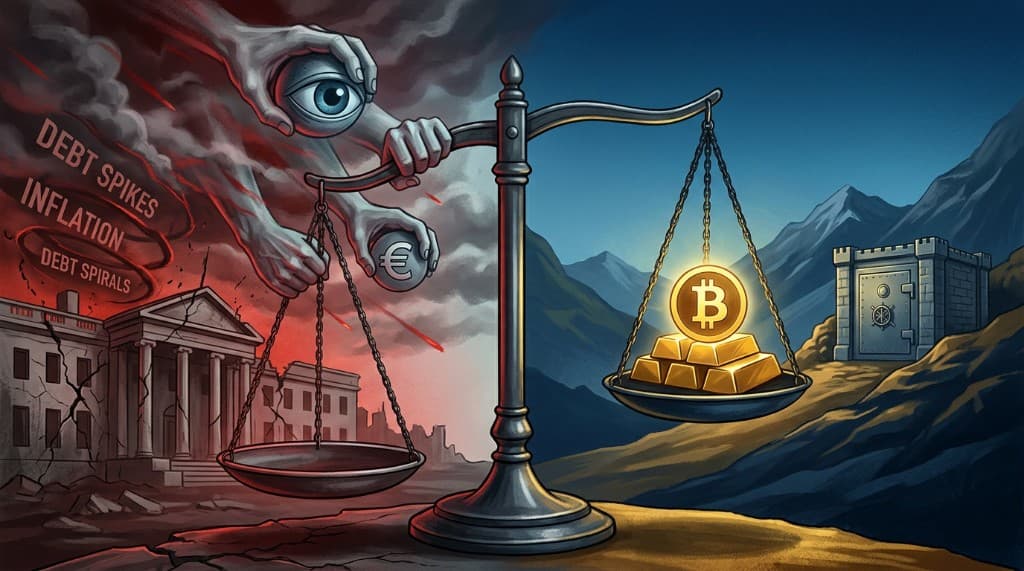
The New Wealth Extraction Playbook: Unrealized Gains Taxes, the Digital Euro, and Why the Middle Class Must Own Hard Assets Now
José Luis Cava connects the dots between Korea's KOSPI crash, the Netherlands' unrealized gains tax, the EU's digital euro project, and the predictable roadmap for US debt management. The conclusion is uncomfortable but consistent: governments facing insolvency will change the rules. Hard assets owned before the rule change are the only protection.
The KOSPI crashed on Tuesday partly because Korean legislators debated taxing unrealized capital gains. The Netherlands already approved such a tax. It appeared in the US Democratic Party platform in the last electoral cycle. The European Union is advancing a digital currency designed to give governments complete visibility — and theoretically, control — over every financial transaction made by their citizens.
These are not isolated events. José Luis Cava connects them into a coherent thesis about where governments facing structural insolvency are heading, and why understanding that trajectory is the most important thing an investor can do right now.
The Pattern: Governments That Cannot Pay Their Bills Change the Rules
The starting observation is uncomfortable but historically well-supported: governments that accumulate unsustainable debt do not admit defeat and restructure honestly. They change the rules.
The sequence Cava describes for the United States is predictable given historical precedents:
First, liquidity injection. When debt matures and cannot be rolled over at acceptable rates, the Federal Reserve creates money to absorb the shortfall. This is already happening at various points in the cycle — it is the mechanism behind every "quantitative easing" episode since 2008.
Second, maturity extension. Rather than paying off debt, the government extends its duration — effectively kicking the obligation further into the future. This reduces the near-term cash requirement at the cost of a larger long-term burden.
Third, rate reduction. Lower interest rates reduce the cost of servicing existing debt. The Federal Reserve's primary mandate in practice — whatever the official language says — is to keep debt service costs manageable for the Treasury.
Fourth, selective repudiation. Cava describes this as the final stage: partial forgiveness of debt, beginning with obligations held by foreign residents (easiest politically, since foreign creditors don't vote) and eventually extending to domestic holders. Historical precedents include the US gold confiscation of 1933, Nixon's 1971 closure of the gold window, and various emerging market debt restructurings over the past fifty years.
The implication for anyone holding government bonds as their primary savings vehicle is direct: in the final stages of this sequence, the real value of those bonds is deliberately inflated away or restructured outright.
The Unrealized Gains Tax: Taxing Wealth Before It Can Escape
The middle class has begun to understand this dynamic. Over the past decade, retail participation in equity markets has grown dramatically. Platforms have democratized access to index funds, gold ETFs, and Bitcoin. The people who would historically have kept their savings in bank accounts or government bonds have begun migrating toward assets that cannot be printed.
The political response to this migration was entirely predictable to anyone who understood the underlying incentive structure.
An unrealized gains tax is a levy on the increase in value of an asset that has not yet been sold. Under conventional tax law, you only pay capital gains tax when you realize the gain — when you sell. An unrealized gains tax would require payment based on paper profits that exist only on a balance sheet, forcing asset sales to generate the cash to pay the tax, or penalizing holders for not selling.
The Netherlands has passed a version of this. South Korea's legislature debated it — and that debate contributed directly to Tuesday's KOSPI panic, as investors processed the implication that their accumulated gains in semiconductor stocks could become taxable before they chose to sell. It appeared explicitly in the US Democratic Party platform in the most recent election cycle.
The political logic is transparent: it targets wealth that has successfully protected itself from inflation by moving into productive assets. It is a mechanism to extract value from precisely the people who were smart enough to move their savings into the right places.
The Digital Euro: Control First, Confiscation Later
The European Central Bank's digital euro project is advancing. Officially, it is framed as a payment efficiency tool — a way to modernize the financial system and reduce transaction costs.
The actual architecture of a central bank digital currency, however, grants issuing authorities capabilities that have no equivalent in the cash-based or commercial banking system. A digital euro can be issued with expiry dates — money that must be spent by a certain date or it disappears. It can be programmed to be spendable only in certain categories. It can be frozen instantly without judicial process. Every transaction is permanently recorded.
This is not speculation about future misuse. It is the inherent technical architecture of the instrument. A programmable digital currency is, by design, a currency under total governmental control.
The relevance for investors is not that this is imminent or that governments will immediately weaponize these capabilities. It is that the direction of travel is unambiguous, and the assets that preserve their value outside this system — physical gold, Bitcoin, equity in businesses with real cash flows — become more valuable precisely as the system around them becomes more controlled.
Gold: The Floor Is Forming
On the asset side, the current data is constructive. Inflows into physical gold ETFs have reached their highest levels since April 2025. The investment community that tracks these flows interprets sustained institutional buying into ETFs backed by physical metal as evidence of a structural positioning shift — not short-term speculation.
Gold's recent correction has been driven by three identifiable temporary sellers: Gulf states liquidating to cover lost oil revenue from the Hormuz disruption, the unwinding of tariff arbitrage trades that had front-loaded gold into US warehouses before Trump's tariff announcements, and the collapse of geopolitical risk premiums following the Iran peace process. All three of these factors are transitional.
The structural buyers — central banks adding to reserves, long-term wealth preservation mandates, investors who have done the math on US debt sustainability — have not gone away. The Gold/Brent ratio forming a base at 43.5 with a target of 69 suggests that the next major leg of the gold rally has not yet begun, and that the correction is creating the entry point.
SpaceX: A Dream Is Not a Business Plan
The analysis of SpaceX's post-IPO behavior yields one specific observation worth noting: the majority of shares in the initial offering were purchased by retail investors. Institutional allocation was oversubscribed but the distribution of actual buyers skews heavily toward individual participants who were buying access to a narrative — space exploration, Elon Musk's vision, the satellite internet revolution — rather than a discounted cash flow analysis.
This matters because retail investors react to price movements differently than institutional holders. They bought a dream and they will sell a nightmare. When SpaceX reaches the $135 placement price — as the algorithmic pressure continues — the reaction from those retail holders will determine whether the bottom is clean or messy. Either way, the process of cleaning out optimistic retail buyers before a genuine institutional base forms is textbook post-IPO mechanics.
The Consistent Answer
Every thread in this analysis leads to the same conclusion. If governments facing insolvency will inject liquidity, extend maturities, cut rates, and eventually seek to extract value from accumulated wealth through unrealized gains taxes or digital currency control — then the assets that protect against this sequence are the ones that exist outside the control of any single government and cannot be printed.
Equity in genuinely excellent businesses — those with real cash flows, durable competitive advantages, and global revenues — is partial protection. The earnings power of a company like Microsoft or Alphabet is not negated by dollar debasement; it is expressed in whatever unit of account the market uses, and it compounds regardless.
Physical gold is the asset that has served this function across every historical monetary reset on record. Central banks buy it precisely because they understand what the endgame looks like.
Bitcoin is the first digitally-native scarce asset. Its value proposition is not primarily speculative return — it is the mathematical guarantee of fixed supply in a world where every other form of money is subject to political decision-making about how much of it exists.
The urgency is not that the endgame is tomorrow. It is that the assets providing protection cost more after the rule changes than before them. The time to own them is while the current rules still hold.
Analysis based on José Luis Cava's market commentary of June 24, 2026. This post is for informational and educational purposes only and does not constitute investment advice.
Explore the data
Check the latest congressional trades and active investment signals.