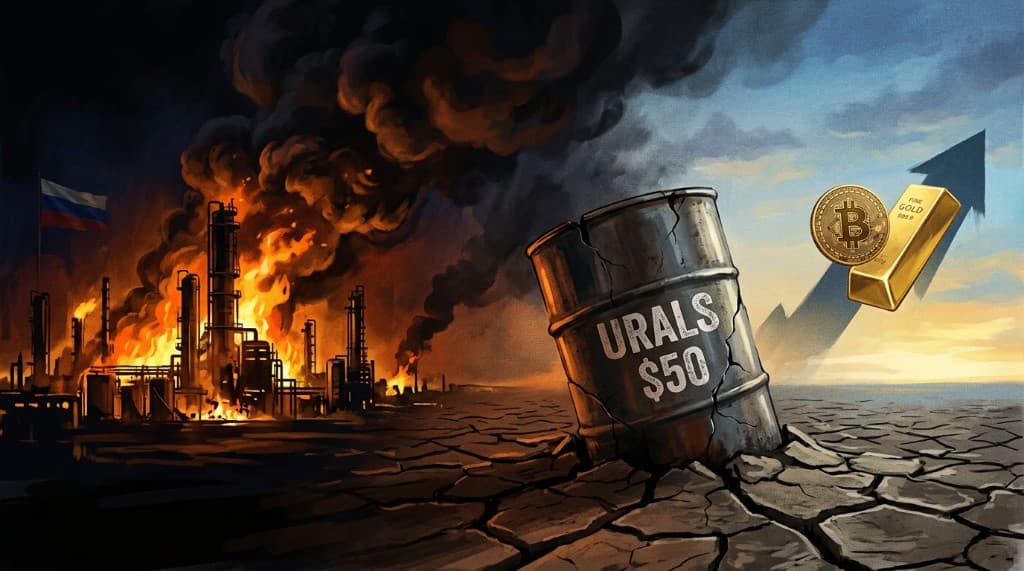
Russia's Oil Trap: Urals at $50, Refineries Burning, and Why the Resolution Could Be Gold's Biggest Catalyst
José Luis Cava connects three threads: the algorithmic cleanup of the KOSPI still targeting 7,040, Russia's fiscal collapse with Urals crude at $50 and 20% of its refining capacity destroyed, and the scenario where a Ukraine or Hormuz resolution triggers a massive surge in gold and Bitcoin.
Three simultaneous stories are converging in global markets. The KOSPI algorithm is still hunting its final target. Russia's fiscal architecture is collapsing in real time. And the assets best positioned for what comes after — gold and Bitcoin — are sitting at discounted prices while the world is looking elsewhere.
The KOSPI Algorithm Has Not Finished Its Work
The Black Tuesday collapse of the Korean index on June 23 was not the end of the process — it was the beginning. José Luis Cava has refined his target: the KOSPI algorithm's objective is the 7,040 level, which corresponds to the origin of the rally that began on May 20.
The logic is precise. Algorithms do not just hunt stops placed above recent highs. They clean the entire cohort of buyers who entered during the rally. Every investor who opened a long position between May 20 and the June 22 peak needs to be expelled before the market can form a genuine base. At 7,040, the last of those positions will have been forced out — either by stop-loss orders or by margin calls like those that devastated leveraged Korean retail investors during the initial collapse.
The KOSPI's high correlation with the Nasdaq 100 and the semiconductor sector index means this process transmits directly to global technology stocks. The cleanup is mechanical, not fundamental. The AI infrastructure build-out has not changed. The hyperscaler capital expenditure commitments have not been cancelled. But until the algorithm completes its work, price pressure in the sector continues.
Russia: The Structural Collapse No One Predicted This Fast
The story of Russia's financial situation has moved significantly faster than most analysts expected, and the mechanism is more damaging than simple oil price decline.
On June 16 and 18, Ukrainian drones struck the Kapotnya refinery in Moscow — the Gazprom Neft-operated facility that supplies approximately one-third of the Russian capital's gasoline and diesel. Both of the refinery's main atmospheric distillation units were destroyed. Industry sources say repairs will take at least six months. The refinery, which processed 11.6 million tonnes of crude per year, is offline until at least the end of 2026.
Kapotnya is not an isolated case. The IEA estimates that Ukrainian drone strikes have now taken more than 20% of Russia's total refining capacity offline. The consequence is structural and self-reinforcing: Russian oil companies are sitting on crude they cannot process, which forces them to export at maximum port capacity — record loadings of 2.7–2.8 million barrels per day from Baltic and Black Sea ports — which floods global markets with supply, which depresses prices further.
The financial arithmetic has turned deeply adverse. Russia's federal budget was constructed on an assumed Urals crude price of $59/barrel. The actual price has collapsed. From the April 2026 peak of $116 — inflated by the Hormuz crisis — Urals has fallen by more than half. The Dated Brent benchmark fell to $72, and the Urals discount has widened to approximately $22/barrel, producing effective prices around $50 for some transactions.
Oil and gas revenues in the first half of 2026 fell 30% year-on-year, generating an estimated deficit of $70 billion. A Gazprombank analysis suggests the June average Urals price will be approximately $63/barrel — 27% below May's average of $86.52 and 33% below April's record of $94.87.
The Geopolitical Compression
The military dimension intensifies the fiscal pressure. Ukraine has announced plans to produce 10,000 long-range drones and new ballistic missiles with sufficient range to target Moscow and Crimea. If those capabilities reach operational scale, the geography of the conflict changes materially.
The specific fear in the Kremlin involves Crimea. Ukraine does not need to hold the peninsula militarily to create an unacceptable situation — it only needs to destroy the bridge and the ferry routes that serve as the supply lines for Russian troops and the civilian population there. Without resupply, the forces and civilians in Crimea face an agonizing attrition. This is the scenario Cava describes as generating genuine panic in Putin's strategic calculus.
Meanwhile, the framework of China's involvement has shifted. China is not a neutral party — it has its own interests, which have never fully aligned with sustaining an expensive Russian war that destabilizes global commodity markets and creates collateral damage to Chinese trade flows. Cava identifies what appears to be a tacit understanding between China and the Trump administration that could accelerate the conditions for a negotiated resolution.
The convergence of fiscal crisis ($70B deficit, oil below budget threshold), military vulnerability (Crimea encirclement threat), and external pressure (China repositioning) creates conditions that did not exist six months ago. Putin's regime is not on the verge of collapse tomorrow — but the sustainability of the current path looks materially worse than it did at the start of 2026.
Gold and Bitcoin: Positioned for the Resolution
The current price pressure on both assets has an identifiable cause. Russia sells gold and Bitcoin to fund military operations when oil revenues fall short. This is forced selling — not a strategic repositioning by long-term holders, not a change in the fundamental investment case, but emergency liquidation by a government under fiscal pressure.
Cava's observation is that a resolution event — whether the end of the Ukraine conflict or a normalization of the Hormuz situation — would remove this selling pressure simultaneously with providing a massive positive signal to global markets.
The mathematics are stark. Gold sold its way from record highs as forced sellers dumped positions to cover revenue shortfalls. Bitcoin sold from its own highs for the same reason and through the same channels. When the forced selling stops — and when the resolution itself triggers a collapse in geopolitical risk premiums that have been embedded in asset prices since February 2022 — both assets face a supply-demand dynamic that has no historical precedent in this cycle.
Four years of war premium deflating is not a small event. The investors who hold gold and Bitcoin through the current drawdown, understanding that the selling is forced and temporary rather than fundamental, are the ones positioned for what Cava describes as the "optimistic end scenario."
The Coherent Picture
What looks like chaos across three separate stories — a Korean stock market algorithmic correction, a Russian fiscal collapse, and pressure on hard assets — is actually one unified process with a defined end state.
The algorithm finishes its work in the KOSPI and semis. Russia's fiscal situation becomes untenable. A negotiated resolution materializes under pressure from China and Trump's strategic calculus. The geopolitical risk premium that has inflated commodity volatility and depressed risk assets deflates rapidly. Gold and Bitcoin, having absorbed the forced selling of a regime under pressure, rally into the new environment.
The uncomfortable part of this thesis is not the logic — it is the timing. These processes move on their own schedule, and maintaining positions through the drawdown requires the discipline that Fernando Sánchez was discussing earlier this week. System 2 investors who understand why they own what they own can watch the prices fall without urgency. System 1 investors who bought because prices were going up will sell at the bottom and miss the resolution.
The resolution will come. The question is only whether you are still positioned when it does.
Analysis based on José Luis Cava's market commentary of June 27, 2026. This post is for informational and educational purposes only and does not constitute investment advice.
Explore the data
Check the latest congressional trades and active investment signals.