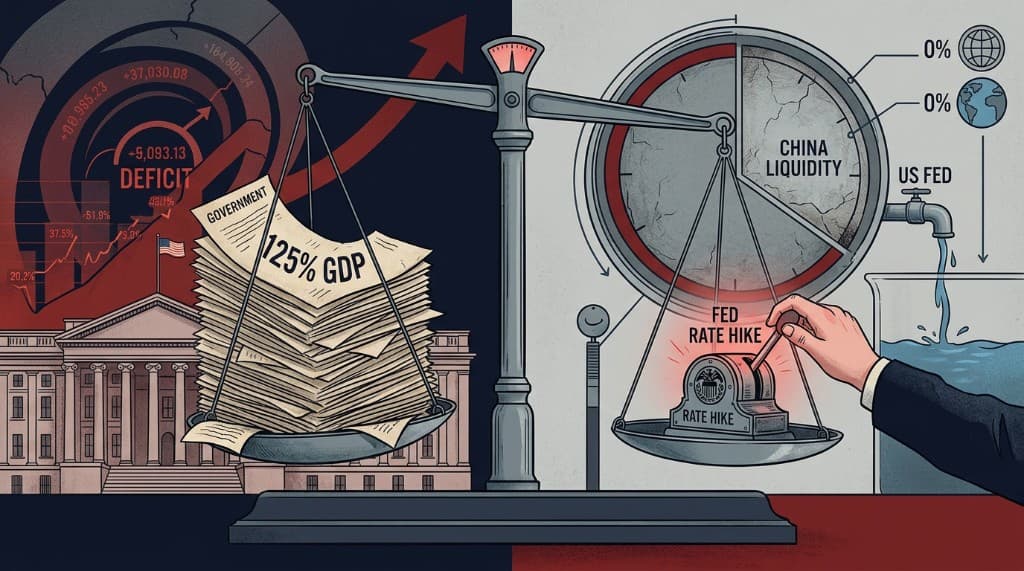
Warsh's Impossible Math: Why Debt at 125% GDP Makes Rate Hikes Fiscal Suicide
Cava explains the structural constraint that will define Warsh's tenure: US debt at 125% of GDP means rate hikes would collapse the fiscal system. Meanwhile, SpaceX and OpenAI megaplacements are draining liquidity from markets, China is paradoxically contracting despite a weak economy, and gold and Bitcoin are signaling the absence of Chinese liquidity.
Kevin Warsh arrived at the Federal Reserve carrying the reputation of a hawk. Markets immediately priced in multiple rate hikes. The bond market sold off. Tech stocks experienced turbulence. The narrative was straightforward: a hawkish Fed chairman means higher rates.
The arithmetic, however, tells a different story.
The Debt Constraint That Changes Everything
US public debt stands at 125% of GDP. The federal deficit runs at 6–7% annually. Interest payments on that debt already represent nearly half of the entire federal deficit — meaning roughly half of every dollar the US government borrows goes immediately to pay the interest on money it already borrowed.
In this context, what does a rate hike actually do? It raises the cost of rolling over existing debt. It increases the interest expense on every new Treasury issuance. It adds directly to the deficit it is supposedly trying to contain. A meaningful rate increase — the kind that would genuinely cool inflation — would risk a fiscal feedback loop: higher rates → higher deficit → more debt issuance → higher rates. The system has no shock absorbers left at that level of leverage.
Cava's reading of Warsh is that the public hawkishness is, at least in part, posture. The underlying constraint is debt sustainability, and no Federal Reserve chairman — regardless of ideological conviction — can ignore the fiscal arithmetic indefinitely. The inflation currently running in the US system is driven approximately 60% by energy (gasoline and airfare), both of which are tied to geopolitical dynamics that monetary policy cannot address. Core inflation has actually declined slightly, suggesting that without the energy component, the case for hikes weakens further.
The economy, meanwhile, is growing at 2.7%. There is no recession forcing the Fed's hand in the dovish direction. But there is also no structural inflation problem that requires the blunt instrument of rate hikes to solve.
The Megaplacement Drain and the Fed's Compensation
The current market environment features an unusual source of liquidity pressure that has nothing to do with central bank policy: the wave of large-scale equity placements by technology companies.
SpaceX's $75 billion IPO. The anticipated offerings of OpenAI and Anthropic. Google's $40 billion share issuance. Meta's capital raises. Each of these transactions extracts money from financial instruments — from the funds and portfolios that would otherwise be invested in stocks, bonds, and other assets — and redirects it into the real economy to fund infrastructure, research, and operations.
This is not inherently negative for the economy. It is, however, a mechanical drag on financial market indices. Money that flows into a SpaceX share purchase is money that does not bid up the price of Nasdaq components. The effect is a dampening of index momentum that persists for as long as the placement wave continues.
The Federal Reserve is aware of this dynamic. Cava notes that the Fed is compensating with targeted liquidity injections designed to keep bank reserves ample without being excessive — threading the needle between supporting market functioning and not providing an explicit stimulus that would undermine Warsh's hawkish credibility.
The net effect is less dramatic than either the bulls or bears believe. The placement drain is real but partially offset. The Fed is not tightening aggressively. The underlying economic engine is growing. The current volatility is more about rebalancing flows than about a fundamental shift in monetary conditions.
China's Paradox: Tightening When the Economy Is Weak
The most analytically puzzling element of the current global picture is China's behavior. Since April 2025, the yuan has been strengthening against the dollar — an appreciation that reflects deliberate liquidity contraction by the People's Bank of China.
This is surprising for several reasons. China's economy is slowing. Domestic debt levels are elevated. The 10-year government bond yield has been trending downward, signaling weak growth expectations. A central bank facing these conditions would normally be expected to ease — to inject liquidity, cut rates, and stimulate. China is doing the opposite.
The consequences show up precisely in the assets most sensitive to global liquidity: gold and Bitcoin. Both have been weak not because their fundamental investment cases have changed, but because Chinese liquidity is absent from the system. When the PBOC is contracting, the marginal buyer that had been supporting commodities and risk assets withdraws.
The divergence this creates is visible at the index level: US technology (Nasdaq, S&P 500) continues to perform while Chinese corporations (CSI 300) struggle. American companies are benefiting from US fiscal and monetary support while Chinese companies face domestic headwinds without the cushion of central bank accommodation.
China ETFs: A Cautious Look
For investors who want to understand the China exposure question — whether to take any position in Chinese assets — Cava examines two vehicles without offering a strong buy recommendation.
ICHN (iShares MSCI China) provides broad exposure to the Chinese economy at roughly half the cost of its main competitor. For investors who believe in a Chinese recovery, it is the more cost-efficient vehicle.
KWEB (KraneShares CSI China Internet) concentrates specifically in Chinese technology — companies like Alibaba and Tencent, which together represent approximately 30% of both ETFs. KWEB is significantly more volatile and has experienced more pronounced drawdowns during China's economic slowdown.
Both vehicles present a coherent risk exposure, but the structural headwinds are real: a contracting central bank, a property market that has not fully resolved, a government that deliberately suppresses domestic consumption, and a geopolitical environment that adds a premium to holding Chinese assets. Until the PBOC shifts to accommodation — signaled most reliably by yuan depreciation to the 0.15 CNY/USD threshold — the risk-reward for Chinese exposure remains unfavorable.
The Unified Reading
The macro picture that emerges from connecting these threads is more coherent than it appears.
Warsh cannot hike aggressively because the debt math would break the fiscal system. He will perform hawkishness while managing the underlying constraint. The Fed will offset megaplacement drains with targeted injections. The US economy will continue growing at approximately 2.7%. Chinese liquidity will remain absent until the PBOC changes course. Gold and Bitcoin will stay under pressure from both Russian forced selling and Chinese liquidity absence — until one or both of those conditions change.
The change, when it comes, will likely be fast and large. Chinese re-accommodation or a geopolitical resolution creates the conditions for a simultaneous unwinding of multiple sources of asset price pressure. Investors positioned in gold and Bitcoin through the current drawdown are not being stubborn — they are waiting for a specific set of conditions to resolve.
The conditions are identifiable. The timeline is uncertain. The outcome, if the analysis is correct, is disproportionate to the patience required.
Analysis based on José Luis Cava's market commentary of June 27, 2026. This post is for informational and educational purposes only and does not constitute investment advice.
Explore the data
Check the latest congressional trades and active investment signals.