When Dalio and Burry Are Both Bearish: The $5 Trillion Fuel Nobody Is Talking About
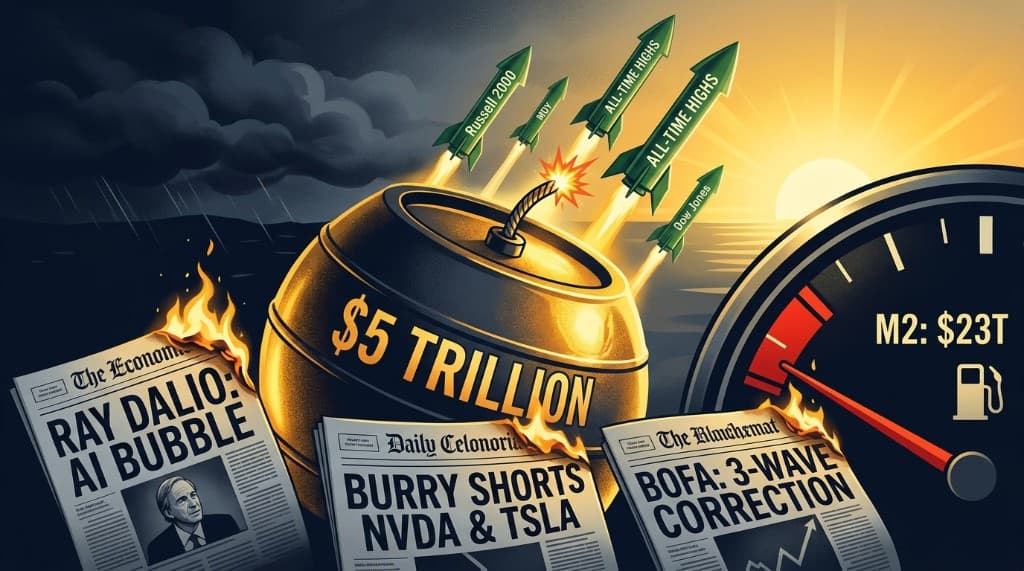
Ray Dalio calls AI a bubble. Michael Burry opens shorts on NVIDIA and Tesla. Professional fund managers reduce US equity exposure at the fastest pace in history. Bank of America forecasts a three-wave correction. José Luis Cava's response: this is the most compelling contrarian setup of 2026. US M2 has grown from $15 trillion in 2020 to $23 trillion today, with May posting the largest single-month increase in history. Households are sitting on $5 trillion in money market funds. The Russell 2000 and mid-cap 400 are at all-time highs. The breadth is broad. The fuel is loaded.
When Ray Dalio warns that artificial intelligence is a bubble, and Michael Burry simultaneously opens short positions against NVIDIA and Tesla, the financial press takes notice. When professional fund managers simultaneously reduce their US equity exposure at the fastest pace in a decade, the narratives align into a coherent bearish consensus. Bank of America adds structure to the narrative with a formal forecast for a three-wave correction. The picture looks serious.
For José Luis Cava, this convergence of famous bears and institutional selling is not a warning signal. It is the single most compelling contrarian indicator of 2026.
Why Famous Bears Are Not Market Predictors
Ray Dalio's macro framework is genuinely sophisticated. Michael Burry's 2008 call was genuinely prescient. But both men have made prominent bearish calls at moments that preceded significant rallies, and neither has a reliable record of timing market tops with precision. More importantly, when their bearish views align with widespread institutional selling and peak pessimism in sentiment surveys, the technical configuration that results is typically the opposite of what their calls suggest.
The mechanism is not mysterious. When respected voices make bearish calls, investors who were already nervous accelerate their selling. When professional fund managers reduce equity exposure at historical rates, they exhaust the available supply of motivated sellers. When Bank of America issues a formal three-wave correction forecast, the clients who act on it are already out. The selling that could happen has happened.
What remains is a market in which the bearish case has been priced into positioning. For prices to fall further requires a new wave of sellers — and that wave is harder to generate when everyone who was persuadable has already sold.
The Liquidity Foundation
The central argument for the continuation of the bull market is not a valuation argument or a technical argument. It is a liquidity argument, and the numbers make it unusually concrete.
The US money supply (M2) stood at approximately $15 trillion in 2020. It now stands at $23 trillion — an increase of more than 50% in six years. In May 2026, the United States recorded the largest single-month M2 increase in recorded history. The pace of money supply growth has reaccelerated to more than 6% annually.
What this means for asset prices is a matter of arithmetic. A fixed stock of real assets — companies, property, commodities — being pursued by a continuously expanding supply of money will, on average, see prices rise in nominal terms. This is not a market prediction. It is the mechanical consequence of monetary expansion applied to a real asset base.
The more immediately actionable component of the liquidity picture is the $5 trillion currently sitting in US household money market funds. This is a record level of cash parked in near-zero-duration instruments, earning just enough to offset inflation — barely. It represents capital that is available to move but has not yet moved. It is invested conservatively precisely because its owners are cautious about equities.
The behavioral pattern that converts this defensive capital into equity exposure is price appreciation. When markets rise, the discomfort of watching prices advance without participation — the fear of missing out — gradually overcomes the inertia of caution. Each incremental move higher by the indices pulls some fraction of this $5 trillion off the sideline. As it enters, it bids prices higher, which pulls more of the sideline capital in, which bids prices higher again.
This is the self-reinforcing dynamic that Cava identifies as the mechanism for the next leg of the rally. The fuel is loaded. The ignition has already begun.
The Breadth Argument: Not a Six-Stock Rally
One of the most persistent bearish arguments of 2026 has been that the equity rally is hollow — that the index gains are being driven by a small number of mega-cap technology companies, and that the underlying market is deteriorating. This argument is empirically testable, and the current data does not support it.
The Russell 2000, which tracks approximately 2,000 small-capitalization US companies with no representation from the large-cap technology names that dominate the major indices, is at all-time highs. These are not the same companies as NVIDIA, Microsoft, or Alphabet. They are small businesses: regional manufacturers, specialized service firms, small financial companies. Their collective performance reaching record levels is not consistent with a narrow, tech-driven bubble.
The MDY ETF, which tracks 400 mid-capitalization US companies, is also at all-time highs. The Dow Jones Industrial Average — which tracks 30 large but economically diverse companies across industrials, financial services, consumer goods, and healthcare — is in the same zone.
When small caps, mid caps, and the broad industrial index are simultaneously at or near all-time highs alongside the technology-heavy indices, the advance is broad-based. The breadth data confirms what the index levels suggest: this is a rally with wide participation, not a distortion driven by a handful of names.
This matters specifically because broad market advances tend to be more durable than narrow ones. They reflect widespread improvements in economic conditions or widespread responses to monetary expansion — both of which are self-sustaining forces. Narrow rallies, concentrated in a few names, are more vulnerable to rotation and sector-specific disappointments.
Semiconductors: Bounce From Support, Not Breakdown
The semiconductor sector — the focal point of June's correction and the source of the most dramatic institutional selling — provides the specific technical confirmation Cava points to.
The iShares Semiconductor ETF found its first significant support around the 572 level. The bounce from that support was immediate and sharp. In Cava's technical framework, the character of a bounce from support is diagnostic: a weak, low-volume drift upward suggests exhausted buyers and continued risk. A sharp, high-momentum recovery suggests that genuine demand was waiting at the support level, that the sellers who drove the decline have been absorbed, and that the path of least resistance has reversed.
The semiconductor bounce fits the second profile. The ongoing construction of data center capacity — driven by hyperscaler capital expenditure programs running at $180-190 billion annually at companies like Google and Microsoft — means that the underlying demand for semiconductor products is not in question. The correction was about positioning and mechanics, not about changed fundamental outlook. The technical resolution confirms it.
Cava also flags cybersecurity and optical memory as sectors with particularly strong momentum profiles for the current phase. These are not speculative additions to a defensive portfolio. They are areas where price action is leading the broader market higher, which in a momentum framework is where the risk-reward ratio favors participation.
The Philosophy Behind the Trade
Cava concludes with a framing that is worth examining on its own terms. He describes the skilled speculator as an "experienced loser" — someone who has internalized the inevitability of being wrong a significant fraction of the time, and who has structured their approach around controlling the losses when they occur rather than avoiding them.
This framing cuts directly against the instinct that drives most retail investors into the patterns that hurt them. The fear that Dalio and Burry are right — and that this specific moment is the exception where the bearish case finally plays out — is the emotion that leads investors to sell into algorithmic traps, to sit in money market funds while indices hit all-time highs, and to mistake temporary volatility for permanent deterioration.
The "experienced loser" framework does not claim certainty. It acknowledges that the current bullish setup could be wrong. It says that when the evidence — $5 trillion in sideline fuel, all-time highs in Russell 2000 and MDY, record M2 growth, extreme fear with expanding breadth — points in one direction, the correct response is to act on that evidence with appropriate position sizing, with a defined exit if the evidence changes, and without the emotional paralysis that famous bearish voices tend to induce.
The market has priced in the bears. It has done the work of extracting the institutional sellers over eight consecutive sessions of record volume. The sideline capital is loaded. The question is not whether Dalio or Burry are smart. They are. The question is whether their current positioning is actionable information about market direction or simply well-publicized opinion that has already been reflected in prices.
The evidence points toward the latter.
Analysis based on José Luis Cava's market commentary from July 1, 2026. This post is for informational and educational purposes only and does not constitute investment advice.
Explore the data
Check the latest congressional trades and active investment signals.