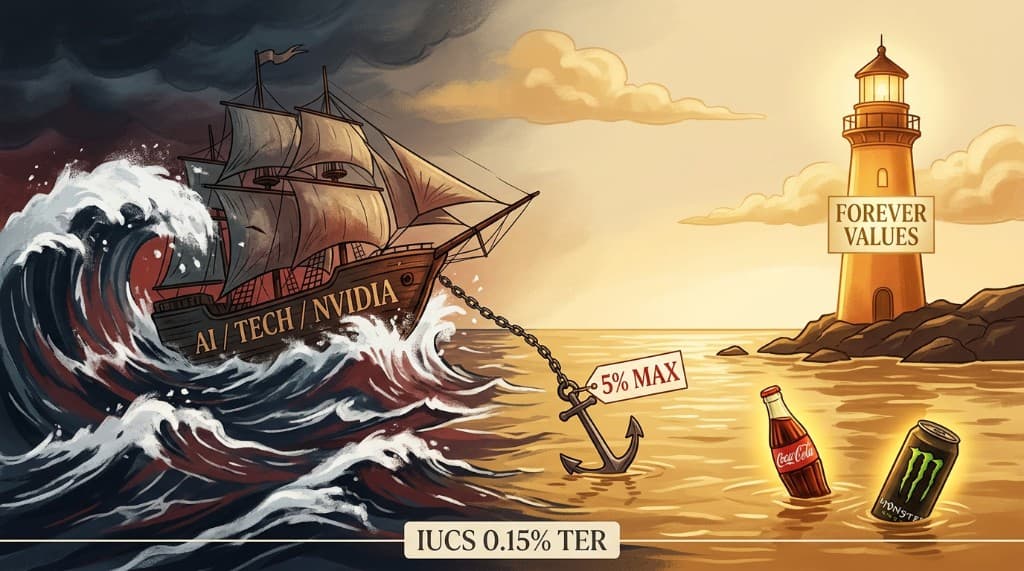
Forever Values: The 5% That Keeps You Sane When AI Stocks Fall 30%
José Luis Cava introduces the concept of 'forever values' — assets held permanently to reduce drawdown in portfolios concentrated in high-volatility sectors like AI. Monster Beverage and Coca-Cola meet the criteria: predictable revenue, positive free cash flow, buyback programs, and competitive dividend yields. The allocation rule is strict: maximum 5% of portfolio, with entry discipline tied to algorithmic sweep patterns and specific support zones.
The investor who concentrates their portfolio in artificial intelligence, semiconductors, and high-growth technology accepts a specific trade-off: in exchange for above-average long-term returns, they also accept above-average short-term volatility. When NVIDIA drops 15% in a week, when SK Hynix falls 25% in a single session following an algorithmic sweep, when the Nasdaq corrects 10% in a month — the emotional cost of holding through that volatility is significant, and the temptation to sell at the worst moment is real.
José Luis Cava's response to this trade-off is not to reduce exposure to high-growth sectors. It is to build a specific kind of counterweight within the portfolio — positions he calls valores para siempre: forever values.
What a Forever Value Is
The concept is simple but the criteria are precise. A forever value is an asset you intend to hold for as long as it continues to meet certain fundamental requirements — not forever out of sentiment, but forever as a default position unless the fundamentals change. The purpose is not to generate the portfolio's highest returns. It is to reduce drawdown — the peak-to-trough decline that makes investors sell at the bottom — and to provide a psychological anchor when the high-volatility positions are under pressure.
The four requirements Cava applies:
Predictable business: revenues that grow consistently over time, not cyclically. A company whose earnings can collapse 60% in a downturn is not a forever value, regardless of how attractive it looks at a given price.
Positive free cash flow: the company generates more cash than it consumes. This cash flow funds the programs that create shareholder value without requiring additional capital raises that dilute existing shareholders.
Buyback programs: the company actively repurchases its own shares. Buybacks reduce the share count, which increases earnings per share mechanically and supports the price during market corrections by creating a floor of systematic buying.
Competitive dividend yield: the dividend yield should be competitive relative to the 10-year US Treasury yield. When equities pay significantly less than the risk-free rate, the defensive argument for holding them weakens. When they pay comparably or better, with the added upside of price appreciation, the risk-reward improves.
Monster Beverage: The Growth Compounder
Monster Beverage — the dominant brand in the energy drink category — represents an unusual hybrid in Cava's framework. It satisfies the forever value criteria while also delivering growth rates more typical of the technology sector.
Revenue growth has consistently exceeded 20% annually. The free cash flow profile is strong. Buyback programs are described by Cava as "monstrous" in scale — aggressive share repurchases that mechanically support and amplify the upward trend in earnings per share. From a technical standpoint, Monster currently exhibits stronger relative performance than Coca-Cola: it is moving faster than the broader consumer staples sector, which is itself moving faster than the market during risk-off episodes.
The entry discipline matters here. Cava identifies a potential false breakout zone around the 95.75 level — the type of algorithmic trap that draws buyers in with an apparent breakout, then forces a sharp reversal that shakes those buyers out. The appropriate entry points in his framework are the genuine supports: 87.27, which corresponds to the June 2026 lows, or the deeper support zone between 84.76 and 83.32, which corresponds to May 2026 lows. These are levels where actual demand has previously materialized, not levels that look obvious on the surface.
Coca-Cola: The Buffett Benchmark
Coca-Cola is the archetype of the forever value category — Warren Buffett's most famous long-term holding, maintained through multiple market cycles for decades. The fundamentals that justified the position decades ago continue to apply: consistent annual earnings growth around 7%, systematic buybacks, and a dividend yield that competes with fixed income while providing equity upside.
The entry discipline for Coca-Cola mirrors the approach for Monster. Cava identifies a zone between 83.50 and 81.39 as an algorithmic wall — a level that may produce a false signal before the actual support resolves. The genuine support zones are 78.65 (June 2026 lows) and the deeper range of 76.30 to 75.00 (April 2026 lows). Buying at the wall, or chasing a breakout above it, invites the algorithmic reversal. Buying at or near the genuine support zones, ideally with a momentum signal confirming exhaustion of selling pressure, provides the entry condition that Cava's system requires.
The European Alternative: IUCS
For European investors who prefer the diversification of a fund over individual stock selection, Cava identifies IUCS — the iShares S&P 500 Consumer Staples UCITS ETF — as the appropriate vehicle.
The key characteristics: accumulation structure (no dividend distribution, which defers taxation until sale), TER of 0.15%, and UCITS compliant for European regulatory purposes. The composition is weighted toward Coca-Cola at approximately 10.5% and Monster Beverage at approximately 2.5%, alongside the broader consumer staples universe.
The entry zones for IUCS are 9.72 as a first support and 8.90 as the deeper support corresponding to 2026 lows. At either level, the fund has found buyers in the recent past, making them genuine demand zones rather than arbitrary technical levels.
The American equivalent, PBJ (Invesco Food & Beverage ETF), targets similar exposure with entry zones around the 43.60 to 42.36 range from late 2025.
The Allocation Rule
The precise allocation constraint is not a suggestion — it is a structural requirement. Forever values should not exceed 5% of total portfolio value.
The reasoning is deliberately mathematical. A portfolio concentrated in high-growth sectors like AI, semiconductors, and technology expects to outperform the market over a full cycle. Consumer staples, by definition, underperform in strong bull markets. Adding too large a position in forever values is simply paying for volatility reduction at the expense of returns. At 5%, the reduction in drawdown is meaningful without meaningfully dragging on total performance.
Within the 5% limit, Cava proposes a 3%/2% split: Monster at 3% given its superior current momentum, Coca-Cola at 2%. This internal weighting reflects the relative strength analysis — Monster is the better technical setup in the current phase, while Coca-Cola provides the deeper fundamental anchor.
Why Entry Discipline Applies Even to Forever Values
The most important point Cava makes about this category is that strong fundamentals do not justify buying at any price. This seems obvious but is routinely ignored. Coca-Cola with a 7% earnings growth rate at a PE of 25 is a different investment than Coca-Cola at a PE of 40 — even if the business is identical. The entry price determines the return.
More specifically, algorithmic patterns apply to consumer staples as much as to technology stocks. The false breakout above 95.75 in Monster — if it occurs — will attract momentum buyers who are then shaken out as the price reverts to genuine support. The algorithmic wall between 83.50 and 81.39 in Coca-Cola serves the same function. Understanding these patterns does not require predicting them precisely. It requires not acting on the false signals and being prepared to act on the genuine ones.
The application is simple: monitor the support zones identified above. When price approaches those zones, look for signals of selling exhaustion — declining volume, momentum divergences, or the crossover patterns that Cava's system uses to confirm that the aggressive sellers have been absorbed. Enter then, not when the price looks exciting or when the narrative around the company is most positive.
A forever value entered at the right price becomes a genuinely comforting position to hold. When the rest of the portfolio is experiencing the 15% to 25% swings that are normal in high-growth technology investing, the consumer staples position provides psychological ballast alongside its financial contribution. It is the portfolio's anchor — not its engine.
Analysis based on José Luis Cava's market commentary from July 2026. This post is for informational and educational purposes only and does not constitute investment advice.
Explore the data
Check the latest congressional trades and active investment signals.