July's Rotation, the Margin Debt Warning, and the Best 2+2 Semiconductor Portfolio
José Luis Cava documents three distinct market dynamics converging in July 2026: an equal-weight S&P 500 closing higher while the Nasdaq falls confirms broad rotation, not narrow tech dependence. AAII bearish sentiment at 42% with bullish collapsing to 31% provides the contrarian signal for the month. But two structural risks loom — US margin debt at all-time highs and the SpaceX lock-up expiry — while the ECB's June rate hike is now confirmed as a policy error with oil down 25% since. For semiconductor investors, a 'Best 2+2' replication strategy captures 75% of the DRAM ETF return at half the cost.
Three separate signals arrived simultaneously in the first days of July 2026, and together they form a coherent picture of where markets stand — and where they are heading.
The first is a rotation signal that proves the current advance is broader than critics claim. The second is a sentiment reading that provides the contrarian backing for July's bullish bias. The third is a pair of structural risks that will eventually matter — but not yet.
The Rotation Evidence: RSP vs. Nasdaq
The most common criticism of the 2026 equity rally is that it is not real — that it is a distortion produced by a handful of mega-cap technology companies whose weight in the market-cap-weighted indices makes the underlying market look better than it is. The criticism has surface plausibility but fails a straightforward empirical test.
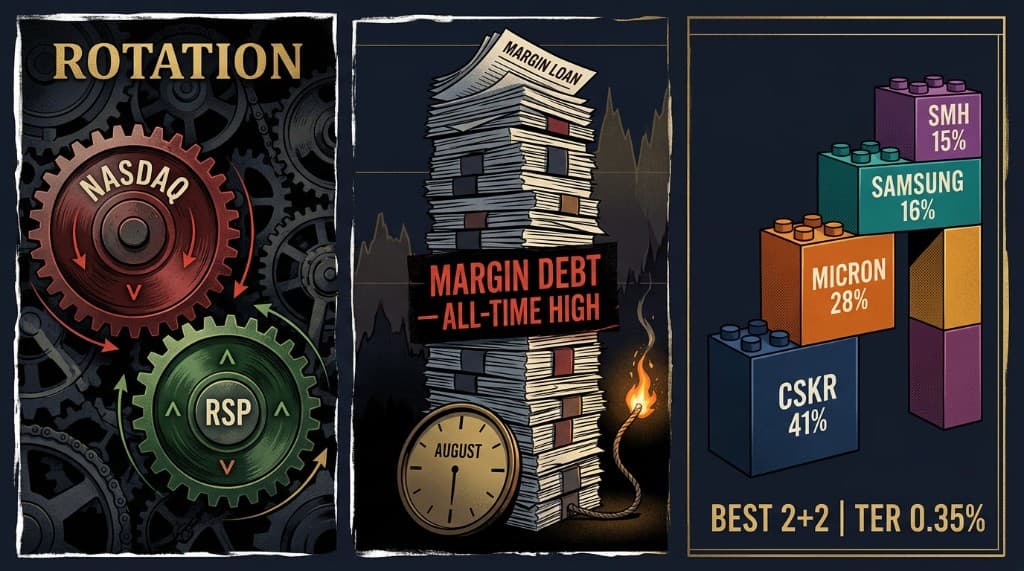
On the same day that the Nasdaq 100 and the semiconductor sector experienced notable declines, the RSP — the Invesco S&P 500 Equal Weight ETF, which gives each of the 500 components identical weight regardless of market capitalization — closed in positive territory.
This is not consistent with a narrow tech bubble. In a narrow bubble, when the large-cap technology names that dominate the capitalization-weighted index fall, the equal-weight version falls with them or worse. What actually happened is the opposite: while the cap-weighted tech-heavy index fell, the average S&P 500 company rose. The advance was concentrated in the broad market, not the mega caps. Capital was rotating from momentum technology names into the rest of the market — financials, industrials, consumer staples, healthcare — which is exactly what a healthy, broad-based bull market does.
The Nasdaq 100 futures, despite their recent correction, have held above the critical support zone at 29,160. No support of significance has been broken. The correction in technology is a rotation, not a reversal.
The Sentiment Reading: 42% Bears Is a Contrarian Buy Signal
The American Association of Individual Investors (AAII) weekly sentiment survey provides one of the most reliable contrarian signals in US market history. When retail investors become overwhelmingly bearish, they have already reduced their equity exposure — which means the selling pressure that would drive prices lower has already been exerted. What remains is the powder they are sitting on, waiting to be deployed when confidence returns.
The current reading: bearish sentiment has risen above 42%, while bullish sentiment has collapsed from 44% to 31%. The bull-bear spread has moved sharply into negative territory. This is the kind of reading that has historically preceded positive one-month returns in the S&P 500 with high consistency.
Taken together with the RSP/Nasdaq divergence and the technical picture — Nasdaq futures holding above 29,160 — the July setup remains intact. The month is expected to be bullish.
The ECB's Policy Error: A Lesson in Institutional Hubris
On June 11, the European Central Bank raised interest rates by 25 basis points. The stated justification was a pickup in inflation readings for May, driven primarily by energy prices.
The decision was a mistake, and the mistake was visible before it was made. At the time of the June 11 meeting, Brent crude oil futures were already in backwardation — the futures curve was pricing oil lower, not higher, in the months ahead. The oil price was trading below its 50-session exponential moving average. One-year inflation expectations were already declining between April and May.
Since the rate hike, Brent crude has fallen 25%. The energy-driven inflation that justified the decision has not only failed to materialize — it has reversed sharply. European households and businesses are now paying higher borrowing costs because of a policy decision based on a data reading that the forward markets had already signaled was temporary.
Cava's specific criticism is directed at the governor of the Bundesbank, who has continued to defend the June hike as correct despite the subsequent evidence. This combination — raising rates based on a temporary energy signal, ignoring forward market evidence, and then refusing to acknowledge the error — is the definition of institutional overconfidence. Its cost is borne by European citizens through higher mortgage rates, higher business borrowing costs, and a weaker economic backdrop, in a country (Germany) that is already experiencing cyclical weakness.
The implication for investment positioning is straightforward: European equities face a headwind from unnecessarily tight monetary policy that has no equivalent in the United States. The strategic concentration in US-domiciled businesses with global revenues — rather than European domestic companies — is validated once more.
Two Structural Risks That Will Matter Later
July's bullish bias does not eliminate the medium-term risks. Two specific catalysts are building that will eventually produce the 15% to 20% correction that Cava has been forecasting for the August-September window.
Margin debt at all-time highs. The balance of loans taken out by US investors specifically to purchase equities has reached record levels. The historical pattern is sobering: accelerating margin debt coincided with the market tops of 2000, 2001, and 2007, each of which preceded significant bear market phases. The mechanism is not subtle — leveraged investors who have borrowed to buy stocks are forced sellers when prices decline, and their forced selling accelerates and extends any correction that begins for other reasons. At current leverage levels, a correction that might normally stop at -8% can extend to -15% or -20% because of the margin call cascade.
SpaceX lock-up expiry. SpaceX is currently trading in a sideways range between 171 and 188. The price action is orderly — no distress, no collapse — but it conceals the risk that arrives with the lock-up expiry. When insiders and early shareholders are released from their selling restrictions, the volume of supply that enters the market can overwhelm demand, particularly in the thin summer trading conditions of August. Given SpaceX's significant weighting in major indices following its June IPO, a sharp decline in its price would mechanically drag index levels lower, triggering further forced selling from index-tracking vehicles.
Neither of these risks will materialize in July. The fuel for the July rally — extreme bearish sentiment, cash on the sideline, broad market rotation — is more immediately powerful than the structural risks, which require a specific catalyst to activate. But they are the reason the August-September window for significant correction remains on the table.
The "Best 2+2" Semiconductor Portfolio
For investors who want exposure to the structural growth in memory and AI semiconductors but cannot access the DRAM ETF — either because they are European investors subject to UCITS regulations, or because they find the ETF's cost structure unattractive — Cava proposes a custom replication strategy.
The American DRAM ETF provides concentrated exposure to memory semiconductor companies: Micron, Samsung, SK Hynix, and related names. Its European UCITS equivalent, launched in June 2026, cannot legally replicate the same concentration levels under European fund regulation. The workaround is a manually constructed portfolio using two direct equity positions and two ETFs.
The "Best 2+2" composition:
Micron (28%) — the largest US memory producer, providing the direct American exposure that no European-domiciled fund can match in the required concentration. Covers the Western Digital and Seagate exposure gap that UCITS compliance creates.
Samsung (16%) — direct Korean equity position, securing the required weight in the dominant global memory manufacturer.
iShares MSCI South Korea ETF (CSKR) (41%) — the largest single component. CSKR provides indirect exposure to both Samsung and SK Hynix through its Korean equity index weighting, while adding diversification across Korean financials, industrials, and technology companies. The Korean financial exposure acts as a partial stabilizer: it reduces the portfolio's volatility relative to a pure memory semiconductor position, smoothing out the sharp drawdowns that characterize the sector while also modestly capping the upside in the strongest semiconductor rallies.
VanEck Semiconductor ETF (SMH) (15%) — includes Micron and provides correlation with NVIDIA, Broadcom, and Intel, the AI-adjacent semiconductor names that benefit from the same infrastructure spending tailwind as the pure memory players.
The resulting portfolio achieves several objectives simultaneously. The combined TER is approximately 0.35% — roughly half the cost of the pure American DRAM ETF (0.65%) or its European equivalent (0.69%). The historical return correlation captures approximately 75% of DRAM's performance. And the CSKR component reduces the maximum drawdown during sector-specific corrections, making the position psychologically easier to hold through volatility.
For existing holders of SK Hynix directly, the CSKR component represents a comparable exposure profile at lower single-stock concentration risk. For investors building a semiconductor position from scratch, the 2+2 structure provides a cost-efficient path to the structural AI memory theme without the UCITS constraint forcing an all-or-nothing choice between expensive replication and no exposure at all.
Analysis based on José Luis Cava's market commentary from July 3, 2026. This post is for informational and educational purposes only and does not constitute investment advice.
Explore the data
Check the latest congressional trades and active investment signals.