Burry's 42-Year Case Against Memory: Why Micron Is a Capital Destructor at Cycle Peak
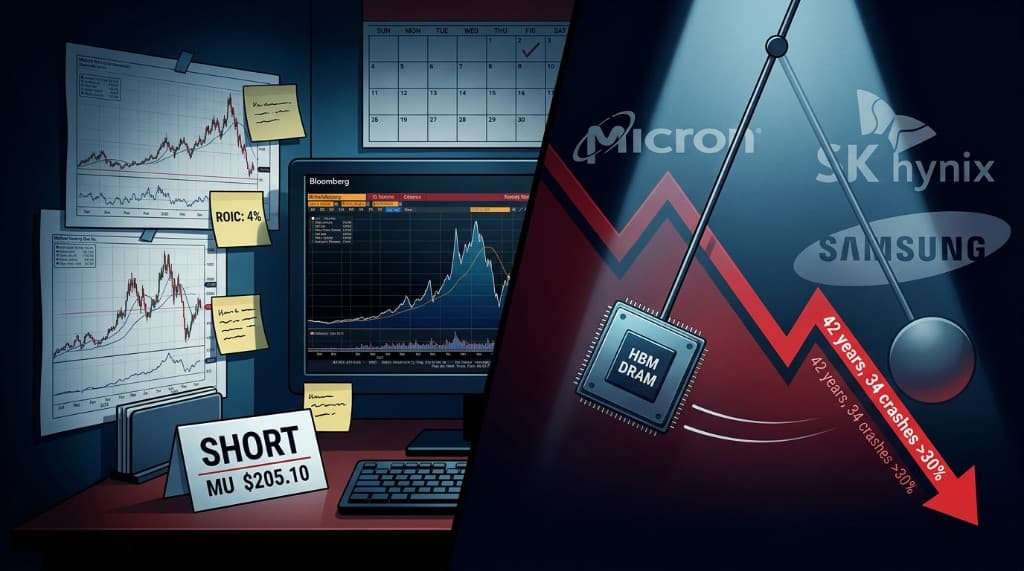
Michael Burry has opened short positions against Micron at $205.10, SOX, and Applied Materials — while going long Microsoft. His thesis is not a macro call. It is a data-driven argument built on 42 years of Micron's history: a median ROIC of 4% against a cost of capital above 10%, negative free cash flow in 48% of all quarters, 34 crashes of more than 30% in four decades, and a current valuation of 12x sales against a historical median of 2.2x. Fernando Sánchez explains why this cycle will not be different enough to matter — and why Micron's contribution of 16% of all S&P 500 earnings growth in 2026 makes this more than a sector call.
In 2005, Michael Burry read mortgage documents that nobody else was reading and concluded that the US housing market would collapse. He was right. In 2015, he warned about water scarcity as a systemic risk. In 2021, he warned about equity market valuations and meme stock speculation. He has also made calls that did not play out on the timeline he expected.
What makes his current position against the memory semiconductor sector different from his macro predictions is the nature of the evidence. This is not a thesis about geopolitics, monetary policy, or a black swan event. It is a thesis built on 42 years of one company's financial history — and the numbers are unusually clear.
The 42-Year Case Against Micron
Burry entered a short position against Micron at $205.10 per share, simultaneously opening shorts against the SOX semiconductor index and Applied Materials. On the long side, he holds Microsoft — a positioning that expresses a specific view: the infrastructure layer of AI will win, and the cyclical hardware suppliers will lose.
The Micron short is grounded in historical data that Fernando Sánchez presents in detail. The core of the argument is return on invested capital.
Over 42 years, Micron's median ROIC has been approximately 4%. Its cost of capital — the minimum return required to justify the investment of shareholders and creditors — exceeds 10%. The gap between these two numbers is the definition of value destruction. A business that returns 4% on every dollar invested while its capital costs more than 10% to provide is, on a structural basis, making its investors poorer. The share price can rise for extended periods when cycle conditions are favorable, but the underlying economics consistently destroy more value than they create.
The free cash flow data reinforces the picture. In approximately 48% of all quarters over Micron's history, the company generated negative free cash flow — spending more than it earned. Almost half of the time, the business required external capital rather than providing it. This is the financial signature of a commodity cyclical: enormous capital requirements, thin or negative margins in down cycles, spectacular profits in up cycles.
The crash history is the most visceral component of Burry's argument. In 42 years, Micron has experienced 34 drawdowns of more than 30% from peak to trough. Seven of those drawdowns exceeded 70%. This is not a quirk of one bad period or a single recession. It is the structural pattern of a cyclical business in which supply and demand repeatedly move through the same sequence: shortage drives prices up, high prices incentivize massive capacity expansion, new supply floods the market, prices collapse, companies cut capacity, shortage returns.
The Current Valuation: Peak-Cycle Metrics
The bull case for Micron in 2026 rests on the apparent cheapness of its PER. The problem is the denominator. When Burry entered his short at $205.10, Micron's earnings were at or near cycle highs — the best they have been in years, driven by HBM pricing premiums and the extraordinary demand from hyperscalers building AI data centers. A PER that looks low on peak-cycle earnings is not cheap. It is the classic value trap of cyclical investing.
The more revealing metric is the price-to-sales ratio. Micron at $205.10 traded at more than 12 times its sales. The historical median for the company is 2.2 times sales. This is a 5.5x premium to the median valuation across its full history — a premium that is justified only if you believe the current revenue level is the new normal rather than a cyclical peak.
The sentiment context that surrounded this entry price is itself a signal. Tim Cook described current HBM memory demand as "a flood that happens once every 100 years." Donald Trump publicly praised Micron as a symbol of an economic golden age. Fifty-two of 57 Wall Street analysts had buy recommendations. These are the markers of cycle peak sentiment — the moment when the consensus is most uniformly optimistic, which historically corresponds to the moment when the upside is most limited and the downside is most dangerous.
Robert Cialdini's influence principles — scarcity, social proof, commitment, authority — are all operating simultaneously. The perception of HBM scarcity drives urgency. The unanimous analyst consensus provides social proof. Years of momentum investing in the AI narrative creates commitment bias. Trump and industry executives provide authority. When all four are present at the same time, the rational assessment of future supply-demand dynamics tends to be overwhelmed by the emotional urgency to participate.
Why This Cycle Will Be Different — And Why It Won't Be Different Enough
The bull argument acknowledges the cyclicality but argues that AI is a structural shift that makes this cycle fundamentally different. HBM is not commodity memory. The technical barriers to HBM3E production are genuinely high. Only SK Hynix and Samsung are capable of producing at scale for the highest-performance applications, and the shortage is real.
Burry's response to this argument is not a refusal of the AI premise. He accepts that the AI infrastructure build-out is real. His position is that the cycle does not need to be stopped for it to be mean-reverting. It simply needs to follow the pattern it has always followed: high prices incentivize massive investment in new capacity, that capacity arrives 18-24 months later, the shortage resolves, pricing power dissipates, and margins compress.
Samsung is accelerating its HBM production investment. Micron is investing to close the gap with SK Hynix in HBM3E. New entrants are attempting to develop HBM-compatible alternatives. The hyperscaler customers — Microsoft, Amazon, Google, Meta — have every incentive to develop second-source relationships and reduce their dependence on a single supplier. None of this happens immediately. But Burry's trade does not require immediate resolution. It requires the market to begin pricing in the eventual resolution.
The Systemic Risk: Micron and the S&P 500
Fernando Sánchez highlights a dimension of the Burry thesis that extends beyond the individual company. According to Goldman Sachs data, Micron alone contributes approximately 16% of the expected earnings growth for the entire S&P 500 in 2026. The semiconductor and AI infrastructure sector as a whole contributes approximately 50% of all US market earnings growth.
This creates a systemic dependency. Index funds and passive vehicles own the S&P 500 in proportion to its market capitalization — which means they are implicitly long on the semiconductor cycle at whatever weight the sector represents. When the cycle turns, the correction is not contained within the sector. It propagates into the indices, which propagate into passive funds, which propagate into retirement accounts and institutional portfolios that have no conscious semiconductor exposure.
Burry's long position in Microsoft is the clearest expression of his alternative view: the companies that purchase compute capacity and deploy it to generate software revenues — the toll road operators rather than the road builders — are not subject to the same cyclical risk as the hardware suppliers. Microsoft's Azure revenues are recurring subscription income from enterprises that have committed to multi-year cloud contracts. That income does not disappear when memory prices fall. It may actually benefit, as lower input costs for data center operators eventually compress cloud pricing and expand the market.
The Oil Market's False Signal
Separately, José Luis Cava addresses the recent increase in oil prices, which media coverage has attributed to Middle East tensions and Iranian sanctions. His explanation is more mechanical: the price increase is primarily the result of fund managers closing short positions — forced buying from investors who had bet on falling oil prices and are now being squeezed out.
This is not sustained demand driving oil higher. It is a positioning unwind. When the short covering is complete and the managers who were wrong are out of their positions, the upward pressure dissipates. The underlying supply dynamics — including Iran's economic collapse, with GDP contracting nearly 10%, steel and gas production down 30%, and 30-40% of the population below the poverty line — do not generate the kind of demand recovery that would sustain higher prices.
The humanitarian situation in Iran, which Cava describes in considerable detail, represents a failure of the international community to respond proportionally to what has become a collapse of living standards affecting tens of millions of people. The economic dimension — 100% inflation, 4 million jobs lost, hyperinflation eliminating the purchasing power of fixed-income earners — is the predictable consequence of a war economy operating on top of an already fragile pre-war structure.
For energy markets, the implication is that the current price move is mechanical noise rather than a fundamental shift in supply-demand. Oil is not forming a new uptrend based on genuine demand recovery. It is clearing an overhang of short positions before returning to the dynamics determined by actual production and consumption.
Analysis based on Fernando Sánchez's channel content and José Luis Cava's market commentary from July 8, 2026. This post is for informational and educational purposes only and does not constitute investment advice.
Explore the data
Check the latest congressional trades and active investment signals.