The Energy Trap, the China Paradox, and the One Number That Calls the Next Bull Run
Markets are pricing in two Fed rate hikes for September based on rising diesel and gasoline prices. José Luis Cava argues both energy markets just executed textbook false breakouts — institutional traps designed to pull in retail buyers before prices fall. If he is right, the inflation narrative collapses, the rate hike case disappears, and the setup for a Q3-Q4 rally becomes clearer. The deeper story: the real source of global liquidity contraction is not the Fed, which is injecting a billion dollars a week into a system with over three trillion in bank reserves. It is the People's Bank of China, which has deliberately slowed its economy as part of a tacit agreement with Washington to suppress oil demand and contain energy prices. The Yuan is the only number that matters for timing the next move in Bitcoin, gold, and equities.
Markets spent the first week of July pricing in two Federal Reserve rate hikes for September. The justification was straightforward: diesel at historic highs, gasoline breaking above June peaks, energy inflation threatening to reignite the broader CPI. The financial press ran the narrative. Institutional desks updated their models. Retail investors bought energy futures and energy equities in anticipation of a sustained rally.
José Luis Cava's analysis suggests this was precisely the plan — and it already worked.
The Trap in Diesel and Gasoline
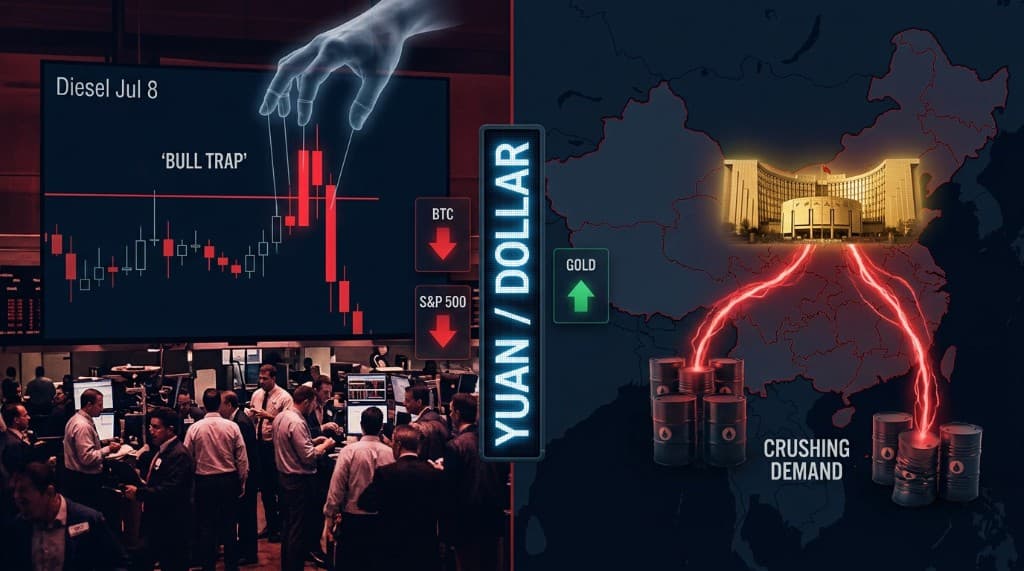
On July 8, diesel futures made a clean move above the highs established on June 8. Volume was present. The move generated buy signals across technical systems. Investors who had been waiting for a breakout confirmation entered the market. Within hours, the price reversed.
On July 9, gasoline repeated the pattern. The futures contract pushed above the highs of June 3, 8, and 11 — three resistance levels consolidated into a single obvious trigger zone. The breakout attracted buyers. The breakout was immediately sold.
Cava describes this as a barrida — a coordinated institutional maneuver in which large players make a calculated purchase above visible resistance levels to trigger retail stop orders and momentum systems, then use the resulting liquidity to distribute their inventory into rising prices. The retail buyer provides the exit for the institutional seller.
The projected targets for the reversal are not optimistic for energy bulls. Cava expects diesel to return to the July 7 lows around 3.237, with a potential extension toward the July 2 lows near 3.151. Gasoline targets the origin of the most recent rally, around 2.855.
These are not minor corrections. They represent a complete unwind of the moves that drove the inflation narrative.
What Falls When Energy Falls
The Fed's calculus for September hinges on the inflation trajectory. Two rate hikes are currently priced into the interest rate futures market. The justification is energy-driven inflation flowing through to transport costs, food production, and consumer prices.
If diesel and gasoline retrace to Cava's targets, the input cost argument for persistent inflation weakens substantially. The CPI component most responsible for the renewed rate hike expectations — energy — would be contributing deflation rather than inflation by the time the September meeting arrives.
The implication for equity markets is significant. Rate hike expectations are one of the primary sources of multiple compression in growth assets. A forward P/E of 19 on the S&P 500 at 4.5% bond yields is already attractive by historical standards. Remove two anticipated rate hikes and the bond yield trajectory reverses — the valuation argument for equities strengthens precisely when sentiment is most cautious.
This is the inversion Cava identifies: the market is positioned for a scenario that his technical analysis suggests is based on a false signal. When the signal corrects, the positioning must also correct.
The China Paradox
The second video addresses a question that has been generating confusion among market participants for weeks: why are Bitcoin and gold falling simultaneously when the Federal Reserve is actively injecting liquidity?
The answer, according to Cava, is that the Fed is not the relevant actor in global liquidity right now. The United States banking system holds over three trillion dollars in reserves. The Fed is injecting approximately one billion dollars per week into a system that has no shortage of dollars. That is not the source of the tightening.
The source is China.
The People's Bank of China has suspended its liquidity injection program despite an economy growing at subdued rates with weak private consumption. From a textbook monetary policy perspective, this makes no sense. A slowing economy with low consumer demand is precisely the environment that calls for monetary stimulus.
Cava's explanation is geopolitical rather than economic. He argues that China's monetary tightening is the mechanism of a tacit arrangement with Washington. By deliberately slowing its own economy, China suppresses its energy demand. Reduced Chinese energy demand keeps global oil prices lower than they would otherwise be given the conflicts in the Middle East and the Iranian sanctions. The arrangement benefits both parties: China maintains its trading relationship with the United States, and the Trump administration achieves the energy price control it has been seeking without needing to negotiate directly with OPEC.
The consequence for global assets is mechanical. Bitcoin and gold are the most sensitive assets in the world to global liquidity conditions. When the aggregate monetary base across major central banks contracts — in this case driven by China despite Fed expansion — these assets correct. The simultaneous decline in both is not a coincidence or a signal about their individual fundamentals. It is a reflection of a single variable: Chinese monetary policy.
The Only Number That Matters
Cava identifies the Yuan-to-dollar exchange rate as the indicator that will call the timing of the reversal.
The mechanism is direct. When the People's Bank of China resumes liquidity injection, the Yuan depreciates against the dollar — more yuan in the system means each yuan is worth less in dollar terms. A weakening Yuan is therefore the real-time signal that Chinese monetary conditions are easing.
When that signal appears, the cascade is predictable: global liquidity expands, Bitcoin and gold recover, and risk assets including the S&P 500 receive the monetary fuel for the next leg higher.
The deep correction that Cava anticipates — one that he describes as potentially appearing to be the beginning of a bear market to retail investors — is the setup for that entry. The correction is not a fundamental deterioration. It is the consequence of Chinese monetary tightening reaching its maximum impact on global risk assets before the PBOC reverses course.
For investors who understand the mechanism, the moment of maximum apparent pessimism is the entry point. For investors who read the surface narrative without understanding the underlying driver, it will appear to confirm their fears.
The OpenAI Delay and Nasdaq Positioning
One additional data point: OpenAI has postponed its public offering from its previously targeted October window. This removes one of the anticipated mega-placements from the Q4 calendar. The SpaceX lock-up expiry in August remains the primary technical pressure on the space and innovation sector, but the removal of an OpenAI IPO from October reduces the capital absorption that would have competed with existing equities during that period.
For investors seeking Nasdaq 100 exposure through the correction, Cava mentions three vehicles with meaningfully different costs. The cheapest is BCFP from DWS at a total expense ratio of 0.13%, an accumulating ETF denominated in euros, though its relative novelty means it may not be available on all platforms. The standard option is CNDX from iShares at 0.30%, with greater liquidity and a longer track record but denominated in dollars. The leveraged option — QQQ3 from WisdomTree at 0.75% — triples daily Nasdaq returns and is subject to the volatility decay that makes leveraged instruments destructive in sideways or declining markets. The mathematics are unforgiving: a 10% gain followed by a 10% loss returns an unleveraged position to 99% of its starting value, while the same sequence in a double-leveraged instrument produces a 96% result. Leveraged ETFs are instruments for confirmed trends, not for holding through correction periods.
Analysis based on José Luis Cava's market commentary from July 10, 2026. This post is for informational and educational purposes only and does not constitute investment advice.
Explore the data
Check the latest congressional trades and active investment signals.