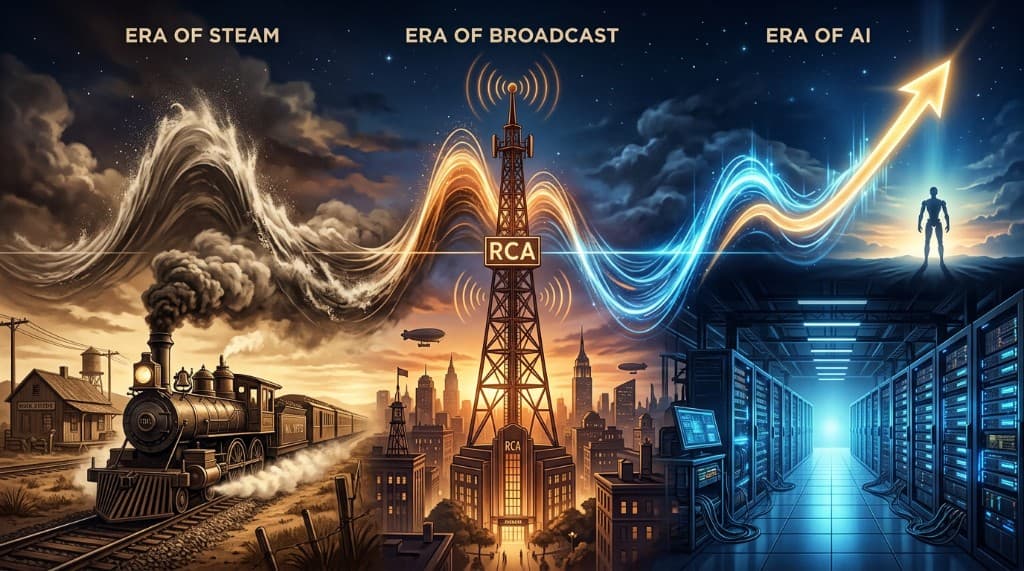
Railroads, Radio, and AI: Why the Last Wave Has Not Arrived Yet
Every major technology cycle in history followed the same pattern: infrastructure built ahead of demand, a vertical price rally, a catastrophic crash, and then decades of economic transformation driven by the technology that survived. The railroad bubble, RCA in the 1920s, and the dot-com collapse of 2000 each destroyed investors who entered at the peak while validating the long-term thesis. Jose Luis Cava argues that the current AI cycle — now approximately two years old — has not yet produced its final explosive wave. NVIDIA and AMD generate real cash. The cycle still has time. But the risk of entering at the top of that final wave will be real. The strategy: position now during the cleanup, and recognize the exit signals before universal optimism arrives.
The technology that changes the world rarely enriches the investors who fund its initial construction. The railroad transformed global commerce, connected continents, and compressed the cost of moving goods by an order of magnitude. The investors who financed the first wave of railroad construction in the 19th century lost everything. The New York Stock Exchange closed for ten days during the panic. The tracks remained. The fortunes did not.
This pattern has repeated with enough regularity that it has a structure. Jose Luis Cava maps it onto the current cycle of artificial intelligence — not to warn that the technology will fail, but to identify precisely where in that structure we are today, and what comes next.
Three Cycles, One Pattern
The railroad era (19th century). Capital poured into rail construction at a pace that dramatically exceeded near-term demand. Infrastructure was built for a future that existed, but not yet. When the discrepancy between asset prices and current revenue became impossible to ignore, the panic was total. Leveraged investors — the overwhelming majority — were destroyed. The technology remained and eventually generated the returns that had been priced in prematurely.
Radio and RCA (the 1920s). The Radio Corporation of America rose more than 400% in a single year before the Great Depression erased those gains and then some. Investors who bought RCA at its peak and held through the crash lost everything in nominal terms. Radio as a technology went on to define mass media for the next half century. The company survived. The late investors did not recover.
Fiber optic and dot-com (2000). Enough fiber optic cable was laid during the late 1990s to transmit every phone call, every television broadcast, and every internet connection simultaneously several times over. The demand for that capacity was real — it simply took fifteen years to materialize. Companies were valued on clicks, not cash. When the market demanded earnings, the structure collapsed. The cable remained in the ground. The broadband internet of the 2010s ran on infrastructure financed by investors who lost everything in 2001.
The common thread is not that the technology failed. It is that investors who entered at peak enthusiasm — when the narrative was universal and the risk felt minimal — paid prices that could not be sustained in the timeframe they required.
Why AI Is Different — So Far
Cava draws a critical distinction between these historical precedents and the current AI cycle. The companies at the center of this wave — NVIDIA above all, followed by AMD — are not speculative stories about future revenue. They are, in his description, machines for generating cash.
NVIDIA's gross margins are extraordinary. Its data center business is sold out. The demand for its products comes from companies with balance sheets strong enough to absorb enormous capital expenditure: Microsoft, Google, Amazon, Meta. These are not startups funding their server purchases with venture capital. They are among the largest revenue generators in the history of private enterprise.
This does not mean the cycle cannot produce a bubble. It means the bubble, when it arrives, will be built on a foundation of real earnings rather than projected ones — which historically has made the initial collapse less total, and the subsequent recovery faster.
The Timing Question
Technology cycles of this scale typically run three to five years from the initial acceleration to the final peak. The current AI cycle began its main acceleration phase in late 2024. We are now approximately two years in.
Cava's conclusion: the final explosive wave — the one that induces universal optimism, fills the covers of financial magazines, and brings in the last wave of retail investors who had been watching from the sidelines — has not yet arrived.
This is the wave to anticipate, not the one we are in. The current correction is the pause before it. The investors being shaken out now are the leveraged participants who rushed in at the June 2026 peak of the semiconductor rally. What follows their exit is a more stable base from which the final advance can launch.
The risk — and Cava is explicit about this — is that when that final wave arrives, it will look identical to the early stages of the move. The narrative will be the same. The companies will be the same. The only difference will be the valuation, and valuations are the last thing retail investors check when prices are moving up 15% per month.
The preparation for that future risk begins now, during the cleanup.
The Equal Weight Strategy
One of the structural responses to the concentration risk of a technology-heavy index is the equal-weight ETF. The standard S&P 500 is capitalization-weighted, meaning the largest companies — primarily the technology and semiconductor leaders — have an outsized influence on the index's return. When those companies correct, the index corrects disproportionately.
An equal-weight version of the same index assigns identical weight to all 500 components. As the AI infrastructure build-out matures and the companies that will use that infrastructure — in manufacturing, logistics, healthcare, energy — begin to reflect the productivity gains in their earnings, an equal-weight approach captures that second wave more directly.
In the United States, the relevant instrument is RSP. For European investors operating in euros, the equivalent is the Xtrackers S&P 500 Equal Weight ETF (XD EW). This vehicle is worth monitoring as a complement to direct semiconductor and technology exposure — particularly as the cycle matures toward its final phase and the concentration risk of the headline indices becomes more relevant.
Bitcoin and the Saylor Signal
One of the more precise indicators of market capitulation has historically been the behavior of Michael Saylor, the executive chairman of Strategy (formerly MicroStrategy), the company that has accumulated the largest corporate bitcoin treasury in history.
During the deepest moments of prior corrections, Saylor was forced to sell bitcoin holdings to meet liquidity obligations. Those forced sales represented genuine capitulation — not a decision, but a necessity. They reliably marked the vicinity of local bottoms.
As of the current period, Saylor has arranged sufficient liquidity to cover his obligations for the next 17 to 18 months without any forced bitcoin sales. This matters for two reasons. First, it removes a known source of mechanical selling pressure from the bitcoin market. Second, combined with the Chinese pivot toward liquidity injection — which tends to lift all risk assets — the conditions for a sustained recovery in bitcoin are now more favorable than they have been at any point in the prior correction.
This does not constitute a buy signal in isolation. But it marks the removal of a specific headwind that had weighed on the asset for months.
Reading the Cycle, Not the Noise
The investors who built lasting wealth from the railroad era, from radio, from the internet were not the ones who funded the first construction. They were the ones who bought the survivors at rational prices during the post-crash recovery, when the technology was proven but the enthusiasm had been destroyed.
We are not yet at that point in the AI cycle. The correction underway is not the post-bubble recovery — it is the technical cleanup before the final wave. The opportunity is to be positioned, with manageable risk, when that wave begins. The separate skill — the harder one — is to recognize when the final wave has become the peak, before universal optimism has arrived but while it is clearly approaching.
Fibonacci levels, breadth indicators, the put-call ratio, and the behavior of forced sellers like Saylor are the tools that provide that warning. Not because they are infallible, but because they measure the emotional state of the market rather than the narrative it is telling about itself.
Railroads were a revolution. Radio was a revolution. The internet was a revolution. AI is a revolution. What changes is not the outcome. What changes is the price at which you board the train.
Explore the data
Check the latest congressional trades and active investment signals.