Cloud +82%, ROIC 27%, and a -7% Drop: Why the Market Got Alphabet Wrong
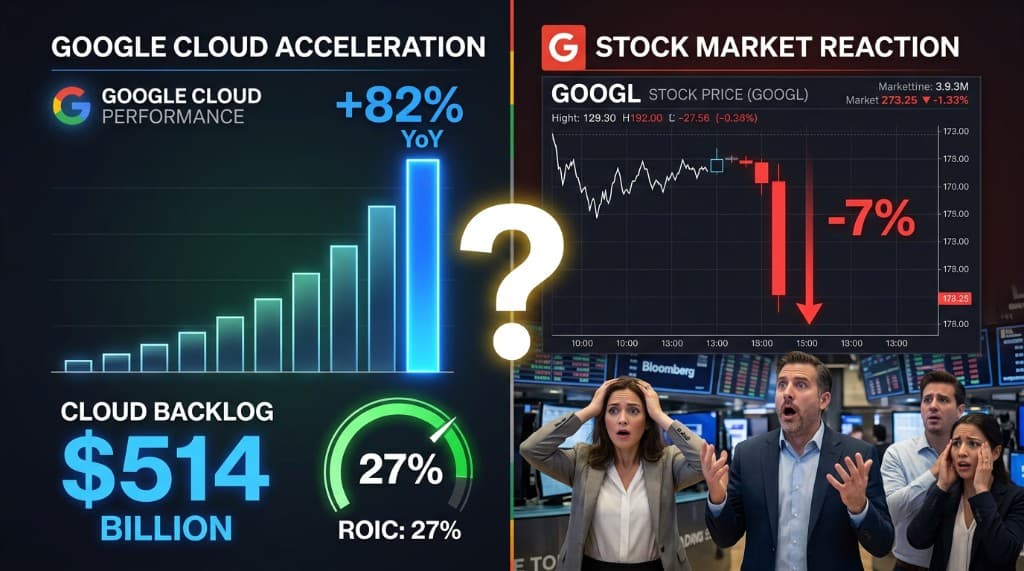
Alphabet reported Q2 2026 results that should have been celebrated: Google Cloud grew 82% year-over-year, beating expectations by more than 10 percentage points. The cloud backlog reached 514 billion dollars. EBIT margins expanded. The CEO confirmed that demand continues to exceed capacity. The stock fell 7%. The reason: the market focused exclusively on rising capital expenditure and a record equity raise, ignoring that Alphabet's return on invested capital is 27% — meaning every dollar deployed generates 1.27 dollars back. Fernando Sanchez argues this is precisely the short-termism that creates long-term opportunity.
There is a specific type of market mistake that creates the best long-term entry points: when investors punish a company for doing exactly what it should be doing.
Alphabet's Q2 2026 earnings report is a case study in that mistake.
What the Numbers Actually Say
The headline figures from Alphabet's second quarter bear examination in full before discussing the market reaction.
Total revenue reached 119.8 billion dollars, beating expectations by 2.4%. Google Search grew 17% — not 11%, not 13%, but 17%, accelerating from prior quarters in the face of a persistent narrative that artificial intelligence would destroy the search business. That narrative has been tested for eighteen months now. Search keeps accelerating.
YouTube advertising revenue reached 11.05 billion dollars, beating estimates and crossing 42 billion dollars on an annualized basis. The 2026 FIFA World Cup was the most watched sporting event in YouTube's history: 1.7 billion unique global viewers. Live sports is proving to be one of the most effective subscriber acquisition tools in the platform's existence — six of the ten best days for new member sign-ups in the past five years were driven by live events.
Gemini reached 950 million monthly active users. Daily active users tripled year-over-year. The API processes 22 billion tokens per minute, up from 16 billion three months ago. Ninety percent of Fortune 100 companies now use Gemini for business applications. These are not projections. They are reported numbers from the quarter just ended.
And then there is Google Cloud.
The Number That Defines the Quarter
Google Cloud grew 82% year-over-year, reaching 24.76 billion dollars in revenue against analyst expectations of 22.46 billion. That is a beat of more than 10 percentage points on consensus — one of the largest positive surprises in the segment's history.
The operating margin for Google Cloud expanded to 35.6%, up from 20.7% in the same quarter of 2025. This is not a business that is growing at the expense of profitability. It is a business where scale is creating operating leverage at an extraordinary rate.
The cloud backlog — committed future revenue from contracts already signed — reached 514 billion dollars, adding 50 billion in new orders in a single quarter. More than half of that backlog is expected to convert to recognized revenue within the next 24 months. This is not speculative demand. It is contracted cash flow with a known delivery timeline.
Sundar Pichai's statement in the earnings call deserves to be read literally: "We are more than doubling our pace of customer acquisition compared to the prior year. Existing customers are expanding their usage and exceeding their budgets by more than 50%. Demand continues to exceed our capacity to supply."
A business where demand exceeds supply, where margins are expanding, where contracted backlog is 514 billion dollars, fell 7% on its earnings day. The reason requires examination.
Why the Market Responded the Way It Did
Three factors drove the negative reaction.
The first is capital expenditure. Alphabet raised its 2026 CapEx guidance from 180-190 billion dollars to 195-205 billion — an additional 15 billion above what had already been communicated. The company also reiterated expectations for "substantial growth" in 2027 CapEx. For investors focused on near-term free cash flow, this is uncomfortable. More spending today means less cash available today.
The second is the equity raise. In a departure from recent quarters, Alphabet executed zero share buybacks in Q2 2026 — compared to 13.2 billion dollars in Q2 2025. Instead, the company raised 49 billion dollars through new share issuance and 20 billion in debt. Long-term debt effectively doubled in three months, from 47 billion to 101 billion dollars. Issuing new shares is dilutive. The market noticed.
The third is the EPS result. Reported earnings per share appeared to miss consensus by 1.7%. What the headline missed is that Alphabet recorded a 99 billion dollar non-cash accounting gain from unrealized appreciation in its investments in SpaceX and Anthropic — a figure that inflated the comparison base without representing any actual cash received. Excluding that extraordinary item, clean EPS grew 23% and beat expectations.
The Question the Market Is Not Asking
The framing that the market applied to Alphabet's results is: "they are spending too much." The question that framing avoids is: "spending at what return?"
Alphabet's return on invested capital in 2025 was 27%. For every dollar the company deployed, it generated 1.27 dollars in value. This is not a company that destroys capital through undisciplined expansion. It is a company with a documented, consistent, and exceptional track record of turning investment into return.
Fernando Sanchez's framework for evaluating companies centers precisely on this metric: ROIC relative to cost of capital. When ROIC substantially exceeds the cost of capital, deploying more capital creates more value. The rational decision for Alphabet's management — the decision that maximizes long-term shareholder value — is to invest as aggressively as the opportunity allows, for as long as the returns justify it.
Pichai was unambiguous: "While we have expanded our capacity significantly in recent years, demand continues to exceed that investment. As long as there are attractive investment opportunities, we will keep investing."
The 514 billion dollar backlog is the proof of concept. The 82% Cloud growth is the proof of return. The 27% ROIC is the proof of discipline.
The Long-Term View
The market's reaction to Alphabet's Q2 results reflects a structural tension that recurs throughout the history of capital-intensive growth businesses: the conflict between short-term free cash flow and long-term value creation.
Amazon spent fifteen years being punished by the market for investing its retail profits into AWS. Every quarter the margin came in below expectations because Bezos was building server capacity that, at the time, appeared excessive. The investors who understood that the investment was generating returns — and held through the quarterly volatility — were eventually vindicated by one of the greatest wealth creation stories in corporate history.
Google Cloud is not AWS in 2010. It is a more mature business, growing faster, with higher margins and a clearer competitive position. The trajectory from 20.7% operating margin in Q2 2025 to 35.6% in Q2 2026 shows what happens to a cloud business as it scales.
The 7% drop on earnings day is not evidence that something went wrong at Alphabet. It is evidence that the market's attention span is shorter than the investment horizon required to understand what is actually happening inside the business.
For investors willing to hold the distinction between short-term cash flow and long-term return, the gap between what the market priced today and what the fundamentals support is where the opportunity lives.
Explore the data
Check the latest congressional trades and active investment signals.