Three Myths Keeping Investors Out of the Market — and Why the Rally to 2027 Is Still Intact
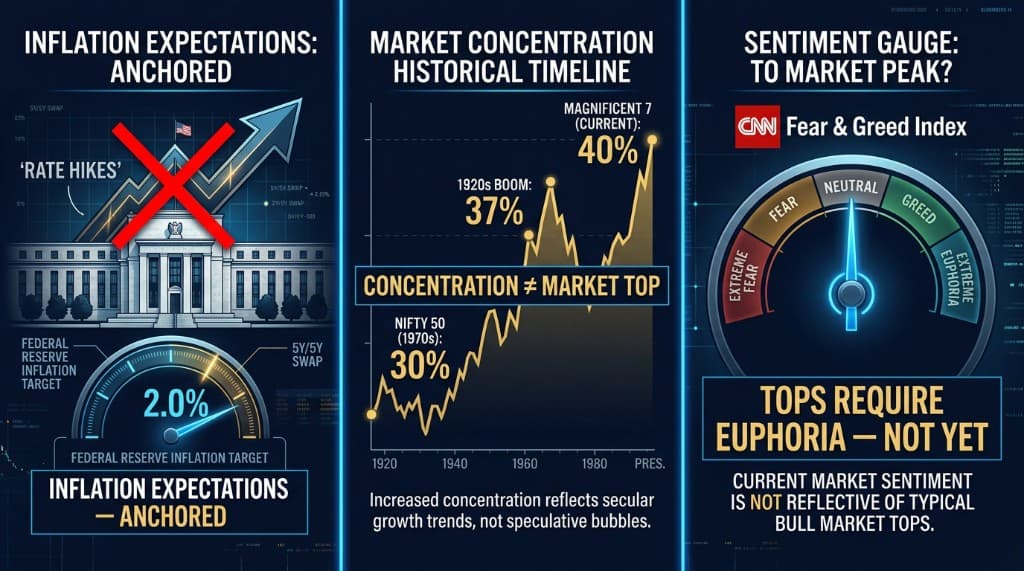
The market is currently pricing two to three Federal Reserve rate hikes for September 2026. But inflation expectations in the bond market have fallen back to 2% — the Fed's own target. HOPLA Finance argues that those rate hike expectations are significantly overpriced and will need to correct downward, creating a powerful tailwind for equities from late October 2026 through 2027. Meanwhile, two persistent narratives — that Magnificent 7 concentration signals a market top, and that neutral sentiment confirms one is imminent — are dismantled by historical evidence. Market tops require extreme euphoria. We are not there.
Three arguments are currently circulating in financial media to justify caution toward equities. Each has surface plausibility. Each collapses under scrutiny. Understanding why matters for positioning in the months ahead.
Myth One: The Fed Will Raise Rates in September
The money market is currently pricing two to three Federal Reserve rate hikes by September 2026, with approximately two-thirds probability assigned to the first increase occurring at that meeting. This expectation has weighed on growth stocks and created a narrative that higher rates will compress valuations across the technology sector.
The problem with this narrative is the evidence from the bond market itself.
Inflation expectations — as measured by the 5-year/5-year forward swap rate, the instrument that professional investors use to price medium-term inflation — have fallen from 2.7% to 2.8% earlier this year to approximately 2%, which is precisely the Federal Reserve's stated target. This is not a peripheral indicator. It is the market's clearest signal of where institutional money believes inflation is heading.
When the money market prices two rate hikes and the bond market prices 2% inflation, one of them is wrong. The bond market, which trades in trillions of dollars and is dominated by sophisticated institutional participants with real capital at risk, has historically been the more reliable signal.
If inflation expectations remain anchored at 2%, the justification for rate increases evaporates. The repricing of rate expectations from "two to three hikes" toward "no hikes, or cuts" would represent a significant positive catalyst for equities — particularly for the technology and growth companies that are most sensitive to the discount rate used in their valuation.
HOPLA's conclusion: the rate hike expectations priced into markets are exaggerated and will correct. When they do, the tailwind for the S&P 500 from late October 2026 through all of 2027 could be substantial.
Myth Two: Magnificent 7 Concentration Means the Market Is About to Peak
The observation is accurate: the seven largest technology companies represent approximately 40% of the S&P 500 by market capitalization. This is a historic high. The argument derived from this observation — that such concentration signals an imminent market top — does not survive historical examination.
The Nifty 50 parallel (1960s-1970s). During this period, the fifty largest US companies grew to represent approximately 30% of the market. This concentration level was cited as evidence of dangerous narrowness. The peak of Nifty 50 concentration occurred approximately ten years before the market itself peaked. An investor who reduced exposure to equities when concentration reached "dangerous" levels in the early 1960s missed a decade of returns before the warning proved meaningful.
The 1920s parallel. Market concentration reached approximately 37% during the 1920s bull market. Crucially, the maximum concentration level was not reached at the market's peak in 1929 — it was reached in the early 1930s, after the crash, as thousands of smaller companies disappeared from public markets and the survivors' proportional weight increased. The concentration metric peaked because companies failed, not because the market was overheated at peak concentration.
The structural explanation. Concentration reflects secular economic reality, not speculative excess. In each historical case, the concentrated companies were genuine economic leaders — railroads in the 19th century, industrials in the early 20th, consumer conglomerates in the postwar era, and technology in the current period. The Magnificent 7 represent approximately 40% of the index because they represent approximately 40% of US corporate earnings growth. This is a reflection of their actual economic weight, not a distortion.
The practical implication: the concentration argument does not identify market tops reliably. The historical record suggests that the most profitable positioning is to remain within the leading group throughout the advance, not to rotate away from it because it has become large.
Myth Three: Neutral Sentiment Means the Top Is Near
The CNN Fear and Greed Index and the AAII investor sentiment survey — the two most widely cited retail sentiment measures — are currently showing neutral readings. This is being interpreted by some commentators as evidence that the market is approaching a top.
The interpretation inverts the actual logic of sentiment-based market timing.
Market tops form under conditions of extreme euphoria, not neutral sentiment. The technical mechanism is straightforward: a market top requires that virtually all available buyers have already committed their capital. When sentiment is at maximum greed and cash allocations are at minimum, there are no remaining buyers to push prices higher. Supply overwhelms diminishing demand and the market reverses.
Neutral sentiment describes precisely the opposite condition. A significant portion of potential buyers remain skeptical, cautious, or underinvested. Their capital is available to enter the market on any improvement in confidence or fundamental data. This available buying power is what sustains advances and extends cycles.
The current readings confirm that the conditions for a durable market top — the universal enthusiasm that characterizes the late stages of a bull market — have not arrived. A correction can occur from neutral sentiment, and corrections have occurred from far lower sentiment readings. But a generational peak in equities does not form while a large portion of investors remain unconvinced.
This connects to a related point about fund manager cash levels. Institutional cash allocations are currently near minimum levels, meaning fund managers have already deployed capital into the market. This reduces the potential upside catalyst from institutional inflows but does not create the conditions for the kind of forced selling that characterizes major market tops.
What This Means for the Months Ahead
Taken together, the three arguments above point toward the same conclusion that has been emerging from several independent analytical frameworks: the corrective phase underway in the summer of 2026 is a shakeout, not a peak.
The shakeout serves a purpose. It removes leveraged and impatient capital from positions that were built on momentum rather than conviction. It resets sentiment from complacent toward cautious. It transfers shares from weak hands to strong ones at prices that offer better forward return potential than the June 2026 highs.
When rate expectations correct downward — as the bond market's 2% inflation reading suggests they must — the repricing will provide a catalyst for the next leg of the advance. HOPLA projects this dynamic to become visible from late October 2026, with the primary advance extending through 2027.
The cleanup is not comfortable to observe from within. But its purpose is to create the foundation for what comes next.
The investor who understands this does not need to predict the exact bottom. They need only to maintain exposure to the leading companies of this technological era through the volatility, with enough capital discipline to add at lower prices if the opportunity presents itself.
The market peaks when everyone believes it cannot fall. It has not reached that condition yet.
Explore the data
Check the latest congressional trades and active investment signals.