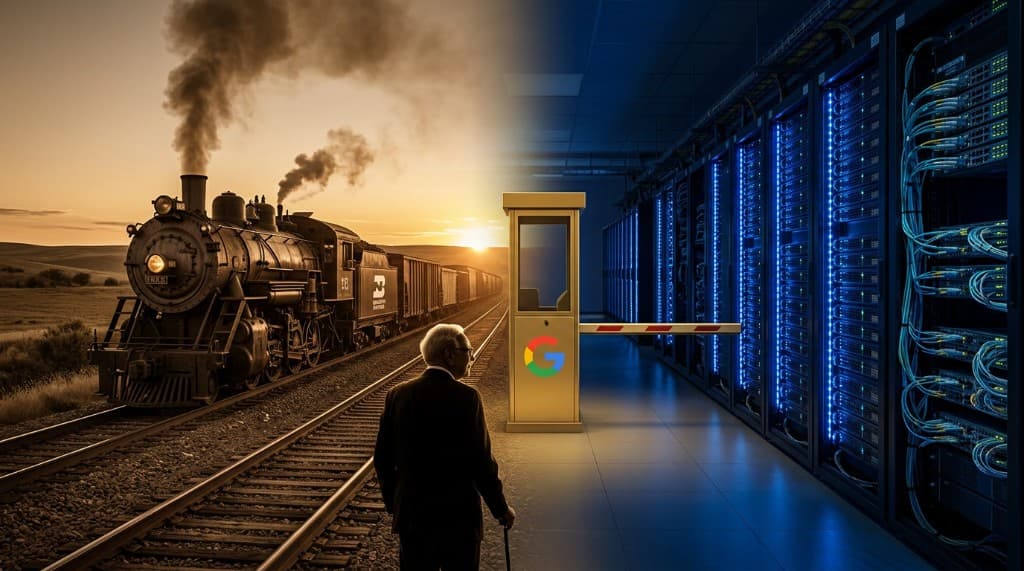
Buffett's $31 Billion Bet: Why the Oracle Now Sees Alphabet as the Burlington Northern of the Digital Age
At 95, Warren Buffett confirmed that a $31 billion position in Alphabet — one of the largest in Berkshire Hathaway's history — was his personal decision, not his successors'. His reasoning dismantles the market's -7% reaction to Alphabet's Q2 earnings: the capital expenditure the market punished is exactly the infrastructure construction that Buffett has spent a lifetime buying. He is not buying a tech company. He is buying a toll road.
Warren Buffett does not give many interviews. When he gives a one-hour interview at age 95, every sentence deserves attention.
In a recent conversation with Becky Quick on CNBC, Buffett confirmed what had been circulating in market circles: Berkshire Hathaway holds more than $31 billion in Alphabet, making it one of his top five positions alongside Apple, American Express, Coca-Cola, and Occidental Petroleum. The position began in Q3 2025 and was completed this year, including a $10 billion private placement last month.
He also confirmed something that surprised even experienced Buffett observers: this was his decision, not his successors'.
The Admission That Explains Everything
Buffett called not buying Google earlier in its life one of his mistakes. He had passed on the company when it was what he loves most — a capital-light business with dominant economics. In those years, Google required almost no physical infrastructure to generate extraordinary returns. Every dollar of advertising revenue flowed through to profit with minimal reinvestment required.
He missed it.
Now he is buying it precisely because that has changed. Alphabet is spending between $195 billion and $205 billion in capital expenditure in 2026. The market saw that guidance and sold the stock seven percent in a single session. Buffett saw the same number and deployed ten billion dollars in a private placement.
The difference between those two reactions contains the entire lesson of his career.
Burlington Northern, Revisited
Buffett spent decades buying infrastructure — utilities, railroads, pipelines. His most celebrated infrastructure acquisition is Burlington Northern Santa Fe, the railroad network that now moves roughly forty percent of the goods transported by rail in the western United States. No one can compete with it. No one can build an alternative. The barriers are physical, legal, and economic simultaneously.
His argument about Alphabet — and about the other hyperscalers building at similar scale: Microsoft, Amazon, Meta — is that they are constructing the equivalent infrastructure for the digital economy.
Every company that needs to store data, run artificial intelligence workloads, or deliver applications at scale must pass through these data centers. There is no alternative at equivalent cost and reliability. The capital being deployed today is not a one-time cost. It is the construction of an economic moat that compounds over decades — the same logic he applied to railroads, to electric utilities, to pipelines.
He is not buying a technology company. He is buying a toll road with a hundred billion dollar annual traffic flow.
The ROIC Framework
Buffett does not measure investment success by quarterly earnings surprises or stock price movements. He measures it by return on invested capital — what the business earns relative to the capital it employs.
His benchmark: a good business should earn significantly more than the risk-free alternative. With the US ten-year Treasury yielding roughly 4.5%, a business that earns 10% on its capital is adequate. A business that earns 20% is exceptional. A business that sustains 25-30% while reinvesting at scale is extremely rare.
American Express earns approximately 30% return on equity. That is why Berkshire has owned it for three decades and has no intention of selling.
Alphabet, despite the current wave of infrastructure spending that is suppressing near-term margins, generates more than 20% in operating return on capital. Google Cloud's operating margin expanded from 20.7% to 35.6% in a single year. The infrastructure investment is not destroying value. It is building the asset base from which future returns compound.
This is the same arithmetic Buffett applied to Burlington Northern forty years ago, to Coca-Cola forty-five years ago, to American Express thirty years ago. The numbers change. The framework does not.
Investors and Gamblers
The sharpest observation in the interview was not about Alphabet specifically. It was a distinction that Buffett has refined over seventy years in markets.
He described two types of participants in today's market. Gamblers buy hope. They check prices every five minutes, trade options expiring at the end of the day, chase meme stocks, and follow sector narratives with impossible valuations. They are not analyzing businesses. They are placing bets on sentiment.
Investors analyze businesses, calculate their real value, and wait patiently.
Buffett held Wall Street directly responsible for the proliferation of gamblers. Financial institutions earn fees when capital moves. They have no incentive to encourage the patient inactivity that produces the best long-term outcomes. Every transaction generates a commission regardless of whether it serves the client. The infrastructure of modern finance is designed to produce activity, not returns.
The seven-percent drop in Alphabet following Q2 results — on revenues of $120 billion growing at 24%, operating profits growing at 30%, and Google Cloud expanding at 82% — is what happens when gamblers set the price. It does not last.
What This Means for Long-Term Holders
Buffett's $31 billion position in Alphabet means several things for investors who have been analyzing the same company from first principles.
The market's reaction to Alphabet's Q2 results was driven by short-term participants focused on the CapEx guidance. Buffett's reaction — deploying ten billion dollars through a private placement in the same period — confirms that the analytical framework matters more than the headline reaction.
Infrastructure investment of this scale does not produce returns in a single quarter. It produces them over a decade. The data centers being built in 2026 will be processing workloads in 2035. The cloud backlog of $514 billion provides visibility into those future revenues. A 27% return on invested capital sustained over that period produces compounding that is difficult to replicate through any other means.
Buffett does not know exactly when the stock price will reflect this reality. He does not need to. At $31 billion committed, he has expressed a level of conviction that requires no further interpretation.
The oracle of Omaha sees Alphabet the same way he saw Coca-Cola in 1988, American Express in 1994, and Burlington Northern in 2009: a dominant business at an inflection point where the right response is not analysis paralysis, but commitment.
The market gave a seven-percent discount on that conviction three days ago.
Buffett took it.
Explore the data
Check the latest congressional trades and active investment signals.