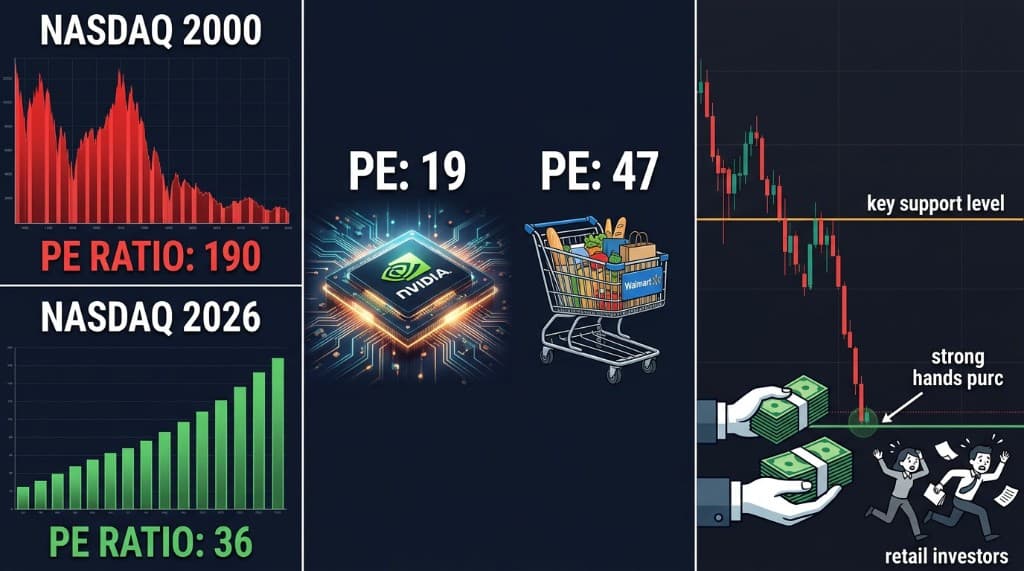
NVIDIA Trades at a Lower PE Than Walmart. This Is Not the Dot-Com Bubble.
The Nasdaq 100 hit a PE ratio of 190 in the year 2000. Today it sits at 36. NVIDIA, the company at the center of the AI revolution, trades at a PE of 19 — lower than Walmart, lower than Costco, lower than Microsoft in 2000. José Luis Cava dismantles the bubble narrative with data, explains why bubbles only burst when central banks pull liquidity, and shares the most important lesson he learned from 2000: the deliberate market sweep that expels weak hands before the next leg up.
The numbers that end the bubble debate
Every market cycle produces the same comparison. Charts are overlaid, warnings are issued, and the word "bubble" is deployed with confidence. The problem with confidence is that it does not require data.
Cava provides the data.
In the year 2000, at the peak of the dot-com bubble, the Nasdaq 100 traded at a PE ratio of 190. Companies with no earnings, no revenue model, and no path to profitability were valued at 190 times whatever profits they might theoretically generate someday.
Today, the Nasdaq 100 trades at a PE of 36. That is not cheap. But it is not 190.
The comparison that most effectively neutralizes the bubble argument is specific to NVIDIA: NVIDIA currently trades at a PE of approximately 19. For context, Walmart trades between 45 and 50 times earnings. Costco trades at similar multiples. These are stable, predictable consumer staples businesses that grow at low single-digit rates. NVIDIA is growing revenues at 85% year over year.
At the peak of the dot-com bubble, Microsoft traded at a PE of 57. The company at the center of the current AI revolution trades at a third of that multiple.
The bubble narrative fails the most basic quantitative test.
Why bubbles actually burst — the liquidity lesson
Cava's deeper point is structural: bubbles do not burst because someone makes a logical argument. They burst when central banks withdraw liquidity from the system.
The architect of the 1990s expansion — Alan Greenspan, whom Cava refers to as "Alan Burbujita" — was the champion of expansionary monetary policy. Greenspan injected liquidity aggressively through the late 1990s, fueling both the real economy and the speculative excess in technology stocks. The Dow Jones and the Nasdaq rose together, and the reasoning was always circular: rising asset prices justified the expansion, and the expansion justified rising prices.
The bubble did not burst because analysts published bearish reports. It burst in 2000 when Greenspan raised rates and removed the liquidity that had been sustaining valuations disconnected from fundamentals.
Jerome Powell repeated the pattern on a larger scale. Under his tenure, the Dow Jones has risen 93%. The mechanism is the same: monetary degradation transfers purchasing power from cash holders to asset holders, and the process is structurally self-reinforcing until the central bank reverses course.
The hyperscalers — Microsoft, Amazon, Google, Meta — are funding their AI infrastructure buildout primarily from their own cash flows, not from borrowed money. This is the opposite of 2000, when companies raised equity capital to fund projects that had no revenue. The current cycle has a financial foundation that the dot-com era never had.
The Binance-Iran architecture: blockchain transparency cuts both ways
Cava references a Wall Street Journal investigation that illustrates how blockchain's immutability — often cited as a feature — creates a permanent public record of every transaction, including ones that governments and corporations would prefer to keep private.
According to the investigation, Iran conducted transactions exceeding one billion dollars through Binance from 2024 onward to fund the Revolutionary Guard. What is notable is that these transactions were flagged as suspicious by Binance's own compliance team — and allowed to proceed regardless.
The political dimension: Binance's founder received a presidential pardon from Donald Trump, and the platform has made financial contributions to entities connected to the Trump family. Cava presents this not as a moral judgment but as a demonstration of how financial infrastructure, blockchain or otherwise, operates within political systems rather than above them.
The takeaway for investors: blockchain is not neutral. It is transparent to those who know how to read it, and its governance is subject to the same capture dynamics as every other financial system.
The lesson from 2000: the market sweep
The most operationally useful section of Cava's analysis concerns a pattern he identified by living through the dot-com crash — a pattern he has since recognized in every major asset across every cycle.
Between 1998 and 2000, the Nasdaq 100 rose from approximately 1,050 to 4,800. After the bubble burst, the index did not simply retrace to its starting point. It was driven below 1,000 — below the level from which the entire bull run had begun. Every investor who had entered during the 1998-2000 advance was now sitting on a loss. The psychological pressure was sufficient to force most of them to sell at the worst possible moment.
This is not random market behavior. Cava describes it as a deliberate maneuver by major institutional players — "strong hands" — to expel retail investors from their positions at maximum pain. Once the weak hands have been cleared, institutions accumulate at discounted prices, and the next advance begins from a cleaner base.
The pattern repeats across asset classes: Bitcoin, the SP500, oil, bonds. In each case, the price is temporarily driven below a psychologically significant support level — the origin of the previous advance, or a key round number — to trigger stop-loss orders and panic selling. The subsequent recovery confirms that the "sweep" was accumulation in disguise.
The practical implication: when you see a price break below a level that everyone has been watching as support, accompanied by media coverage describing it as a structural break — that is the moment to evaluate whether you are witnessing a sweep, not a reversal. The distinguishing factor, as always, is what happens to gold and to long-term bond yields in parallel.
Analysis based on a José Luis Cava video published May 22, 2026. For informational purposes only — not financial advice.
Explore the data
Check the latest congressional trades and active investment signals.