The Dark Side of Bitcoin: How Market Makers Use Your PUT Options Against You — and Where the Real Opportunity Is
Bitcoin rose from $65,000 on March 30 to nearly $84,000 in May. Now the market makers have a map of exactly where retail investors are positioned — and they will use it. José Luis Cava explains the mechanics of the sweep: why $65,000 is the target, how PUT option concentration in IBIT tells institutions where to push the price, and what the professional speculator does while everyone else is panicking.
The objective of the dark side
Understanding how large institutional players operate in crypto markets requires accepting an uncomfortable premise: the market is not a neutral mechanism for price discovery. It is an environment where entities with superior capital, information, and execution capability systematically extract value from retail participants.
The method is not random. It is structural and repeatable.
The primary objective is to identify where the largest concentration of retail buyers is positioned — the price levels where the most people entered long positions — and drive the price below those levels to trigger forced selling. When the mass of retail investors capitulates in fear, institutional capital absorbs their positions at discounted prices. Once the clearing is complete, price recovers sharply, leaving the retail investors who sold at the bottom with losses and the institutions with profitable long positions.
Cava calls this "the dark side." Understanding its mechanics does not make you immune to it. But it changes what a price decline means — from a reason to panic to a roadmap of where the opportunity lies.
Bitcoin: the sweep target and what follows
Bitcoin's recent trajectory provides the context. After bottoming at approximately $65,000 on March 30, 2026, the price recovered to nearly $84,000 in May — a move of nearly 30% in under two months. The majority of that move was bought by retail investors entering as the rally became visible.
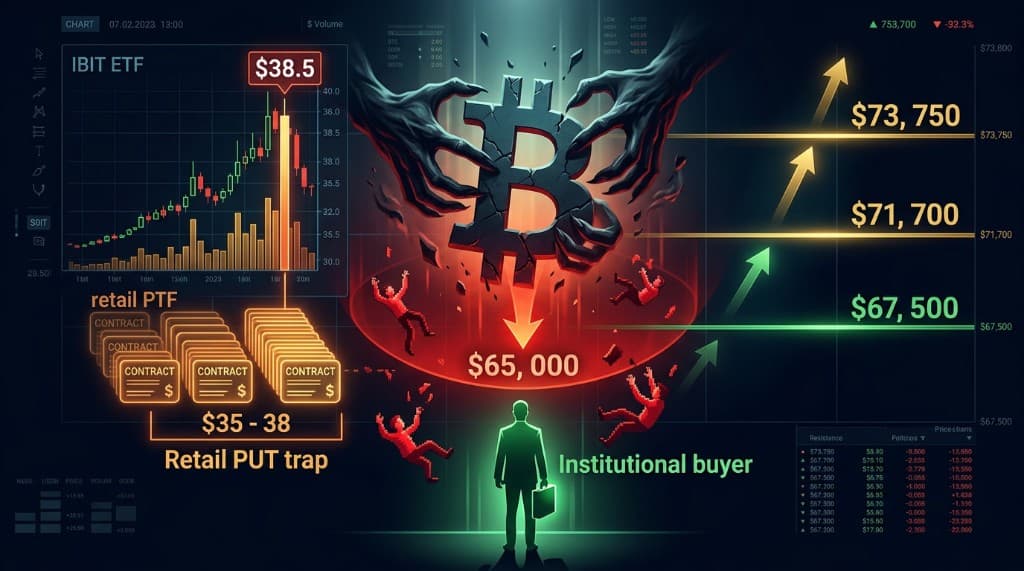
The volume profile analysis identifies where those buyers concentrated: above $65,000. This level now serves as the primary sweep target. The institutional playbook requires driving price back below $65,000 to trigger stop-loss orders and generate the fear necessary for retail capitulation.
Once the sweep is complete — once the maximum number of weak hands have been expelled — the technical roadmap for the recovery is defined by the resistance levels that must be broken in sequence:
$67,500 — first confirmation. Breaking above this level means that the short positions opened during the decline are being forced to close (short covering requires buying, which amplifies the upward move). This is the signal that the sweep is finished and the recovery has begun.
$71,700 — intermediate target. The next significant resistance zone after the first confirmation.
$73,750 — critical resistance. A major level where the initial recovery move is likely to pause or face significant selling pressure.
The stop-loss rule is precise: if, after entering a position during the sweep zone, Bitcoin breaks decisively below $65,000, all positions must be closed immediately. A break of this level means the technical structure has been invalidated — the sweep has gone deeper than expected and the scenario changes.
IBIT: the PUT options tell you exactly where the price is going
The IBIT Bitcoin ETF provides a particularly useful case study because the options market creates a visible map of retail positioning.
The volume profile for IBIT shows a concentration peak at $38.5 — the level where the most trading has occurred and where the most retail investors are positioned long. This is the primary sweep target for the ETF.
The PUT options add a layer of precision that makes the institutional strategy visible. Retail investors, worried about a decline, have purchased large volumes of PUT options on IBIT with strike prices between $35 and $38. A PUT option at these strikes gives the holder the right to sell IBIT at that price — it is insurance against a decline.
Here is the mechanics that Cava highlights: the institutions writing these PUT options are on the other side of the trade. If IBIT falls to $35 or below, they must pay out significant sums to the PUT holders. This creates a perverse incentive: drive the price low enough to generate maximum retail fear (and maximum buying opportunity for institutions), but not low enough to trigger mass PUT option payouts.
The result: the PUT option concentration at $35-38 tells institutions exactly where to drive the price. Deep enough to create panic. Not deep enough to pay out the PUTs. The retail investor who bought insurance paradoxically provided the roadmap for their own sweep.
The ideal entry zone for the professional speculator, according to this analysis: $35-37 on IBIT, where fear is at maximum and the institutional interest in not going lower creates a structural floor.
MicroStrategy: the same mechanics at a different scale
MicroStrategy (MSTR) follows an identical pattern. The volume profile shows a significant concentration at $135 — the sweep target. PUT option concentration from retail investors sits at approximately $120 — which defines the lower boundary of where institutions will drive the price.
The pattern is consistent across all three instruments: Bitcoin spot, IBIT, and MSTR. The same institutional playbook, the same retail positioning map, the same structural floor defined by PUT option strikes.
The professional execution plan
Cava's approach to this environment is not to predict precisely when the sweep will happen or how low it will go. It is to have a structured plan ready before it begins:
-
Identify the sweep zone. For Bitcoin: below $65,000. For IBIT: below $38.5, targeting $35-37. For MSTR: below $135, targeting $120.
-
Wait for maximum fear. The sweep is complete not when price hits the target, but when sentiment turns maximally bearish — when the majority of commentators are convinced the decline is the beginning of a structural reversal.
-
Enter with defined risk. The stop-loss level is the structural floor: $65,000 for Bitcoin spot. If price breaks decisively below this level after entry, the scenario has changed and the position must be closed.
-
Confirm with the first resistance. Entering at the sweep zone and waiting for the first resistance break ($67,500 for Bitcoin) provides confirmation that the recovery is underway before adding to the position.
The dark side is not invisible. It leaves its fingerprints in volume profiles and options positioning data. The speculator who reads these prints does not panic when the sweep arrives — they have been waiting for it.
Analysis based on a José Luis Cava video published June 3, 2026. For informational purposes only — not financial advice.
Explore the data
Check the latest congressional trades and active investment signals.