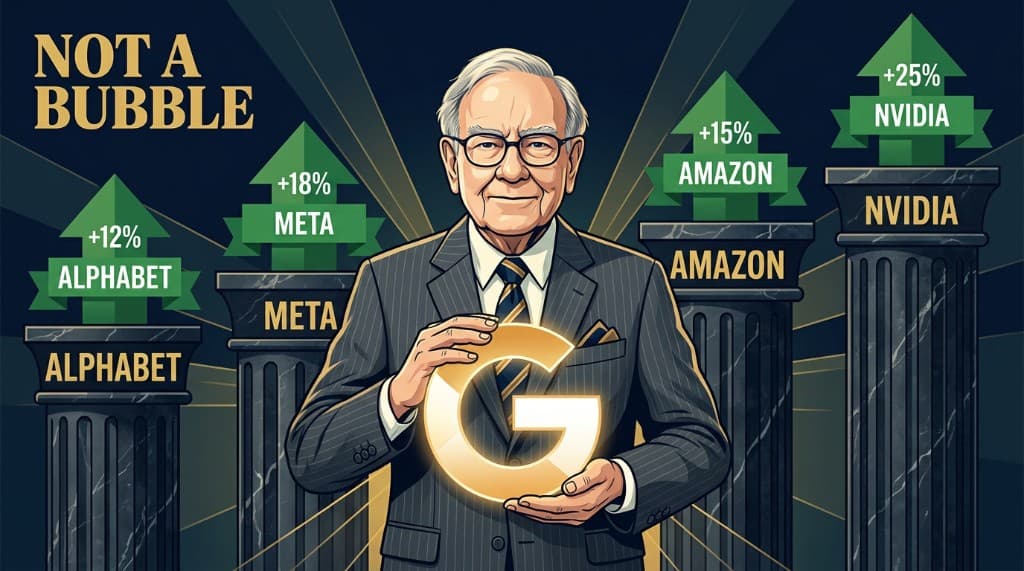
Buffett Buys Alphabet: Why AI Is Not the Dotcom Bubble
Warren Buffett's largest investment since 2018 — a $10 billion position in Alphabet — is the clearest signal yet that the AI infrastructure buildout is not speculative excess but rational capital allocation with real returns. Fernando Sánchez analyses why the hyperscalers are different from the dotcom era, why Meta is the most undervalued of the group, and where the real bubble risk actually lies: in memory semiconductors, not in the companies building the AI stack.
The signal that matters most
Warren Buffett, through Berkshire Hathaway and now under the operational management of Greg Abel, has made his most significant investment since approximately 2018. A $10 billion position in Alphabet, establishing it as the fourth largest holding in Berkshire's portfolio.
For investors who follow fundamental principles, this is not a minor data point. Buffett's entry criteria — businesses with durable competitive advantages, rational management, and prices that make sense — have not changed. What has changed is his assessment of Alphabet's position in the AI era. The conclusion is unambiguous: the massive capital expenditure that technology companies are directing toward AI infrastructure is not reckless spending but the foundation of future cash flows.
The mechanics of the entry are also worth noting. Alphabet executed a capital raise — dilution of approximately 1.4%, negligible — to bring Berkshire in as a shareholder. The logic: at current valuations, financing through equity at an implied cost of approximately 3.3% is cheaper than issuing debt at 5%. When a company of Alphabet's quality is using its own stock as currency because it is cheaper than bonds, that is a statement about valuation discipline, not exuberance.
Why this is not 1999
The most frequent comparison — AI today versus dotcom 2000 — fails on the most important metric: earnings.
In 1999, valuations were disconnected from reality because there were no earnings to justify them. Companies were priced on eyeballs, page views, and imagined future revenues that never materialized. The infrastructure buildout of that era destroyed value because it was built ahead of demand that did not exist.
The situation today is structurally different. The ten largest AI-linked companies represent approximately 40% of the US market — a concentration that looks alarming in isolation. But those companies are generating earnings that justify their prices. S&P 500 earnings are projected to grow 37% in 2026, driven by AI productivity gains flowing through into corporate results. Concentration without earnings growth would be dangerous. Concentration with 37% earnings growth is a different story.
The hyperscalers: ROIC above 20%
The four companies at the center of AI infrastructure — Alphabet, Amazon, Meta, and Microsoft — share a characteristic that separates them from speculative tech investments: they are reinvesting their own operating cash flows into AI at returns on invested capital above 20%.
This is not debt-funded speculation. These companies are generating so much cash that they can fund transformational capital expenditure internally while maintaining strong balance sheets. The AI buildout is self-financing at scale.
Alphabet: The narrative has shifted from "AI loser" to "AI winner" with the arrival of Gemini 3.5 Flash and the transition toward agentic AI — systems that can automate bureaucratic and management tasks without human intervention. The Buffett investment validates the pivot. Alphabet also benefits from its dominance in search, cloud, and YouTube, all of which get more valuable as AI is embedded into each product.
Meta: Fernando's analysis identifies Meta as the most undervalued of the hyperscalers — "the Alphabet of last year." The market has been slow to price in two emerging revenue streams: subscriptions that allow users to remove advertising (following the Snapchat+ playbook), and AI agents integrated into WhatsApp and Messenger for businesses. The potential operating margins for Meta approach 50%. At current prices, that earnings potential is not fully reflected.
Amazon: The expansion of its logistics network to third-party providers (3PL services) is creating direct competition with UPS and FedEx. For investors, this means Amazon is converting its existing infrastructure into a margin-expanding service business — operational leverage without proportional capital expenditure.
NVIDIA: Continues to exceed expectations at every reporting cycle. The transition toward agentic AI — which requires constant computation rather than batch inference — means demand for NVIDIA's hardware increases as AI becomes more embedded in daily operations, not less. NVIDIA is growing faster than the hyperscalers it serves.
Where the real bubble risk is
The analysis does not claim there is no risk in technology. The warning is specific: memory semiconductors.
Companies like Micron, Samsung, and SK Hynix trade at price-to-earnings multiples of 6 to 8 — appearing cheap by conventional metrics. But the risk is cyclical. The massive orders from hyperscalers for HBM and advanced memory may not be recurring at the same volume. If AI infrastructure spending plateaus or redirects, these companies face earnings compression that low multiples would not protect against.
This is the distinction between structural winners — the companies building AI products that generate recurring revenue — and cyclical suppliers whose fortunes depend on the pace of hardware orders. The former compound over time. The latter oscillate with the investment cycle.
The market context
The S&P 500 has returned approximately 11% year-to-date in 2026, following a 9% correction earlier in the year. Historically, geopolitical volatility — including the current Middle East tensions — resolves without permanent economic damage in approximately 90% of cases, with markets recovering their highs once catastrophic scenarios are ruled out.
The primary macro risk to monitor remains the Federal Reserve. Kevin Warsh, anticipated as the next Fed chair, carries a less interventionist and more hawkish stance toward inflation. The April inflation data — particularly the housing component — may prompt rate increases. Rising rates affect technology valuations through the discount rate applied to future earnings. However, companies with ROIC above 20% are significantly more resilient to rate increases than companies with no earnings at all — the 1999 situation.
The Buffett investment in Alphabet is a vote of confidence in the earnings power of AI-era technology. It is the opposite of a bubble signal.
Analysis based on a Fernando Sánchez video and Telegram messages from early June 2026. For informational purposes only — not financial advice.
Explore the data
Check the latest congressional trades and active investment signals.