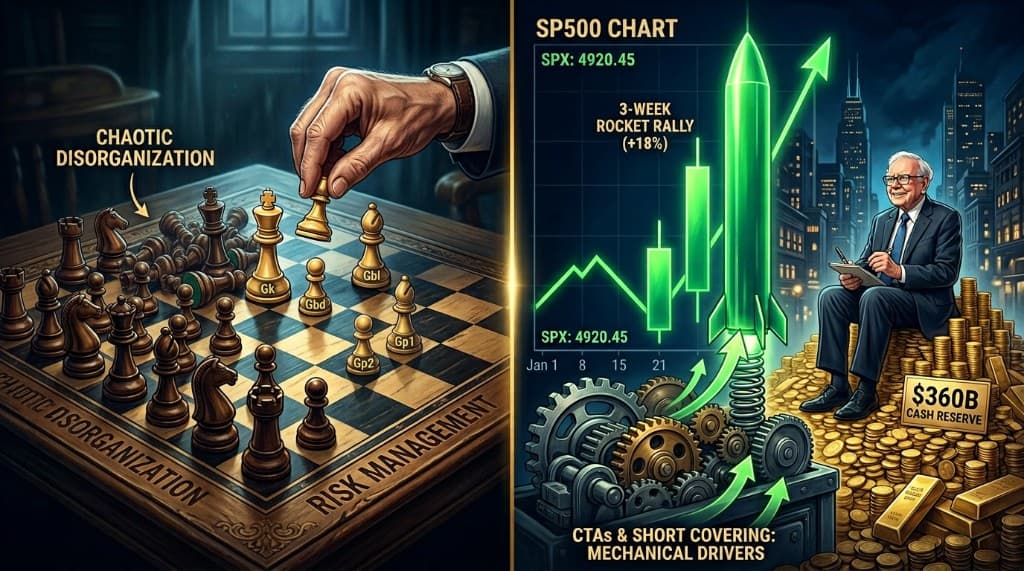
Cava Reveals His Speculation System — Why Risk Management Beats Fundamentals, and Why Buffett Is Wrong to Sit on $360B
Cava opens his playbook in a rare double feature. Part one: the foundations of his speculation system — why the investor who only wins 20% of the time but controls risk beats the fundamental analyst and the technical trader. He maps the SP500's intraday patterns hour by hour, revealing when 'dumb money' enters vs when institutional money closes the day. And he takes a direct shot at Buffett: sitting on $360B in cash during a bull market is a one-trick strategy. Part two: the US economy is stronger than headlines suggest (GDP ~2.6%, consumption resilient, earnings +15%), the historic 3-week rally was driven by $90B in short covering and CTA buying, and credit market stress is fading. The system is still bullish — but the mechanical buying is nearly exhausted.
Part 1: The Speculation System
The three investors — and who actually wins
Cava presents a framework that challenges everything most people believe about investing:
Investor 1: The Fundamental Analyst Knows every balance sheet, every earnings report, every metric. Deep knowledge of the business.
Investor 2: The Technical Trader Reads charts, identifies trends, gets the direction right 60% of the time.
Investor 3: The Risk Manager Only gets the direction right 20% of the time. But exercises strict risk control — cuts losses immediately when wrong, and lets winners run with favorable risk-reward ratios.
Who wins? Investor 3. Every time.
You don't come to markets to be right. You come to manage risk.
This is counterintuitive but mathematically sound. If you lose small on 80% of trades and win big on 20%, you end up ahead. Volatility and mean reversion work in your favor when you have discipline. The fundamental analyst who's "right" but holds losers too long gets destroyed. The technical trader who's right 60% but has no position sizing gets wiped out by the 40%.
The SP500's daily rhythm (Spanish time)
Cava maps out the intraday behavior of the SP500, revealing exploitable patterns:
15:30 – 17:00 — Market open. "Dumb money" enters (retail market orders). 70% of the time the market goes sideways. Only 30% maintains the opening trend.
17:00 – 18:00 — The European close dip. European markets close and unwind positions. The SP500 tends to drop. Exploitable pattern.
18:00 – 20:00 — Dead zone. Low volume, no significant movement. Nothing happens here.
20:00 – 21:00 — Volume picks up. Algorithms begin operating. The market prepares for the final move.
21:00 – 22:00 — The most important hour. Institutional money enters and drives the close to their desired level. This is where the real direction of the day is decided.
The key insight: the market's real direction is set in the last hour, not at the open. The opening is noise from retail. The close is signal from institutions.
Why Buffett is wrong (according to Cava)
This is a bold take. Cava directly criticizes Warren Buffett for sitting on $360 billion in cash during a raging bull market.
His argument:
- Buffett only has one setup: buy when the market drops 20%+
- That's a valid strategy, but it means sitting idle for years waiting for a crash
- Meanwhile, the SP500 has returned 10% annually for nearly 100 years — through two world wars, two pandemics, a Great Depression, and 25 recessions
- Cava prefers to apply risk management and favorable risk-reward ratios during bull markets, not just wait for crashes
The implicit message: you don't need to predict crashes to make money. You need to manage risk on every trade, in every environment.
The 100-year perspective
Since 1896, through every imaginable catastrophe, the SP500 has delivered ~10% annually. This is the structural case for being invested rather than sitting in cash — even imperfect market timing beats no timing at all, as long as risk is controlled.
Part 2: The Economy and the Historic Rally
Consumption is resilient — the K-shaped recovery
Despite the pessimistic headlines:
- Credit and debit card payments are growing 5-9% year over year
- Delinquency rates have NOT increased
- The economy is experiencing a K-shaped recovery: wealthier segments drive spending, masking weakness in lower income brackets
- Defense spending is expected to surge, boosting GDP further
GDP: Atlanta vs New York
Two very different estimates for Q1 2026:
- Fed Atlanta: ~1.3% (mechanical data accumulation)
- Fed New York: 2.6% (econometric model — Cava considers it more reliable and stable)
Cava's team (HOPLA) believes the US economy is growing solidly above 2%, driven by consumption and defense spending.
Inflation and the Fed transition
Inflation expectations remain anchored at 2.56%. The market's focus is shifting to Kevin Warsh's nomination as the new Fed Chair and how markets will react to his appointment — a potential catalyst for volatility.
Earnings season: +15% growth
Corporate profits are growing at approximately 15%:
- Semiconductors and ASML: Outstanding results
- PepsiCo: Revenue up 8.5%+ — proving consumers can absorb the Iran war tensions
- Netflix: Beat revenue expectations (though stock initially dipped)
Credit market stress is fading
Private credit tensions are reducing. The Blue Owl case is telling: shares fell on massive redemptions but have formed a "false breakdown" at 2022-2023 lows ($9.85 zone), suggesting the worst has passed.
The historic rally explained
The SP500's recent surge was unprecedented:
- Three consecutive weeks of 3%+ gains, each larger than the previous
- Nasdaq: Fourth largest rally in history
- VIX: Dropped 44% — the fifth largest decline ever recorded
What caused it?
- Massive short covering — positions opened at the start of the Iran war were forcibly closed
- Monthly options expiration — created mechanical buying pressure
- CTA buying — trend-following funds bought approximately $90 billion, with potential for $20 billion more
This is critical: the rally was driven by mechanical forces (short squeeze + options + CTAs), not by new fundamental optimism. When the mechanical buying exhausts — and it's nearly exhausted — the market loses its fuel.
The synthesis
Cava is telling us two things simultaneously:
-
Long-term: stay invested. The SP500 returns 10% annually through every crisis. Risk management, not market prediction, is the key skill.
-
Short-term: the mechanical fuel is running out. The $90B in CTA buying is nearly done. The short squeeze is complete. What's left is $20B — maybe a few more days of upside. Then gravity takes over.
This is exactly why we're holding positions but not adding. The structural case is bullish. The tactical case says: wait for the correction that comes when the mechanical buying stops.
This analysis is based on Cava's double feature from May 1, 2026. For informational purposes only — not financial advice.
Explore the data
Check the latest congressional trades and active investment signals.