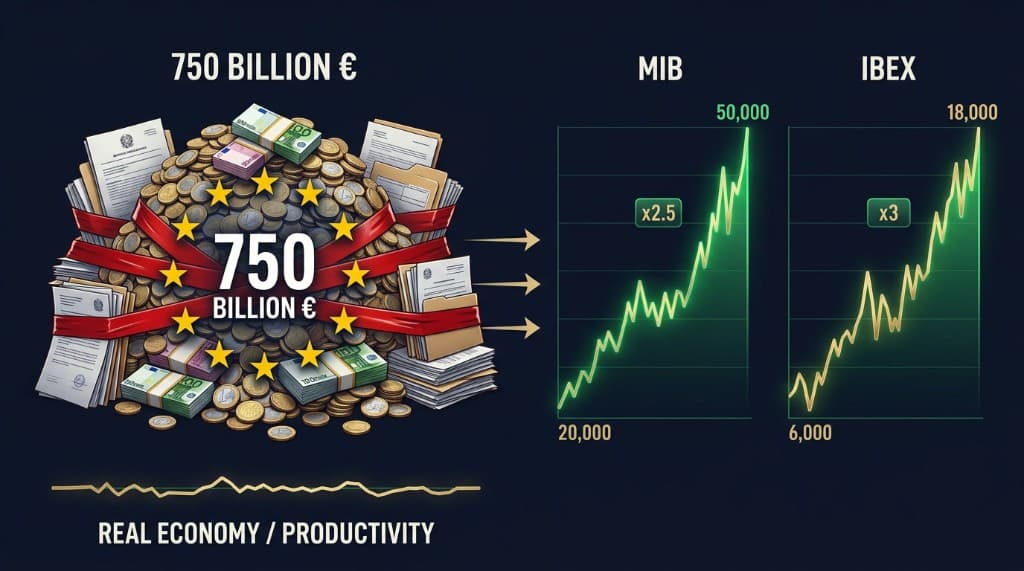
750 Billion Euros That Failed the Economy — and Tripled the Stock Market
The EU's Next Generation recovery fund deployed 750 billion euros between 2020 and 2021 — comparable to what Google, Meta, Microsoft and Amazon spent on AI infrastructure in a single year. The economic objectives failed: growth was modest, productivity barely moved, the North-South gap persists. But the Italian stock market tripled. The Spanish IBEX multiplied by three. Cava's conclusion: the money never reached the real economy. It went straight into financial markets.
The scale of the plan
Between 2020 and 2021, the European Union approved the Next Generation recovery fund — a 750 billion euro intervention designed to rebuild southern European economies after the pandemic shock and accelerate the digital and ecological transition.
To understand the scale: 750 billion euros is roughly double the EU's entire annual defense budget of 325 billion. It is also comparable to the amount that Google, Meta, Microsoft, and Amazon collectively spent on AI infrastructure in a single year — the investment that is reshaping the global technology landscape. The EU deployed the equivalent of one year of hyperscaler capex, distributed across member states through administrative bureaucracy.
Approximately 500 billion euros went to Italy and Spain:
- Italy: ~300 billion euros, representing 8.4-8.5% of its GDP — one of the largest single fiscal injections in any major economy in the post-war era.
- Spain: ~200 billion euros, representing more than 4% of GDP.
The stated objectives were clear: accelerate economic growth, improve productivity through digital and ecological transformation, and close the structural gap between northern and southern Europe.
The failure
Cava's assessment is direct: the plan has not achieved its objectives.
Growth across Italy and Spain has been modest — not the structural acceleration that a transfer equivalent to nearly a decade of normal EU cohesion funding was supposed to generate. Productivity, the metric that determines long-term living standards, has not improved meaningfully. The economic gap between northern and southern Europe persists.
The diagnosis points to two structural failures in how public funds flow through administrative systems:
Bureaucratic velocity: A modern AI company can decide to build a data center, contract construction, and begin operations within 18-24 months. A government distributing EU funds through national and regional administrative layers moves at a fraction of that speed. By the time approvals, environmental assessments, public procurement requirements, and political negotiations are completed, the economic moment that the funds were meant to address has often passed.
Decision criteria: Private capital is allocated by market competition — it flows toward the uses with the highest expected returns and away from underperforming projects. Public funds allocated by civil servants follow different incentives: compliance with regulations, political considerations, and institutional risk-aversion. The result is systematic misallocation relative to what competitive markets would have produced.
The money was real. The institutional infrastructure to convert it into productive economic activity was not adequate.
What actually happened to the money
Here is where the analysis becomes useful for investors.
The funds did not disappear. They were distributed — through bank accounts, government contracts, pension payments, operational spending, and financial intermediaries. Once money enters the financial system at scale, it does not stay in the real economy. It migrates toward assets.
The evidence is in the indices:
Italian MIB: From lows near 20,000 points to approximately 50,000 — a 2.5x increase.
Spanish IBEX: From lows near 6,000 points to approximately 18,000 — a 3x increase.
These are not the returns of economies that achieved structural transformation. They are the returns of markets flooded with liquidity that had nowhere productive to go in the real economy and found its way into equities.
This is not a coincidence or a secondary effect. It is the primary mechanism through which large public expenditure programs affect investors. The officials managing the programs measure success by economic indicators that are improving slowly or not at all. The speculators watching the same process measure it by the prices of financial assets — and those prices have told a very different story.
The speculator's conclusion
Cava closes with his characteristically blunt formulation: the "good speculator" does not need to evaluate whether a government program achieves its stated objectives. The question is simpler — does it inject liquidity into the system? If yes, financial assets will reflect that injection, regardless of what happens to the real economy targets.
The Next Generation fund is a case study. 750 billion euros deployed with the intention of transforming southern European economies. The economies are broadly where they were. The stock markets of Italy and Spain have multiplied by factors of 2.5 and 3 respectively.
The money went somewhere. It went into the markets. The speculators who understood this in advance captured those returns. The citizens whose productivity and living standards were supposed to improve are still waiting.
"Don't work. Speculate."
Analysis based on a José Luis Cava video published May 27, 2026. For informational purposes only — not financial advice.
Explore the data
Check the latest congressional trades and active investment signals.