Every New Fed Chair Gets Tested. The SP500 Target Is 7,000. And 2027 Will Be Excellent.
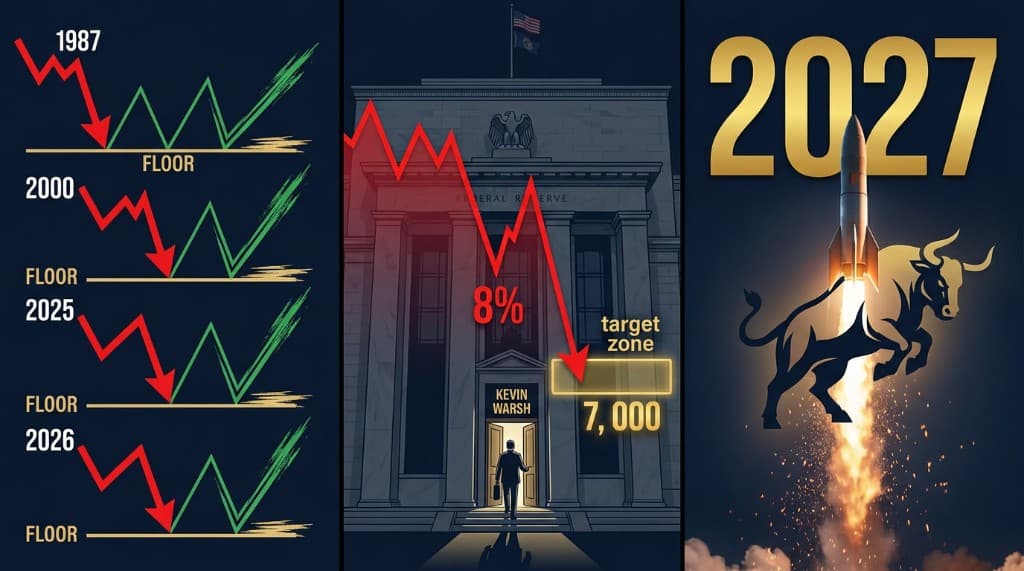
Every time a new Federal Reserve chair takes office, markets test them within one to two months. The median drop is 8%. The current target, based on Cava's sweep mechanics, is SP500 7,000-7,046 and Nasdaq 27,000. This is not a bear market. It is a deliberate institutional maneuver to expel weak hands before the next leg up. Those who understand this and hold their reserves will find 2027 to be one of the best years of their investment careers.
The pattern that repeats with every new Fed chair
History has a specific lesson about Federal Reserve leadership transitions that most investors have never been taught, because it is not in their interest for most investors to know it.
When a new chair takes the helm of the Federal Reserve, markets systematically test them within one to two months of their assumption of office. The mechanism is not accidental. It is the way major institutional players evaluate whether the new chair will respond to market stress with liquidity — and historically, they always do.
The data across historical transitions:
- Average drop: 12%
- Median drop: 8% — a more representative figure, as the distribution includes extreme outliers ranging from 2% to 33%
Kevin Warsh, the incoming Fed chair, presents a setup that Cava describes as resembling Alan Greenspan's entry conditions. Greenspan's inauguration preceded the 1987 crash — one of the most dramatic single-day market events in modern history, and one that resolved within months into a complete recovery and subsequent bull market.
The resemblance is not a coincidence. The conditions that invite the test are consistent: a new chair with something to prove, a market near highs, and institutional players with the scale to engineer the move.
The sweep: a consistent behavior across every crisis
The specific mechanism Cava describes — the "sweep" or "barrida" — is the single most useful concept for understanding what large institutions actually do during market dislocations. The cause of each crisis varies. The behavior is constant.
1987 — Liquidity crisis: There was no counterparty to sell to. The market fell with no floor visible. But when the dust settled, the decline had stopped precisely at the lows of the previous year — expelling every investor who had entered during 1986 and holding on into 1987. Greenspan injected liquidity. Recovery was rapid.
2000-2002 — Dot-com: A prolonged contraction driven by Greenspan's deliberate withdrawal of liquidity to address "irrational exuberance." The Nasdaq fell 80% over two years. The floor was where it needed to be: below the level where the final surge began, in 1998. Everyone who entered during the 1998-2000 advance was swept out.
Bitcoin, October 2025: Bitcoin swept the buyers from April 2025 at $74,000. The level was not random — it was the origin of the prior advance. Strong hands bought there. The recovery has been consistent since.
SP500, April 2025 and March 2026: Both corrections targeted the origin of the preceding wave — the point where the most recent group of buyers entered. Each time, the price recovered sharply once the sweep was complete.
The pattern is structural. It is not driven by economic fundamentals — it is driven by the mechanics of how institutional capital accumulates at scale without moving the price against itself.
The mechanics, step by step
Cava maps the sweep process clearly:
- Target identification: The price level where the last meaningful uptrend began — the point at which the largest number of recent buyers entered.
- Engineering the fear: Drive the price below that level. The psychological effect is critical: investors who entered at or above the origin of the move are now in loss. The more the price falls below that level, the more capitulation pressure builds.
- The narrative: Financial media provides the intellectual justification. The longer the decline, the more persuasive the case for a structural change. "This time is different" is the phrase that accompanies every sweep.
- Fed intervention: Fear of systemic collapse induces the Federal Reserve to inject liquidity. This is not charity — it is the predictable response that institutional players are counting on.
- The rocket: Once weak hands have sold, the price recovers with a speed and conviction that surprises everyone who sold at the bottom.
The 2026 targets
Cava provides specific levels derived from sweep mechanics — the zones where the prior waves originated and where the market needs to reach to complete the clearing process:
SP500: 7,046 to 7,000 From the current resistance zone near 7,550, this represents a decline of approximately 8% — consistent with the historical median for Fed chair tests. This level corresponds to the origin of the April 2026 advance that pushed the index to new highs.
Nasdaq: 27,000 An approximate decline of 10% from current levels, targeting the March 2026 lows where the prior correction found its floor and reversed.
These are not predictions of catastrophe. They are the natural clearing levels that the sweep logic requires — deep enough to convince weak hands that a trend change is underway, not deep enough to represent fundamental economic deterioration.
What this means for 2027
Cava's conclusion is unconditional: 2027 will be an excellent year for investors. The qualification is equally clear: only for those who survive the sweep.
Surviving the sweep means two things. First, not selling at the worst moment — not being the weak hand that capitulates near the bottom because the narrative has become maximally frightening. Second, having reserves available to deploy when the opportunity is most obvious and most psychologically difficult to act on.
The investors who will look back on 2026 as the moment that defined their portfolio for the following decade are the ones who understood what was coming, held their positions through the fear, and deployed capital at 7,000 on the SP500 while the headlines explained why it was going to 6,000.
The sweep is coming. The target is 7,000. The year after will be excellent.
Analysis based on a José Luis Cava video published May 26, 2026. For informational purposes only — not financial advice.
Explore the data
Check the latest congressional trades and active investment signals.