The First €100K Is a Nightmare — And That's Exactly the Point
Charlie Munger called it a nightmare. Fernando Sánchez calls it the great financial inflection point. The first €100,000 in liquid financial assets is the hardest milestone you'll ever reach — and the one that changes everything. At 10% annual returns, €100K generates €833 per month without lifting a finger. But getting there destroys most people in the first five years, when compound interest is still a slow-moving snowball. Here's the math that makes the difference: formula of poverty vs formula of wealth, three scenarios to reach 100K, and why the second hundred thousand arrives three times faster than the first.
Charlie Munger's nightmare
The late Charlie Munger — Warren Buffett's partner and one of the greatest investors of the 20th century — had a famous quote about the first $100,000:
"The first $100,000 is a b*tch."
It wasn't a complaint. It was a warning. And a promise.
The first €100,000 in liquid financial assets is the hardest milestone you'll ever reach. It's the point that separates those who build lasting wealth from those who give up believing the system doesn't work. Fernando Sánchez from Invertir desde Cero has been explaining this for years — and the math behind it is worth understanding deeply.
What counts — and what doesn't
This matters: the €100,000 milestone must be in liquid financial assets — stocks, ETFs, cash equivalents. Not patrimony.
Doesn't count:
- Your primary residence (a liability that consumes capital)
- Your car (depreciates from day one)
- Any asset you can't convert to cash quickly without major loss
Does count:
- Stock portfolio
- ETF holdings (SP500, sector funds)
- Cash in savings or investment accounts
- Pension funds you actually control
The goal is capital that works for you. At 10% annual return — what a diversified SP500 portfolio has historically delivered — €100,000 generates €10,000 per year, or €833 per month, without any additional effort. That's a second income for most Spanish households.
Why the first €100K destroys most people
Two forces make it brutal:
Limited savings capacity. If you save €300/month without investing, reaching €100,000 takes 27 years and 9 months. Most people never get there.
The slow start of compound interest. In the early years, compounding looks like nothing. The snowball barely moves. Fernando Sánchez estimates that 80% of people abandon in the first five years, convinced the system doesn't work — right before it starts accelerating.
This is the cruel irony: the math only becomes obviously impressive after you've already done the hard part. You quit precisely when the acceleration is about to begin.
The two formulas
Most people apply the formula of poverty without realizing it:
Income − Expenses = Savings
Whatever's left at the end of the month goes to savings. The problem: there's usually nothing left. Expenses always expand to fill available income.
The formula of wealth inverts the equation:
Income − Savings = Expenses
Pay yourself first. Set aside your investment allocation before anything else. You live on what remains. This single behavioral shift is responsible for more wealth accumulation than any investment strategy.
Common "invisible" expenses that drain €6,500+ per year: tobacco, streaming subscriptions, delivery food, impulse purchases, unused gym memberships. Invested at 10% annually for 25 years, that €6,500/year becomes over €700,000.
The three scenarios (all starting at €300/month)
Fernando Sánchez runs three scenarios for reaching €100K with a €300/month contribution:
At 0% return (cash in a bank account): 27 years and 9 months. By the time you get there, inflation has eaten roughly half the real value.
At 10% return (SP500 ETF, historical average): 13 years and 3 months. More than halved. This is why passive index investing is the baseline for anyone starting out.
At 15% return (curated stock portfolio with knowledge): 10 years and 11 months. Three years faster than the SP500 baseline — but requires genuine investment knowledge and active management.
The lesson: the return rate matters enormously in the early phase, when you're building toward the first €100K. After that, the absolute capital size takes over.
The acceleration effect after €100K
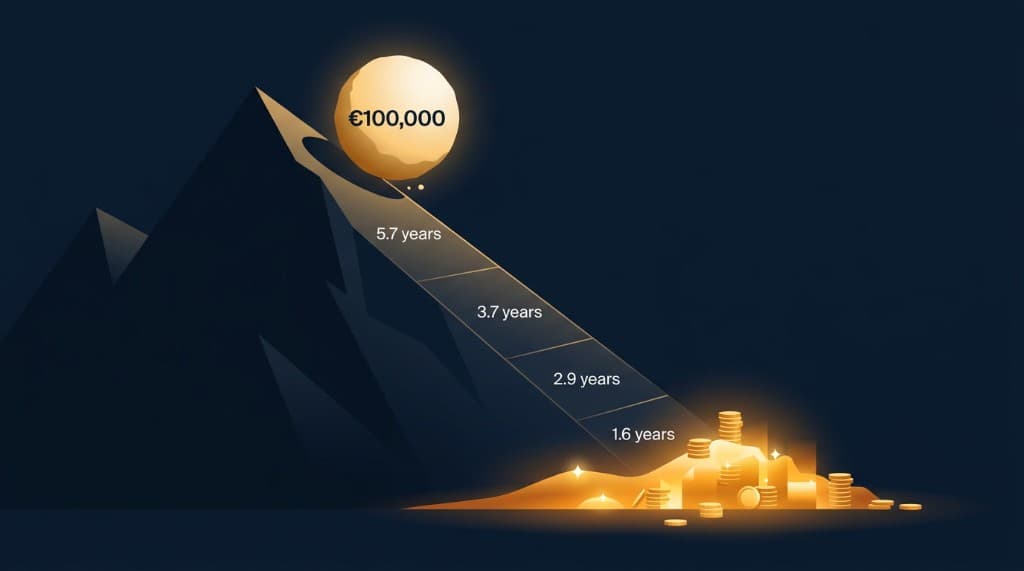
This is where Munger's "nightmare" transforms into something else entirely. Once you cross €100K, the same 10% annual return generates progressively larger absolute amounts:
From €100K to €200K: 5 years and 7 months.
From €200K to €300K: 3 years and 7 months.
From €300K to €400K: 2 years and 9 months.
From €600K to €700K: 1 year and 6 months.
Each successive €100K arrives faster than the previous one — not because the percentage changes, but because the base is larger. A 10% return on €600K generates €60,000 in a single year. The snowball that barely moved for years is now an avalanche.
The uncomfortable truth about time
The math is unambiguous: starting matters more than anything else.
Every year of delay costs more than the previous year. The 25-year-old who starts with €300/month is not slightly better off than the 35-year-old who does the same — they're building a fundamentally different financial future, because compound interest doesn't add up linearly: it multiplies.
At 45, the first €100K might feel far. But consider: with disciplined monthly contributions and intelligent allocation, a 45-year-old today can reach it by 55-57 — and then watch the acceleration phase work its magic for another 10-15 working years before any consideration of retirement.
The nightmare isn't the destination. It's the discipline required to keep going when the snowball seems barely to move.
This analysis is based on a video by Fernando Sánchez from Invertir desde Cero, published May 10, 2026. For informational purposes only — not financial advice.
Explore the data
Check the latest congressional trades and active investment signals.