The Global Bond Crisis, the Coming SP500 Crash, and Why It Will Be a Magnificent Buying Opportunity
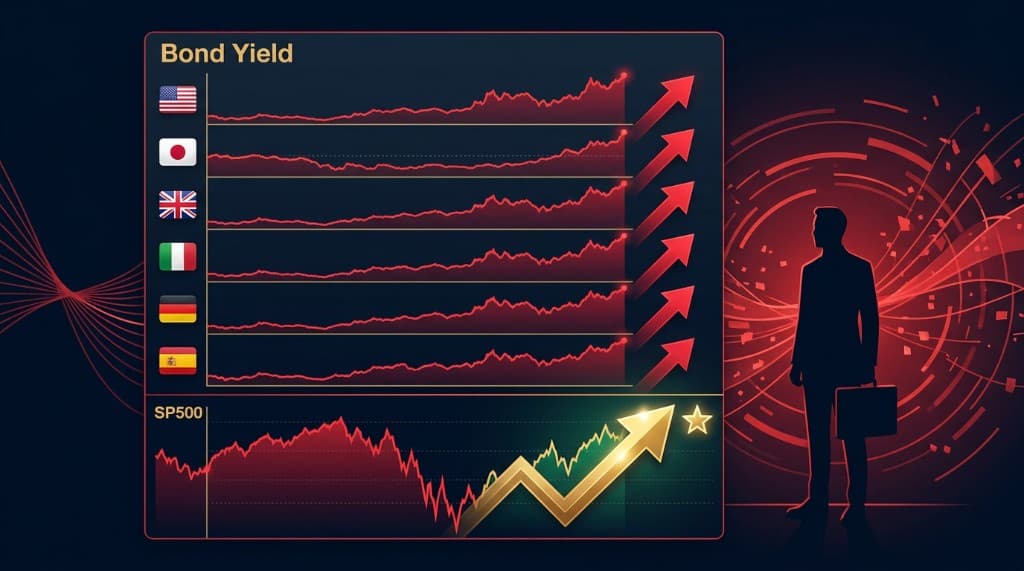
Bond yields are rising simultaneously in the US, Japan, UK, Italy, Germany, and Spain. José Luis Cava calls it a broken system. Stocks haven't fallen yet — and he explains why. But if yields keep escalating, a violent market correction is coming. The media will call it a prolonged bear market. Cava calls it a magnificent buying opportunity.
The narrative and what it is hiding
The financial media has a clean story for the current rise in US 10-year Treasury yields: Trump's policies are reducing demand for American debt, and inflation is coming back. Both factors are pushing yields higher, and the trend is real — yields are approaching 4.67% with upward momentum.
Cava's reading is more precise. Yes, the trend is up. But the investors driving it are not making a fundamental bet on long-term inflation — they are selling bonds simply because they see yields rising, and they use inflation as the intellectual justification. The momentum is self-reinforcing, and the narrative is borrowed after the fact.
The test for whether inflation is truly the driver: look at oil futures. If inflation were the genuine concern, futures curves would be pricing in rising energy costs over time. What the futures market is actually showing is a negatively sloped curve — the market expects crude oil prices to fall from here. If oil falls, the inflation narrative loses its foundation, and bond yields will eventually follow prices down.
For now, the trend is up. But the fuel driving it is not as durable as the headlines suggest.
A broken system: the global bond crisis
What makes this moment structurally different from previous cycles is that the bond yield problem is not contained to the United States. It is happening everywhere, simultaneously.
Japan: The 10-year yield has broken above the 2% resistance level and is in a clear upward trend. This is historically significant — Japan has kept rates near zero for decades through explicit yield curve control policy. The breach of 2% represents a structural shift. Cava notes that Japan will not technically default given its enormous stock of foreign assets, but the pressure on Japanese equities is real and ongoing.
United Kingdom: Yields are heading toward 5.9% to 6%. Cava describes UK fiscal management plainly as a disaster. Reaching 6% would be politically and economically unsustainable — a level that would likely trigger a government crisis given the UK's debt servicing requirements at that yield.
Europe: Italy is moving toward 4.90%. Spain toward 5%. Even Germany — the continent's fiscal anchor — is pushing toward 3.75%. The synchronization across countries with very different fiscal profiles confirms the thesis: this is not a country-specific problem. It is a systemic one.
When bond yields rise simultaneously across the US, Japan, the UK, and the major European economies, the conclusion Cava draws is direct: the global public finance system is broken and out of control. Governments have borrowed beyond their capacity to manage the cost of that debt in a normalized interest rate environment.
Why stocks have not fallen yet
Given the pressure that rising bond yields theoretically impose on equity valuations, the obvious question is: why are stocks holding up?
Cava offers a tactical explanation that connects directly to yesterday's analysis. Goldman Sachs and the financial institutions managing the SpaceX IPO need equity markets to remain elevated — the higher the price of comparable technology assets, the more they can charge for SpaceX shares, and the larger their commission. There is a direct financial incentive for major market participants to prevent a significant equity correction before the IPO is placed.
This is not a conspiracy theory — it is standard practice in capital markets. Underwriters of large offerings actively manage market sentiment in the period preceding a deal. The result: stocks may even push somewhat higher in the near term, absorbing the bond yield pressure without a proportional correction.
But there is a limit. If bond yields keep climbing — and particularly if the US 10-year approaches 5% — the pressure on equity valuations will become too great to absorb. At that point, the correction will be violent.
The magnificent buying opportunity
This is where Cava's framing becomes strategically important for investors.
When the correction comes — driven by bond yield escalation, preceded by SpaceX and Iran being fully priced in — the financial media will deploy a predictable narrative: this is the beginning of a prolonged bear market, a structural shift, a regime change. The coverage will be designed, consciously or not, to induce maximum fear at maximum prices.
Cava's counter-thesis: because the system is broken, the correction in the SP500 will be a magnificent buying opportunity.
The logic is the same as the one underlying the long-term bull case. Governments cannot let equity markets collapse without responding — central banks will inject liquidity, fiscal policy will accelerate, and the cycle will reset. The structural forces driving corporate earnings growth (AI investment, reindustrialization, the US-China competition) have not changed. The broken bond market creates volatility; it does not change the direction of the underlying economy.
For investors who have been accumulating cash reserves — precisely the discipline that Fernando Sánchez describes as the foundation of wealth building during the early phases of an investment journey — this is exactly the scenario those reserves are for. The media narrative will be maximally frightening at the moment the opportunity is maximally attractive.
Know the script in advance. The crash is coming. It is not the end. It is the entry.
Analysis based on a José Luis Cava video published May 20, 2026. For informational purposes only — not financial advice.
Explore the data
Check the latest congressional trades and active investment signals.