Gold Is Forming a Floor: Identified Temporary Sellers, Iran's Capitulation, and the ECB's Policy Error
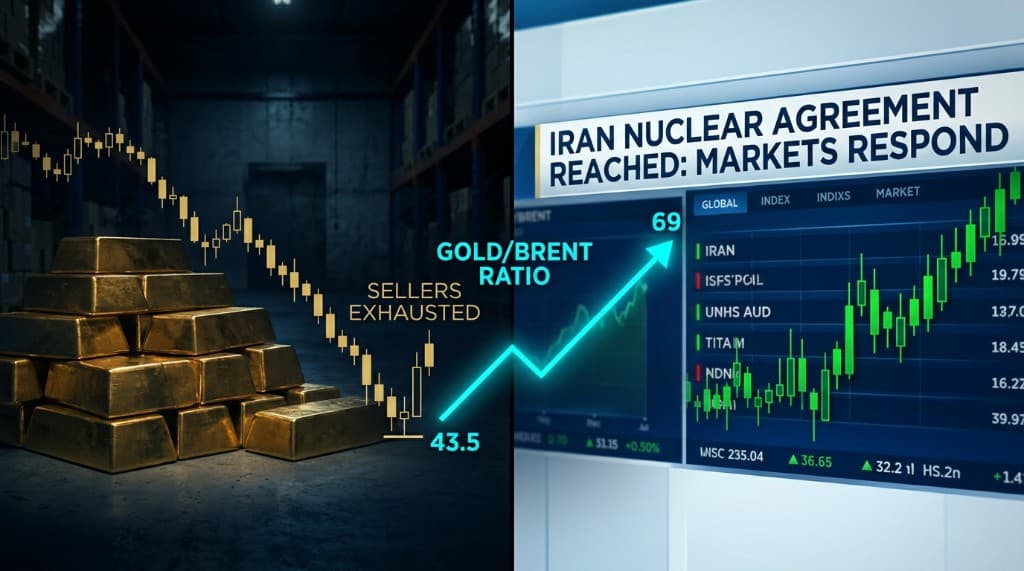
José Luis Cava identifies three temporary causes behind gold's recent decline — Gulf states selling for cash, Trump tariff arbitrage unwinding, and geopolitical risk premia. The technical picture confirms an emerging floor: extreme bearish sentiment, a completed sweep of March lows, and the Gold/Brent ratio building a base at 43.5 with a target of 69. Meanwhile, Iran's strategic capitulation in the peace deal collapses global risk premiums — highly bullish for growth assets. The ECB's rate hike decision, in this context, is described as a significant policy error.
The Gold/Brent ratio and where the floor is forming
Cava's framework for timing gold's cycle uses the ratio between gold and Brent crude oil, both priced in dollars. This ratio strips away the noise of dollar movements and isolates the relative strength of gold as a real asset against the dominant global commodity.
Through 2025 and into early 2026, the ratio trended strongly upward — gold was outperforming oil. Since early 2026, a correction has been underway. The ratio has now reached the zone of 43.5, where Cava identifies the formation of a technical base. The signal to watch for is a sustained close above this level, which would open the path toward the target zone of 69 — a move that would represent a significant appreciation of gold relative to oil.
The Gold/Brent ratio is not just a technical tool. It encodes fundamental information: when gold rises relative to oil, it typically reflects either increased monetary stress (demand for real assets) or reduced energy dominance in global asset pricing. A reversal upward from this base would signal that the forces temporarily suppressing gold have exhausted themselves.
Three temporary sellers: why the decline is not structural
The fundamental analysis identifies three distinct and temporary causes behind gold's weakness in recent months, none of which reflects a structural change in gold's role or value:
The Gulf states' liquidity crisis. The Hormuz Strait disruption has left Gulf oil producers unable to export their full volumes. With oil revenue dramatically reduced, sovereigns have been forced to liquidate their most liquid reserve asset — gold. This is emergency cash generation, not strategic portfolio repositioning. When Hormuz normalizes — and it is normalizing, as the peace process advances — this source of selling stops.
The Trump tariff arbitrage unwind. Between December 2025 and May 2026, the United States recorded extraordinary gold exports — at peak, gold became the single largest US export category, exceeding petroleum and semiconductors. This occurred because investors globally feared that Trump would impose tariffs on gold imports into the US. To get ahead of those tariffs, they imported gold in record quantities and stored it in US warehouses. When the tariffs did not materialize, that accumulated gold stock was no longer needed. It is now being sold back into the market, creating a supply overhang that is transitional and will end once inventories normalize.
The geopolitical risk premium collapse. As the Iran peace framework solidified, the risk premium embedded in gold (driven by fears of Middle East escalation) began to deflate. This is, paradoxically, bearish for gold in the short term but highly bullish for the economy and growth assets.
Cava's conclusion is explicit: all three selling forces are temporary and identifiable. They do not change gold's long-term role as a monetary hedge against currency degradation. When they cease, the buyers — structurally present, as central banks have been accumulating gold consistently — will reassert themselves.
The technical confirmation: sentiment extremes and the completed sweep
The technical picture reinforces the fundamental case. Market sentiment toward gold has reached extremes in bearishness: there is an unusual accumulation of put options combined with heavy selling of call options. For a contrarian analyst, this configuration — the "dumb money" positioned maximally against an asset — is one of the most reliable early signals that a reversal is approaching.
The price action adds further confirmation. Gold fell below its 200-session moving average and then extended lower to sweep the March 2026 lows — a mechanical move that forces weak speculative longs out of their positions. Cava interprets this sweep as classic floor-formation behavior: the market clears out the remaining sellers in a sharp, concentrated move, then stabilizes. The next step to watch is a recovery above the 200-session moving average, which would confirm that the new upward impulse has begun.
Iran's peace deal: the geopolitical shift that changes everything
Cava's political reading of the US-Iran peace agreement is deliberately contrarian to the mainstream framing.
Iran, in his analysis, has capitulated strategically. The regime has agreed to relinquish its nuclear weapons program and its missile programs — the two pillars of its regional deterrence — while receiving very little in exchange. More importantly, Teheran has been forced to abandon the ideological promises that legitimize the regime internally: ending Israel's existence and expelling the United States from the Gulf. Without those objectives, the regime's narrative loses its binding power over its base.
The consequence for financial markets is direct and powerful: the collapse of Iran's deterrence capability, combined with the ongoing weakening of Hezbollah, removes the primary source of geopolitical risk premium that has been embedded in energy prices and global equity risk for years. Add to this the existing US-China trade normalization, and the result — in Cava's framing — is the foundation for a period of exceptional global economic growth.
This is not a minor adjustment to the macro backdrop. The removal of sustained geopolitical tension from the Persian Gulf, while alternative energy supply chains in the Caribbean basin continue to develop, reshapes the risk environment for equity investors worldwide. The correction that follows the SpaceX IPO should be viewed against this backdrop: not as a structural bear market, but as a temporary rebalancing in an environment that is becoming fundamentally more favorable.
The ECB's policy error
In the context of falling global risk premiums and an improving growth outlook, the European Central Bank's decision to raise interest rates stands out as a significant miscalculation. Tightening monetary policy at the moment when geopolitical risks are collapsing and global growth is reaccelerating applies economic brakes precisely when the engine is beginning to recover.
Cava's critique is pointed: an institution tightening into a period of improving fundamentals and declining risk premiums is not reading the environment correctly. The ECB's error is not just timing — it risks exporting deflationary pressure into a eurozone economy that already struggles with structural competitiveness challenges.
For investors, the ECB error has a concrete implication: European equity markets will face a headwind that is policy-created rather than economically justified. This argues, once again, for concentration in businesses with global earnings — US technology, semiconductors, AI infrastructure — rather than domestically-focused European companies.
The operative picture for June 15
Gold is building a floor with temporary sellers identified and beginning to exhaust themselves. The contrarian sentiment extreme and the completed price sweep are the technical confirmation. PPFB remains the correct vehicle for the current phase.
The Iran peace deal is the most significant macro event of the cycle so far. Its consequences — collapsing risk premiums, accelerating growth, stable energy prices — validate the 18-24 month bullish thesis for technology and growth equities that Cava has articulated since May. The correction window (August-September, SpaceX lock-up mechanics) is a buying opportunity in a world that is structurally improving.
The Yuan is at 0.1480, within 1.3% of the 0.15 resistance signal. The liquidity floor for risk assets globally is approaching.
Analysis based on José Luis Cava video published June 15, 2026. For informational purposes only — not financial advice.
Explore the data
Check the latest congressional trades and active investment signals.