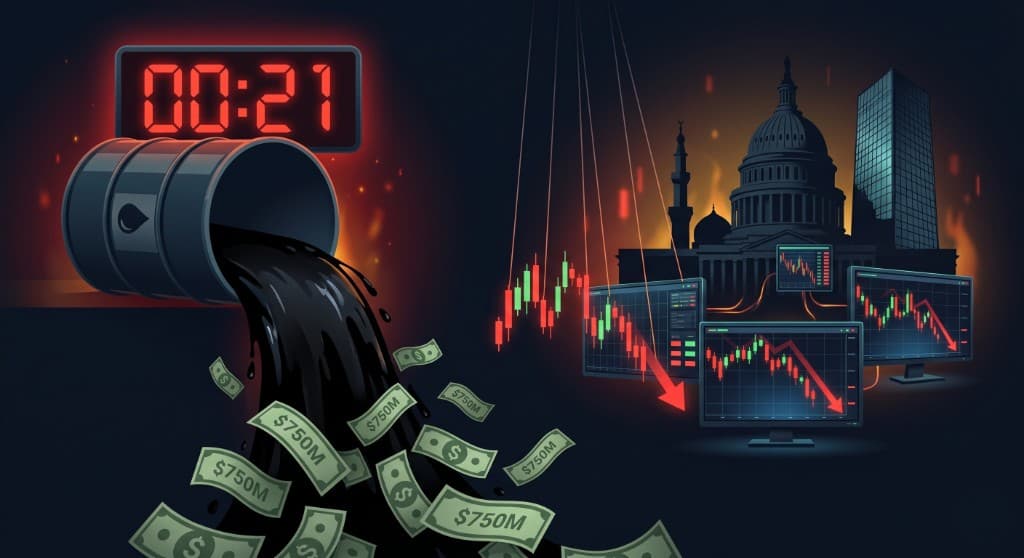
Governments Don't Just Start Wars — They Trade Them. $750M in Oil Shorts Placed 21 Minutes Before Iran's Announcement
Someone sold $750 million in Brent oil futures exactly 21 minutes before Iran announced the reopening of the Strait of Hormuz. That's not luck — that's privileged information weaponized for profit. Cava exposes how governments on all sides of the conflict are actively speculating in financial markets, and analyzes the UAE's suspicious request for a Fed currency swap despite sitting on massive reserves.
$750 million in oil shorts — 21 minutes before the announcement
Let that sink in. Twenty-one minutes before Iran officially announced the reopening of the Strait of Hormuz, someone dumped $750 million in short positions on Brent crude oil futures.
This wasn't a hedge. This wasn't algorithmic trading reacting to news. The news didn't exist yet. This was someone who knew what was coming and positioned to profit from the price collapse.
Cava walks through the mechanics:
- Brent was trading at known support levels where normal speculators would be buying
- Instead, a massive short position appeared — going against the typical behavior at those price levels
- The size ($750M) is far beyond what any normal institutional player would risk at a support zone
- 21 minutes later, the announcement hit — oil crashed — the position printed hundreds of millions in profit
When someone bets $750 million against the crowd at a technical support level and wins 21 minutes later on an announcement that didn't exist yet, it's not speculation. It's information warfare.
Governments speculate in markets — all of them
This is the uncomfortable truth Cava has been building toward for weeks. The Iran conflict isn't just about territory, oil routes, or nuclear programs. It's also about money.
Key evidence:
- Since Trump's presidency, market volatility has been unprecedented, with suspicious trading patterns appearing before every major geopolitical announcement
- Bitcoin, SP500, and Brent have all shown pre-announcement moves that suggest privileged information
- Iranian officials were found using Bloomberg terminal commands despite being under sanctions — meaning they have active access to financial markets and are trading them
- Multiple governments and regimes are simultaneously fighting wars and speculating on their outcomes
This isn't conspiracy theory. The pattern is consistent and the amounts are too large to be coincidence. When you control the timing of announcements, you control the market.
The UAE's suspicious swap request
In a separate but connected development, the United Arab Emirates has requested a currency swap with the US Federal Reserve.
What makes this suspicious:
- The UAE sits on substantial foreign reserves — they don't need dollar liquidity
- A currency swap with the Fed is typically reserved for countries in financial distress
- The timing coincides with the ongoing conflict costs
Cava's interpretation: this isn't about liquidity. It's about sharing the financial burden of the war. The UAE wants the Fed to absorb some of the risk and cost of regional instability. It's a political-financial maneuver disguised as a routine central bank operation.
If the Fed approves it, it signals continued US commitment to regional stability (bullish for markets short-term). If denied, it could create friction with a key Middle Eastern ally.
What this means for us
For retail investors like us, the takeaway is sobering but actionable:
-
Volatility is manufactured, not organic. When you see sudden 3% moves on "news," someone already made money on that move before the news hit. Don't chase.
-
Support and resistance levels can be overwhelmed by political actors. Normal technical analysis assumes market participants are playing by the same rules. Government actors with inside information break that assumption.
-
CongressFlows matters more than ever. If governments trade on privileged information, so do the people who work for them. Congressional trading data is one of the few legal windows into what the political class knows before the market does.
-
Cash remains king. Our strategy of holding ~1,790€ in liquidity while the market runs on mechanical buying (CTAs, short squeezes) is validated. The people with real information are taking profits — we should be cautious about adding at these levels.
The market is a casino, but some players can see everyone else's cards. Our edge isn't information — it's patience, positioning, and following the breadcrumbs that public disclosure laws force into the open.
This analysis is based on Cava's market commentary from April 20, 2026. For informational purposes only — not financial advice.
Explore the data
Check the latest congressional trades and active investment signals.