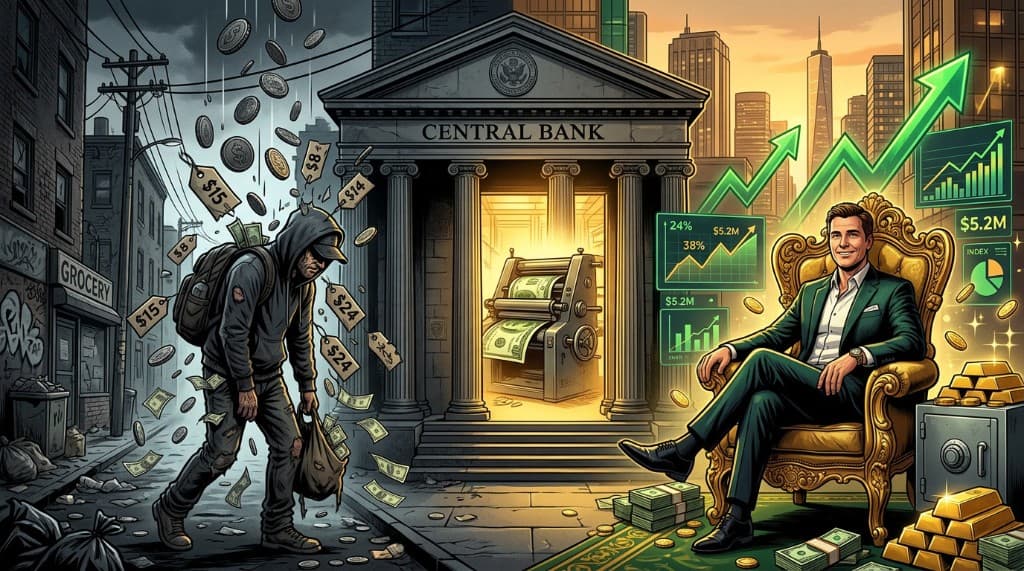
Inflation Is a Tax on the Poor. Assets Are a Machine for the Rich.
Central banks inject liquidity. Prices rise. The poor pay more for basics. The middle class gets pushed into higher tax brackets despite losing real purchasing power. The wealthy hold assets that appreciate, borrow against them tax-free, and never sell. José Luis Cava explains why this is not a flaw in the system — it is the system. And why the Wizard of Oz, written in 1900, already had the answer.
The machine nobody talks about honestly
There are two economies running in parallel.
In one, prices rise every year, wages chase inflation but never quite catch it, taxes quietly increase as nominal salaries climb into higher brackets, and debt compounds at rates that guarantee poverty for those who carry it.
In the other, a small group holds assets — stocks, gold, real estate, semiconductors — that appreciate precisely because of the same monetary expansion that destroys the purchasing power of everyone else. They do not sell. They borrow against the appreciated value, consume, and pay no capital gains tax. The machine runs silently.
José Luis Cava's latest analysis is one of the clearest explanations of why this divergence is not accidental — and what you can do about it.
The Keynesian lie at the center of monetary policy
The Federal Reserve, the ECB, and the Bank of England share a theoretical framework: inflation, they say, is caused by rising production costs. When businesses pay more for energy, labour, or raw materials, they pass those costs on to consumers.
Cava rejects this model entirely, citing Milton Friedman's foundational insight:
Inflation is always and everywhere a monetary phenomenon.
It does not rise because producers charge more. It rises because central banks inject liquidity into the system, creating more monetary units competing for the same quantity of goods and services. More money chasing the same output — prices go up. The cost narrative is a convenient distraction that obscures who made the decision that caused the price increase.
The decision was made in a central bank boardroom, not in a factory.
Three classes, three experiences of the same inflation
The same 5% inflation does not feel the same across the income spectrum.
The poor spend most of their income on consumption basics: food, rent, energy, transport. When those prices rise, their real standard of living falls immediately. There is no buffer. Many carry credit card balances at 20-25% annual interest — a compounding trap that guarantees they will fall further behind regardless of what nominal wages do.
The middle class faces what Cava calls "cold progressivity." Inflation pushes nominal salaries up. Higher nominal salaries push workers into higher income tax brackets. The result: they pay more taxes in absolute and relative terms even though their real purchasing power has fallen. They earn more on paper, own less in reality, and the state takes a larger share of the nominal gain.
The wealthy own the machine. Their assets — equities, gold, property, semiconductor companies — appreciate when central banks expand the money supply. But they do not sell. Selling triggers capital gains tax. Instead, they use the appreciated assets as collateral for credit: they borrow at low rates, fund their consumption, and their net worth keeps compounding. They pay no income tax on unrealized gains. The system, as designed, does not require them to.
The debt spiral and the distraction
Governments justify expansionary fiscal policy as a tool to close growth gaps and reduce inequality. When it fails — and it regularly does — central banks are asked to compensate with more liquidity injections. This produces:
- Higher public deficits and debt loads
- Further asset price appreciation (benefiting asset owners)
- Higher inflation (taxing those who hold no assets)
- Greater social polarization
Cava's most pointed observation: political systems manage this polarization by keeping the population focused on internal conflict — cultural, ideological, generational — while the underlying economic mechanics remain intact. The poor are distracted by fighting each other. The machine keeps running.
The problem, he is careful to clarify, is not capitalism itself. Capitalism generates productivity, innovation, and growth. The problem is the specific management decisions of governments that fail to redistribute the gains and actively distort the monetary system in ways that concentrate wealth upward.
Kevin Warsh and the road not taken
Kevin Warsh — whom Cava affectionately calls "Kevin Costner" — has argued that it is theoretically possible to lower interest rates while controlling inflation by simply stopping the liquidity injections. No new money creation, no balance sheet expansion, rates fall because capital is efficiently allocated rather than artificially suppressed.
Cava acknowledges the theoretical coherence of this position. He is skeptical it will happen. Control of the monetary system is in the hands of political actors whose incentives — re-election, short-term growth metrics, debt rollover — point consistently toward expansion rather than restraint.
Understanding this dynamic is not pessimism. It is the operating context for every investment decision you make.
The Wizard of Oz knew this in 1900
Cava closes with a teaser that deserves its own analysis: the HOPLA team is preparing a video arguing that everything discussed above was already encoded in The Wonderful Wizard of Oz, published by L. Frank Baum in 1900.
The hint: what does "Oz" mean?
The answer that historians and monetary economists have argued for decades: Oz is an abbreviation of ounce — as in, an ounce of gold. The yellow brick road is the gold standard. Dorothy's silver shoes (changed to ruby in the film) represent the silver monetary movement. The Wizard behind the curtain is the banking and political establishment manipulating the monetary system while maintaining the illusion of authority.
The book was published during one of the most heated monetary policy debates in American history — gold standard versus bimetallism — at a moment when farmers and workers were being crushed by deflation while creditors and Eastern bankers prospered.
The story has not changed. Only the names have.
What to do about it
Cava's answer is the same as always: become a "good speculator." Not a gambler — a person who understands the mechanics of monetary degradation and positions their capital in the assets that benefit from it rather than in the currency that erodes.
Equities. Gold. Productive assets with real earnings. Anything that rises in nominal terms when the money supply expands.
The machine runs whether you understand it or not. The only question is which side of it you are on.
Analysis based on a video by José Luis Cava from HOPLA Finance, published May 12, 2026. For informational purposes only — not financial advice.
Explore the data
Check the latest congressional trades and active investment signals.