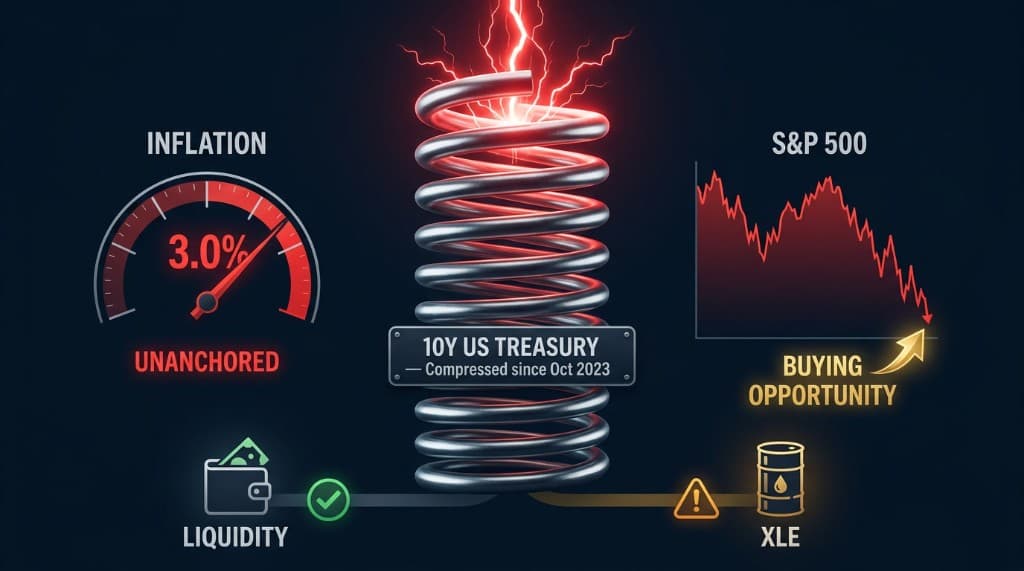
The Bond Market Is a Compressed Spring — And Inflation Is About to Release It
The US economy is strong. Corporate earnings are growing. AI investment is accelerating. And yet the HOPLA team is warning of a significant market correction between now and the end of summer. The reason: inflation expectations are unanchoring precisely as the Federal Reserve transitions leadership, and the 10-year Treasury bond has been compressing like a spring since October 2023. When it releases, equity markets will feel it. Here is what to do — and what not to do.
The apparent paradox
The macroeconomic data is genuinely strong. US corporate earnings are growing at rates not seen outside of post-recession recoveries. The labor market continues to tighten. AI investment is injecting capital into the economy at a scale that is measurably accelerating productivity. A potential Trump-Xi agreement on Chinese investment in the US adds another tailwind.
Against this backdrop, the HOPLA team is warning of a significant equity market correction between now and the end of summer.
The paradox resolves when you understand that equity markets do not only respond to the state of the economy. They respond to the cost of money — and the cost of money is determined by bond yields, which are determined by inflation expectations.
The unanchoring of inflation expectations
The critical variable is not current inflation. It is where market participants believe inflation will be.
Two-year inflation expectations: 3.0%. Five-year average inflation expectations: 2.7%. Both figures are above the Federal Reserve's 2% target, and both are moving in the wrong direction at a moment of institutional vulnerability.
The Fed is in transition. Kevin Warsh is assuming the chairmanship. New leadership at the Fed creates a period of credibility uncertainty — markets do not yet know how Warsh will respond to inflationary pressure, how firm his commitment to the 2% target will be under political pressure, or how he will balance growth and price stability in his initial months.
When inflation expectations unanchor during a leadership transition, the combination is particularly destabilizing. The bond market does not wait for the new chair to establish credibility. It prices the uncertainty immediately.
The compressed spring
The mechanism of the correction is technical but the implication is clear.
Since October 2023, the yield on the 10-year US Treasury bond has moved in a lateral range — neither breaking decisively higher nor declining to a level consistent with easy financial conditions. Cava's characterization of this pattern is precise: it is a compressed spring.
When a market spends an extended period compressing energy within a defined range — neither breaking out nor breaking down — the eventual resolution tends to be violent in the direction of the underlying pressure. The underlying pressure in this case is inflationary: an economy that is accelerating, combined with an unanchoring of expectations, combined with a bond market that has been contained for nearly two years.
The logical resolution: bond yields break upward. Higher long-term yields mean a higher discount rate for equity valuations. Higher discount rates reduce present values. The equity market correction follows mechanically.
The estimated timing: this process unfolds between now and the end of summer — consistent with the SpaceX IPO dynamics and the Fed transition period already discussed.
What to do: two paths
The HOPLA team offers two strategic responses to this environment. Neither involves panicking.
Path 1: Increase cash. Reduce equity exposure and build a liquidity reserve. This is the approach the HOPLA team itself prefers. The rationale is straightforward: cash in hand during a correction gives you the ability to identify the next cycle's leaders and enter at favorable prices. The cost of holding cash for two to three months is minimal compared to the opportunity of deploying it at the bottom of a correction.
Path 2: Inverse correlation assets. Position in assets that tend to rise when equities fall. Two specific instruments are identified:
- XLE: The US energy sector ETF. Energy companies benefit from geopolitical tension (higher oil prices) and tend to decorrelate from the broad equity market during risk-off episodes.
- SXL: The European equivalent of XLE, denominated in dollars.
The honest risk assessment of defensive plays
Cava does not present the defensive option without its complications.
The timing problem with energy and conflict-driven assets is fundamental: strong hands enter before the news is public. By the time a geopolitical event is visible in financial media, the institutional money that moves energy prices has been positioned for weeks or months. Retail investors who buy XLE after seeing the headline are buying after the move has already happened.
The exit risk is equally dangerous: any peace signal creates an immediate gap down. A ceasefire announcement, a diplomatic breakthrough, a de-escalation communiqué — any of these can eliminate weeks of gains in hours. The same asymmetry that makes energy profitable in conflict makes it treacherous when conflict resolves.
The honest conclusion: for most investors, the cash approach is cleaner. It does not require timing geopolitical events, it does not carry gap-down risk, and it positions you perfectly for the buying opportunity that follows the correction.
Know the spring is compressed. Prepare the reserves. Wait for the release.
Analysis based on a HOPLA Finance video by José Luis Cava, published May 28, 2026. For informational purposes only — not financial advice.
Explore the data
Check the latest congressional trades and active investment signals.