The IPO Trap: Why the Biggest Tech Listings Destroy Retail Wealth
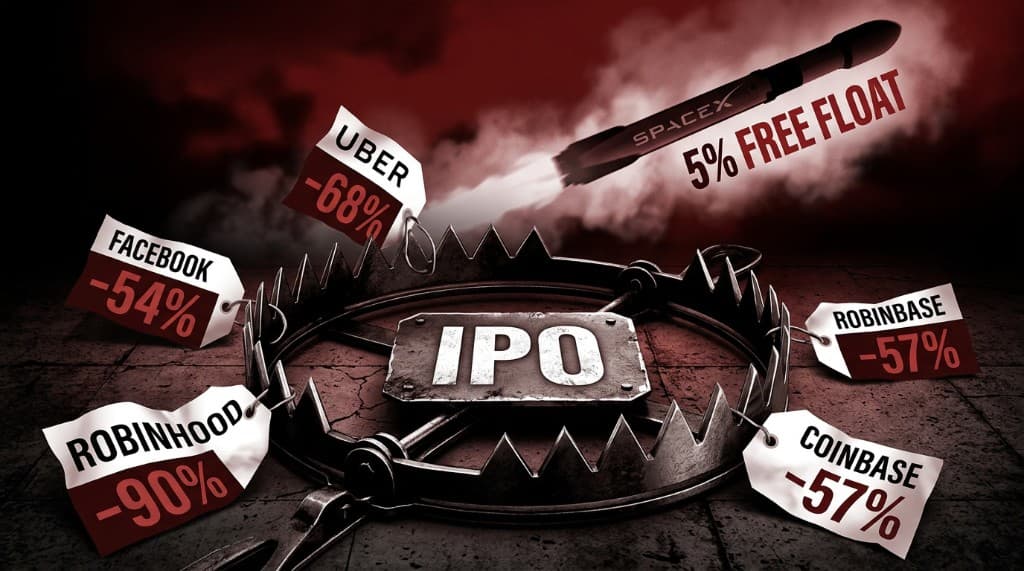
The data is unambiguous: the largest technology IPOs in history have destroyed wealth for retail investors who bought at listing. Facebook, Uber, Coinbase, Robinhood — each fell between 39% and 90% in their first year. With SpaceX preparing the most anticipated IPO since Facebook, and its structure designed to create artificial scarcity, Fernando Sánchez maps the mechanics of why IPOs are built for insiders, not for the public.
The numbers that the IPO hype machine ignores
When a major technology company announces its stock market debut, the financial media generates an enormous volume of coverage: valuations, growth projections, the founder's vision, the transformative potential of the business. What receives significantly less coverage is the historical performance of IPO investors in the twelve months following the listing.
The data, assembled across the most significant technology IPOs of the past fifteen years, tells a consistent story:
Maximum decline from IPO price in the first year:
- Facebook: -54%
- Twitter: -58%
- Alibaba: -49%
- Shopify: -52%
- Dropbox: -54%
- Spotify: -46%
- Zoom: -40%
- Uber: -68%
- Palantir: -53%
- Robinhood: -90%
- Airbnb: -39%
- Coinbase: -57%
- Arm Holdings: -43%
The average across this group: a decline of more than 50% from the IPO price within the first year. Some of these companies — Facebook, Shopify, Zoom — went on to become extraordinary long-term investments. But investors who bought at the IPO price and held through the first year experienced losses that took years to recover.
Why IPOs systematically disadvantage retail investors
The IPO structure is not designed to generate wealth for the public. It is designed to generate liquidity for the private investors, founders, and employees who built the company before it was listed.
The mechanics work as follows. A company approaches the public markets after years of private growth, typically at a moment chosen by its insiders to maximize the price they receive for their shares. The investment banks managing the offering have strong incentives to price the IPO high — their fees are proportional to the total amount raised. The marketing process, known as the roadshow, generates excitement and demand that pushes the price higher still.
By the time retail investors can participate, the price already incorporates significant optimism about the company's future. The early investors who funded the business at much lower valuations are selling into that optimism. The retail investor is, in effect, providing liquidity to the professional investors who are exiting.
The lockup expiration: the hidden second wave
The situation is compounded by the lockup period — the window of time during which insiders and early investors are contractually prevented from selling their shares after the IPO. Standard lockup periods run between 90 and 180 days.
When this period expires, the market absorbs a second wave of selling from insiders who were unable to exit at the IPO date. This is frequently the catalyst for the deepest declines seen in the first year — not the initial listing, but the three-to-six month mark when early investors begin systematically liquidating positions.
Many of the percentage declines listed above occurred precisely at or around lockup expirations, when the market was absorbing selling pressure that the IPO structure had temporarily delayed.
SpaceX: a structure designed for artificial scarcity
The SpaceX IPO, scheduled for June 12 with a valuation of approximately $2 trillion, carries a structural characteristic that makes it even more extreme than typical large IPOs.
Only approximately 5% of shares will be available as free float at listing. The remaining 95% remains in the hands of existing investors, employees, and the company itself. This is not an accident — it is a deliberate mechanism to create artificial scarcity.
With 5% of shares available and the forced buying from Nasdaq 100 inclusion (passive funds must purchase SpaceX in proportion to its weighting), the initial price can be pushed to levels that have no connection to the underlying business value. The low free float ensures that any buying pressure creates outsized price appreciation, generating headlines and further excitement.
The risk is symmetrical: when even a small fraction of that 95% begins to sell — through lockup expirations, staged selling windows, or insider decisions — the same dynamic works in reverse. A thin market absorbing institutional selling can move prices down as rapidly as it moved them up.
Fernando's analysis notes the absence of a traditional lockup, meaning some existing shareholders can sell from day one. Combined with the low free float, this creates a situation where the initial price is maximally vulnerable to selling pressure as the novelty fades.
The alternative framework
None of this means SpaceX is a bad business. It may be extraordinary. But the quality of a business and the quality of an investment are different questions.
The relevant question for investors is not whether SpaceX will be successful over the next decade. The question is what price reflects that success, and whether the IPO price — set at the moment of maximum excitement, with minimum free float, with insiders ready to sell — represents a reasonable entry point for new investors.
Historical data suggests the answer is almost always no. The businesses that became the greatest long-term investments of the past twenty years — Amazon, Apple, Google, Meta — rewarded patient investors who bought after the first-year corrections, not those who participated in the IPO euphoria.
The patient capital that waits for the correction, rather than chasing the listing, has consistently produced better outcomes. The data is not ambiguous.
Analysis based on Fernando Sánchez Telegram messages and video from early June 2026. For informational purposes only — not financial advice.
Explore the data
Check the latest congressional trades and active investment signals.