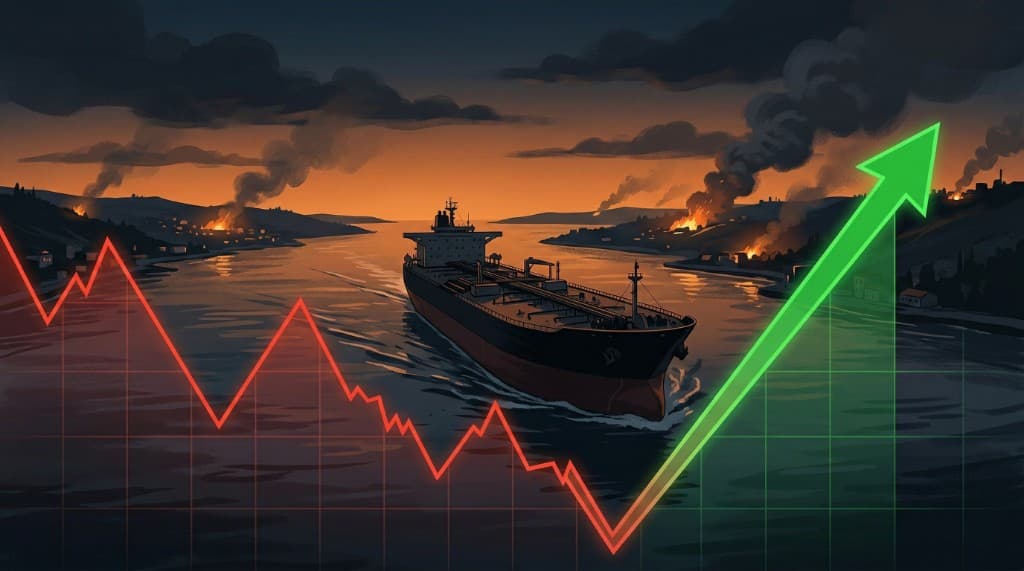
Iran Conflict Shakes Markets — But the Data Says Buying Opportunity
A major escalation in the Middle East has disrupted oil routes and rattled global markets. Yet oil remains below $80, bonds show no panic, and equities are holding. The evidence points to a controlled reaction — and a potential entry point.
The human cost comes first
Before any market analysis, it's important to acknowledge the human reality behind this escalation. The conflict in Iran has caused significant suffering, and no financial commentary should minimize that. What follows is an assessment of economic consequences — not a judgment on the events themselves.
A major attack, a controlled oil reaction
The scale of the attacks is significant. Iran has attempted to disrupt oil supply through the Strait of Hormuz — one of the most critical chokepoints in global energy infrastructure, through which roughly 20% of the world's oil passes daily. Traffic through the strait has been reduced, creating immediate supply concerns.
And yet, the oil market's reaction has been remarkably contained:
- Prices rose approximately 7.5-8%, a meaningful move but far from the panic spikes seen in past geopolitical crises
- Crude remains below $80 per barrel, a level that would need to be decisively broken for inflation concerns to materially escalate
- OPEC's decision to increase production has acted as a counterbalance, signaling that supply disruptions can be partially offset
Oil spiked, but it didn't explode. When the market absorbs a Strait of Hormuz disruption without breaking $80, that tells you something about underlying supply dynamics.
This controlled reaction suggests that markets had partially priced in geopolitical risk in the region, and that the global oil supply chain has enough slack to absorb the initial shock.
Stock markets: corrections, not collapses
The natural expectation after a major geopolitical event is a sharp market sell-off. What we're seeing instead is orderly minor corrections across global equities:
- Japan, South Korea, and China: modest pullbacks within normal ranges
- European markets: slight weakness but no trend damage
- US equities: the S&P 500 has dipped but remains structurally intact
No major index is showing signs of entering a bearish trend. The corrections are measured, volume is not panicky, and there are no signs of capitulation selling. This is the market processing new information, not pricing in catastrophe.
For context, this is consistent with how equities have historically reacted to geopolitical shocks: an initial dip driven by uncertainty, followed by stabilization once the economic impact becomes quantifiable.
The bond market: no panic, no inflation spike
Perhaps the most telling signal comes from US Treasury bonds. The 10-year yield has dropped slightly — a classic "flight to quality" move where investors rotate into safe assets during uncertainty.
What's notable is what the bond market is not doing:
- No sharp yield spike: if markets expected a sustained inflation surge from oil disruption, yields would be rising, not falling
- No recession pricing: the yield curve isn't signaling an imminent economic contraction
- Orderly flow: the move into Treasuries is measured, not frantic
When bonds don't panic, you shouldn't either. The flight to quality is textbook — and textbook means the system is functioning normally.
This suggests that bond traders — typically the most sophisticated participants in financial markets — view the economic impact as manageable rather than structural.
The dollar strengthens, BRIC currencies weaken
As expected in a geopolitical crisis, the US dollar has strengthened as a safe-haven asset. Capital flows toward dollar-denominated assets during uncertainty, reinforcing the currency's dominant role in global finance.
On the other side, BRIC currencies (Brazil, Russia, India, China) have weakened. This dynamic is worth noting because it directly challenges the narrative that an alternative currency bloc could compete with the dollar. When real stress tests arrive, capital still flows to the dollar — not away from it.
For emerging market investors, this creates a temporary headwind. However, as discussed in our previous analysis on emerging markets, the structural growth drivers in these economies remain intact. Currency weakness during acute geopolitical events tends to be temporary.
Why this looks like a buying opportunity
The combination of signals paints a clear picture:
- Oil is contained — OPEC is responding, prices haven't broken critical levels
- Equities are correcting, not collapsing — no trend damage, no capitulation
- Bonds show no panic — flight to quality is orderly and measured
- The dollar is doing its job — safe-haven flows are functioning as expected
Historically, geopolitical-driven market dips that don't escalate into economic crises tend to be fully recovered within weeks to months. The investors who buy during fear — while the corrections are orderly and contained — are typically rewarded.
Markets hate uncertainty. But uncertainty with contained economic damage is historically one of the best entry points for patient capital.
The key risk would be a prolonged closure of the Strait of Hormuz that pushes oil decisively above $80-90 and sustains inflationary pressure. That scenario is possible but not what markets are currently pricing. Monitor oil prices as the primary risk indicator.
What to watch
- Oil price trajectory: sustained moves above $80 would change the calculus. Below $80, the inflationary impact remains manageable
- Strait of Hormuz traffic data: any restoration of shipping volumes would be a strong de-escalation signal
- S&P 500 support levels: as long as the index holds its structural uptrend, dips are buying opportunities
- US midterm election dynamics: political considerations may influence the administration's response and economic policy
- OPEC production data: follow-through on production increases would cap oil's upside
This analysis is based on macroeconomic commentary by José Luis Cava (HOPLA Finance). CongressFlows synthesizes publicly available market analysis to help investors contextualize congressional trading data. This is not financial advice.
Explore the data
Check the latest congressional trades and active investment signals.