Iran Cannot Hold — Rial Approaching Zero, 50% Unemployment, 34 Days Without Pay. Markets at All-Time Highs.
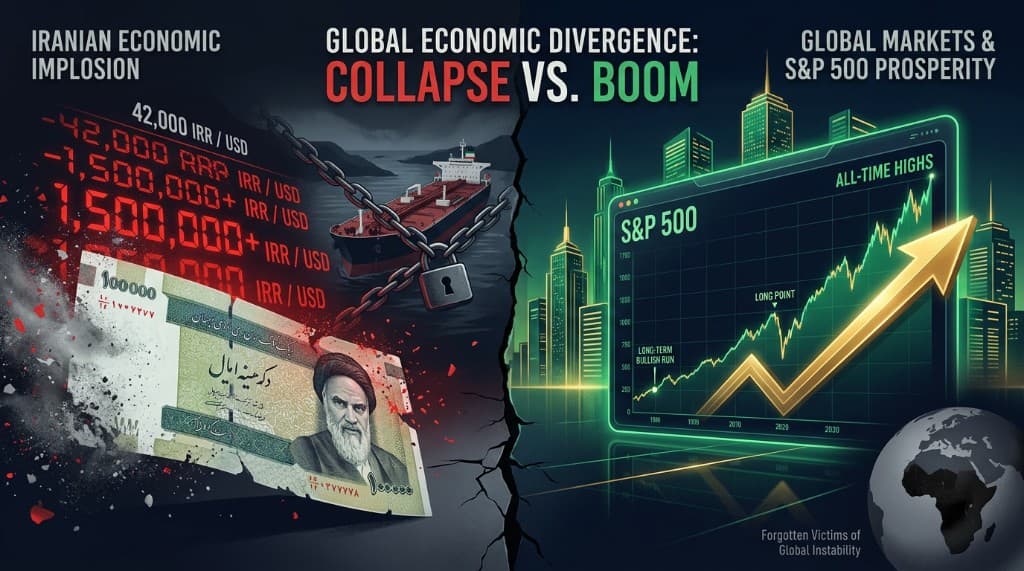
From London, Cava dissects Iran's economic implosion with surgical precision. The numbers tell a story of a regime on the edge: 50% unemployment (12 million people), civil servants unpaid for 34 days, inflation at 70-100%, and the rial collapsing from 42,000 to 1.5 million per dollar. The Hormuz blockade drains $150M net per day. The war has shifted from military to economic — and Cava believes it's unwinnable for Iran. Meanwhile, markets don't care: SP500 and Nasdaq at all-time highs, Brent capped at 103.5, and the 10-year yield steady at 4.3%.
Iran's economic reality — behind the propaganda
Cava opens from London with a message: ignore the regime's propaganda. They're publishing AI-generated videos and statements from "invisible leaders" on Twitter. A speculator looks at the numbers, not the narrative.
And the numbers are devastating.
The collapse in data
Unemployment: 50% of the active workforce — 12 million people — is out of work.
Public sector paralysis: The public sector represents 50% of economic activity. Civil servants have gone 34 days without pay, with a promise to receive salaries in 22 more days. This signals the regime is running out of dollars.
Inflation: Officially above 70%, likely approaching 100%. Basic medicines are already scarce.
Currency destruction: The Iranian rial has gone from 42,000 per dollar before the war to 1.5 million per dollar — effectively approaching zero. The regime tried to maintain a multi-tier exchange rate system, but official rates have converged with market rates because they simply have no foreign currency left. Whatever dollars remain are likely going to weapons purchases (missiles, drones) and payments to China and Russia — who don't help for free.
The Hormuz math
Iran has two outlets to the sea: the Strait of Hormuz and the Caspian Sea. But Caspian trade represents only 5% of Hormuz volume — it cannot compensate.
The blockade's daily impact:
$300M/day: Lost oil export revenue.
$150M/day: Reduced import costs (because nothing comes in either).
Net drain: $150M per day — roughly $4.5 billion per month bleeding out of an economy that was already fragile.
And it's not just about Iran. With imports blocked, consumer goods, industrial raw materials, and machinery aren't entering the country. The population feels it directly.
The forgotten victims
Cava makes a point that Western media largely ignores: the real victims of the Hormuz disruption aren't Western consumers worried about gas prices. They're African nations that depend on fertilizer and food shipments routed through the strait. The humanitarian cost is being borne by the poorest countries.
From military war to economic war
Cava's thesis is clear: the strategy has shifted from military confrontation to economic strangulation. Even if Iran's oil infrastructure suffers damage, that damage is reversible. The economic damage is not.
He believes Iran cannot resist this time. The difference from previous standoffs: the current US posture (which Cava attributes to "deep state" direction regardless of electoral politics) is committed to pushing Iran's economy to collapse.
Markets: perfect calm
While Iran implodes, financial markets are painting a very different picture:
Brent crude: Hit resistance at $113.50, then pulled back after the US Navy announced it would facilitate passage for neutral countries' ships through Hormuz — a deliberate move to cap oil prices.
10-year Treasury yield: Steady at 4.3%, despite rising inflation. The bond market is not panicking.
SP500 and Nasdaq: At all-time highs. The uptrend appears set to continue short-term.
The market's message is unambiguous: Iran's economic collapse is priced in as a positive for global stability. Less Iranian resistance = faster resolution = lower oil risk premium. Markets are looking past the crisis to the other side.
This analysis is based on Cava's Monday briefing from London, May 4, 2026. For informational purposes only — not financial advice.
Explore the data
Check the latest congressional trades and active investment signals.