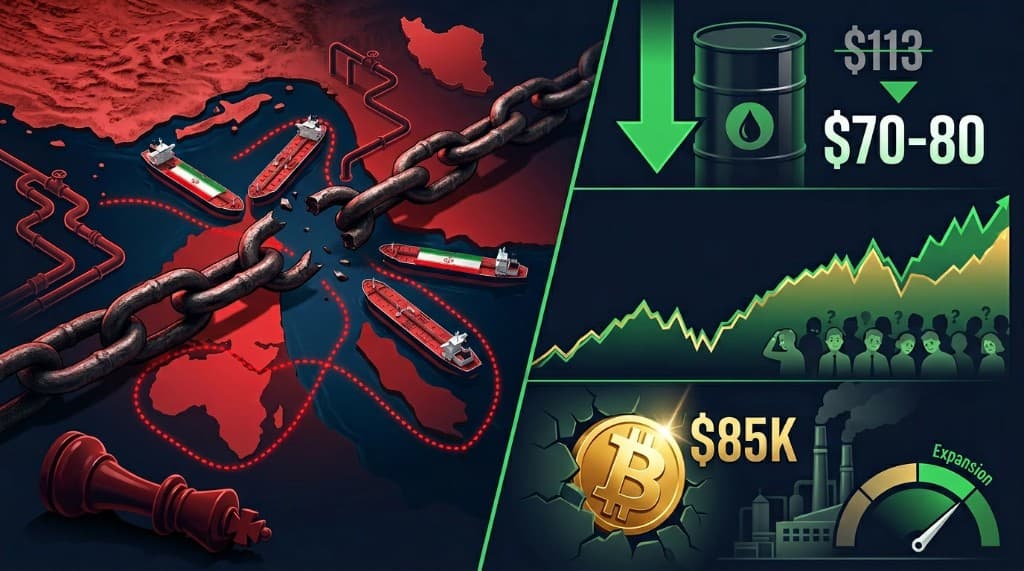
Hormuz Was Iran's Historic Mistake — Oil Heading to $70-80, Bitcoin Targets $100K, and the SP500 Rally Isn't Over
Cava delivers a strategic reversal on Iran: the Hormuz closure wasn't a power move — it was a historic blunder that boosted US oil revenues, strengthened the dollar, and permanently reduced Iran's strategic leverage. The regime survives on 250K barrels/day to China, but the damage is done. Oil is heading to $70-80 as OPEC manages supply carefully. The SP500 still has room to run — bearish sentiment is rising (contrarian bullish), and tech leads at levels not seen since 2000. And Bitcoin breaks the 4-year cycle myth: tied to industrial expansion, not halvings, with targets at $85K, then $100-125K.
Iran: Hormuz was the wrong move
Cava drops a bombshell reassessment. Closing the Strait of Hormuz wasn't a display of Iranian power — it was a historic strategic error.
Why it backfired
The closure was supposed to hurt the United States. Instead, it did the opposite:
Boosted US oil revenues. Higher prices benefited American producers directly.
Strengthened the dollar. Global uncertainty drove demand for dollar-denominated assets.
Exposed the strait's vulnerability. Other nations are now actively building alternative trade routes, permanently reducing Iran's strategic value as a chokepoint.
The real victims: Europe, Asia, and Africa — not the US. The countries that depended most on Hormuz transit are the ones scrambling for alternatives.
Iran's survival math
The regime can survive economically as long as it exports roughly 250,000 barrels per day at elevated prices. That's enough to cover civil servant salaries and sensitive political payments — like missile purchases from China.
This is why the Revolutionary Guard's provocations (attacks on UAE infrastructure, maintaining tensions) are strategic, not irrational. They need high oil prices to prevent internal revolt. Every attack that pushes Brent up by a few dollars buys the regime more time.
But here's the trap: the more they provoke, the more countries abandon Hormuz dependency. It's a strategy that works today but destroys their leverage tomorrow.
Oil: heading to $70-80
Despite OPEC raising production limits, Cava doesn't expect a flood of crude:
Supply will be managed carefully. OPEC members have no interest in crashing prices. With Brent currently at $108-113 due to the geopolitical premium, the post-crisis equilibrium target range is $70-80 — enough to sustain producers without choking demand.
Demand remains strong. The US economy is estimated to grow above 3% in Q2, which means demand won't collapse. Only a global recession would create oversupply, and that scenario isn't on the table.
The implication: oil's current elevated price is temporary. As the Iran situation resolves and OPEP manages the transition, oil settles into a lower, more stable range. Energy-related positions lose their geopolitical premium.
SP500: the rally has more room
Cava is still constructive on equities, and his reasoning is pure contrarian logic:
Bearish sentiment is growing. The number of bearish investors has increased — and when bears multiply, the market tends to go up. It's the classic Cava contrarian signal, but this time it works in the bullish direction.
Sentiment is NOT at extreme optimism. Unlike a few weeks ago when "everyone was bullish" (sell signal), the mood has shifted to cautious skepticism. That's fuel for continuation.
Tech leadership at historic levels. The technology sector's relative strength versus the SP500 is at levels not seen since 2000. If the Magnificent Seven ETF (MAGS) breaks through its resistance levels, the rally could accelerate sharply before any correction.
The key word: before. Cava sees more upside, but he's also flagging that when the correction comes after a parabolic tech run, it will be sharp.
Bitcoin: forget the 4-year cycle
Cava directly challenges one of crypto's most cherished narratives — the halving-driven 4-year cycle:
Bitcoin follows industrial activity, not halvings. The real driver is the industrial cycle (PMI), which is currently in expansion phase (above 50). As long as industrial activity expands, Bitcoin has tailwinds.
Key levels:
$79,500 — Critical support. As long as BTC holds above this level, the bullish case is intact.
$85,000 — Next target after breaking $80,000.
$100,000 – $125,000 — The path opens if $85K is cleared. These aren't predictions — they're the levels where Cava's technical system identifies reduced resistance.
This analysis is based on Cava's Tuesday briefing, May 5, 2026. For informational purposes only — not financial advice.
Explore the data
Check the latest congressional trades and active investment signals.