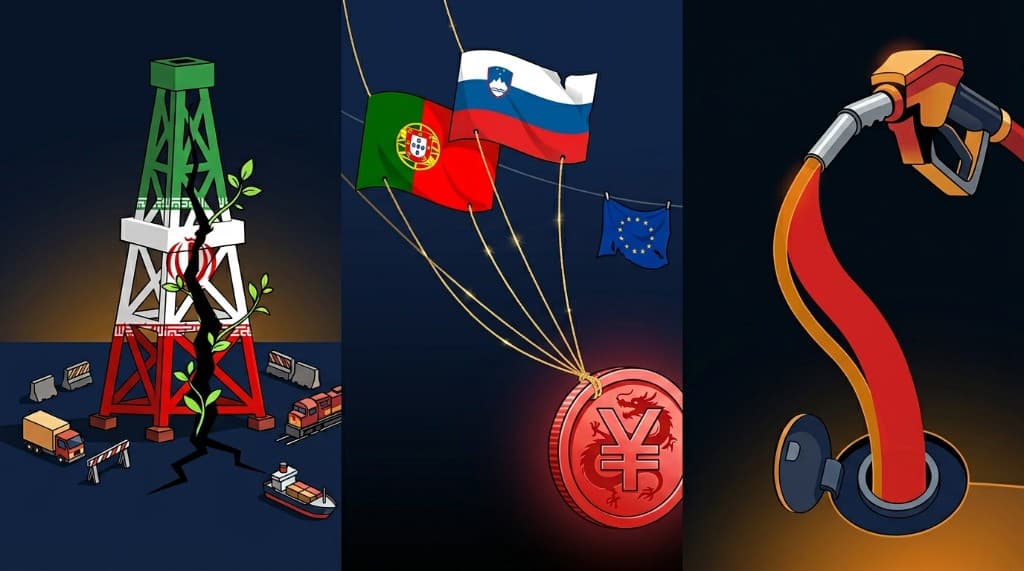
Iran's Oil Fields Won't Die — The Real Damage Is Financial. Plus: Why Are Portugal and Slovenia Borrowing in Chinese Yuan?
Cava dismantles three common narratives. First: the Hormuz blockade won't cause irreparable damage to Iran's oil fields — the real threat is financial, not physical. Iran's largest field (Khuzestan) survives even at zero production, and Iran is already circumventing the blockade via trucks, railways, and coastal ships. Second: Slovenia and Portugal are issuing sovereign debt in Chinese renminbi — cheaper than euros, but it signals China's expanding economic influence in Europe through lobbying and strategic investment. Third: taxes represent 48% of gasoline prices in OECD countries — nearly double the actual cost of crude oil.
Question 1: Will the Hormuz blockade destroy Iran's oil fields?
The narrative is simple: Trump blocks the Strait, Iran can't export, storage fills up, production stops, wells are permanently damaged, and Iran capitulates. Cava asks: is this actually true?
The historical precedents
Cava examines three moments when Iran's production dropped dramatically:
- COVID (2020) — Production fell but recovered. Infrastructure survived.
- 2016 sanctions — Similar pattern. Temporary damage, eventual recovery.
- 1951 — the real comparison — Production dropped to zero. Recovery only happened because a British Petroleum-led international consortium provided money and modern technology.
The 1951 precedent matters because Iran's infrastructure today is in worse shape than it was then. Decades of sanctions have prevented technology upgrades. Revenue has been diverted to defense and government budgets instead of maintenance. The situation resembles Venezuela's oil decline.
The field-by-field reality
Not all fields are equal:
Gas fields: Iran shares the world's largest gas field with Qatar. But Iran currently earns zero revenue from it — maritime extraction is offline due to lack of compressors (sanctions), and onshore infrastructure was damaged by Israeli strikes. The Hormuz blockade changes nothing here because revenue was already zero.
Oil fields near Iraq border: These could suffer serious damage if production hits zero, due to deteriorated infrastructure.
Khuzestan (the big one): Iran's largest oil field would not be permanently damaged even if production drops to zero. This is the critical detail most analysts miss.
Iran is already circumventing the blockade
The blockade isn't airtight. Iran is using "creative" methods:
- Trucks transporting oil overland
- Railways moving product to alternative ports
- Small coastal vessels operating close to shore, harder to intercept
The real conclusion
The threat isn't as severe as the narrative suggests. The damage is primarily financial and short-term, not physical and permanent.
Cava estimates the instability will last 4-5 more months — aligning with the financial runway we've discussed in previous analyses. Iran will suffer economically, but its oil infrastructure won't be destroyed. When a deal eventually comes, production can restart — slowly, expensively, but it can restart.
Question 2: Why are Portugal and Slovenia borrowing in Chinese yuan?
This is a story that flew under most investors' radar.
Both Slovenia and Portugal have issued long-term sovereign debt denominated in renminbi (Chinese yuan), not euros. This raises immediate questions about geopolitical alignment.
The economics
The interest rates are attractive:
- Renminbi debt: ~1.75-1.89%
- Euro debt: significantly higher
From a pure fiscal perspective, it makes sense — cheaper financing. But there's a catch: currency risk. If the renminbi appreciates against the euro over the life of the bond, the total cost increases. Both countries are essentially betting that the yuan won't strengthen dramatically.
The geopolitics
Cava's read is more cynical: this isn't just about cheaper rates. China has excess savings that need to go somewhere, and it strategically places capital in countries where it can build influence through lobbying and investment.
China already has significant presence in Portugal:
- Automotive sector
- Battery manufacturing
- Electricity infrastructure
By becoming a creditor of European governments, China gains political leverage. It's soft power through financial dependency — the same model it uses in Africa and Southeast Asia, now applied to the EU.
What this means
The dollar's position as global reserve currency isn't threatened by these small issuances. But it's a signal: China is quietly building financial influence in Europe, one bond at a time. As Cava noted in earlier analyses, the yuan can't replace the dollar (capital controls), but China doesn't need to replace it — it just needs to create enough dependencies to have leverage.
Question 3: How much of your gasoline bill is actually taxes?
Cava breaks down what consumers actually pay at the pump:
| Component | Share of price | |-----------|---------------| | Taxes | 48% average (OECD/G7) | | Crude oil cost | 33% | | Refining + distribution + margins | ~19% |
In France, UK, and Germany, taxes exceed 50% of the pump price.
The takeaway: taxes represent nearly double the actual cost of crude oil in what consumers pay. When politicians blame "oil companies" or "OPEC" for high gas prices, the data shows that governments take the largest cut.
This matters for the inflation debate: even if oil prices drop (which they will once a deal is reached), gasoline prices won't fall proportionally because the tax component is fixed. The relief consumers feel will be muted.
This analysis is based on Cava's commentary from April 30, 2026, broadcast from London. For informational purposes only — not financial advice.
Explore the data
Check the latest congressional trades and active investment signals.