Iran Can Pump Oil for 20 Years but Goes Broke in 4 Months — While China Crushes Its Own Consumers
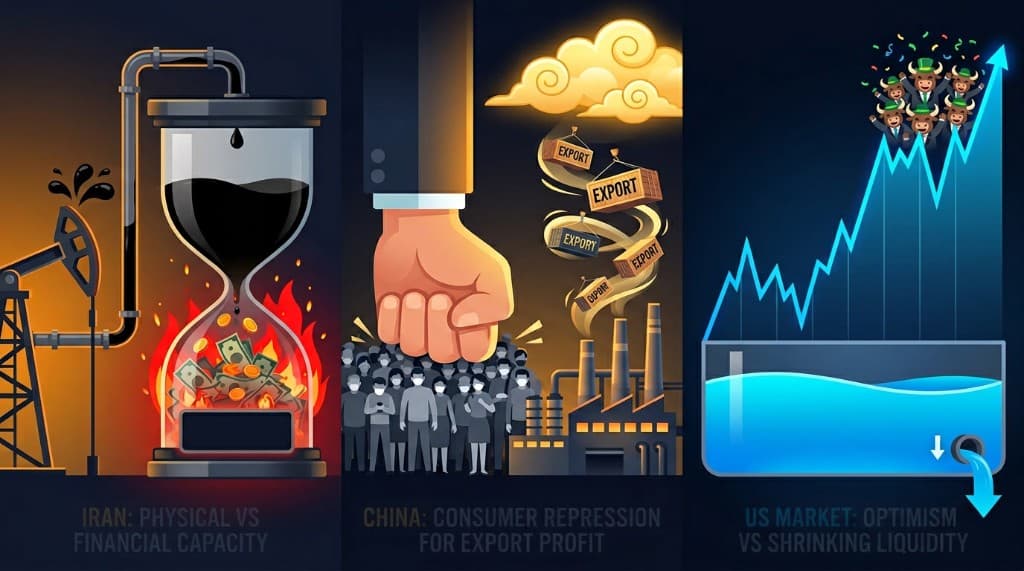
Cava delivers a triple-layered analysis. Iran's oil infrastructure can last 15-22 years, but its finances collapse in 3-4 months — creating a ticking time bomb for oil markets. Crude has broken above $104 and could reach $108, though inverted futures suggest the spike is temporary. Meanwhile, China's government actively suppresses private consumption to fuel exports, crushing workers and savers while the IMF watches passively. And in the US, extreme investor optimism collides with shrinking Fed liquidity — the setup for the correction we've been waiting for.
Iran: 20 years of oil, 4 months of money
This distinction is critical and most analysts miss it:
Physical capacity: Iran's oil fields and infrastructure can sustain production for 15-22 years. The wells aren't running dry.
Financial capacity: Iran's government can only finance operations for 3-4 months at current burn rates. War costs, sanctions, inflation at 60-70%, and the Revolutionary Guard siphoning revenues mean the money runs out long before the oil does.
This creates an asymmetric situation:
- Short-term (weeks): Iran is desperate. The Hormuz blockade and financial squeeze force them toward a deal. Oil stays elevated.
- Medium-term (months): Once a deal is struck, Iranian supply returns to market. Oil drops.
- Long-term (years): Iran has the physical reserves to be a major producer again — but only if it gets the financial breathing room to restart.
Oil at $104, heading to $108?
Cava notes crude has broken above $104 in an uptrend, with potential to reach $108. But here's the key detail: futures are inverted (backwardation).
What this means in plain terms:
- Backwardation = the current price is higher than future prices
- This tells you the market believes the current high price is temporary
- Traders expect supply to return (Iran deal, alternative routes) and prices to normalize
So oil is hot right now, but the market itself is pricing in that it won't stay this high. This reinforces our decision to sell OXY when we did.
US economy: strong data, dangerous optimism
Cava highlights the paradox again:
The economy is solid:
- Growth continues despite recession predictions
- Employment stable
- Consumer spending strong
But the setup is dangerous:
- Investors are extremely optimistic — the bullish consensus we flagged last video
- The Fed is showing signs of reducing liquidity — fewer injections, tighter conditions ahead
- When extreme optimism meets shrinking liquidity, you get a correction
This is the collision course we've been tracking:
- Everyone is bullish → contrarian warning
- Fed reducing liquidity → less fuel for the rally
- Iran deadline approaching → geopolitical catalyst
- Earnings "sell the news" risk → fundamental catalyst
Multiple forces converging toward the same outcome: a correction in the coming weeks.
China: the government vs its own people
This is perhaps the most important structural insight of the video. Cava explains how China's economic model deliberately suppresses its own citizens:
The mechanism
- Government restricts private consumption — through financial repression (low deposit rates), limited social safety nets, and controlled wages
- Excess production flows to exports — Chinese factories produce far more than Chinese consumers can buy
- Exports generate profits — but those profits flow to entrepreneurs and the government, not workers
- Workers save desperately — because there's no safety net, citizens save 30-40% of income in low-yield deposits
- Real estate collapse — the one asset class Chinese citizens relied on to build wealth has crashed, destroying household net worth
Who benefits?
- Chinese government: controls capital, collects export revenues, maintains power
- Chinese entrepreneurs: access to cheap labor and subsidized production
- Western consumers: cheap goods funded by Chinese worker exploitation
Who loses?
- Chinese workers: suppressed wages, no consumption, no wealth building
- Chinese savers: deposits earn below inflation, real estate destroyed
- Global competitors: can't compete with subsidized Chinese production
The IMF's failure
The IMF — the institution designed to correct exactly these kinds of global imbalances — does nothing meaningful. Cava's criticism is sharp: the IMF issues "soft recommendations" that China ignores because enforcing them would require confronting Chinese government interests. The result is that global trade imbalances persist, dollar dominance grows, and Chinese citizens bear the cost.
The storm clouds are gathering across multiple fronts. For investors, the key takeaways are clear: oil's spike is temporary (backwardation confirms it), China exposure carries structural risk, and the correction setup is strengthening with every signal aligning — bullish consensus, shrinking Fed liquidity, Iran deadline, and earnings season. Patience and cash are the most valuable assets right now.
This analysis is based on Cava's economic commentary from April 28, 2026. For informational purposes only — not financial advice.
Explore the data
Check the latest congressional trades and active investment signals.