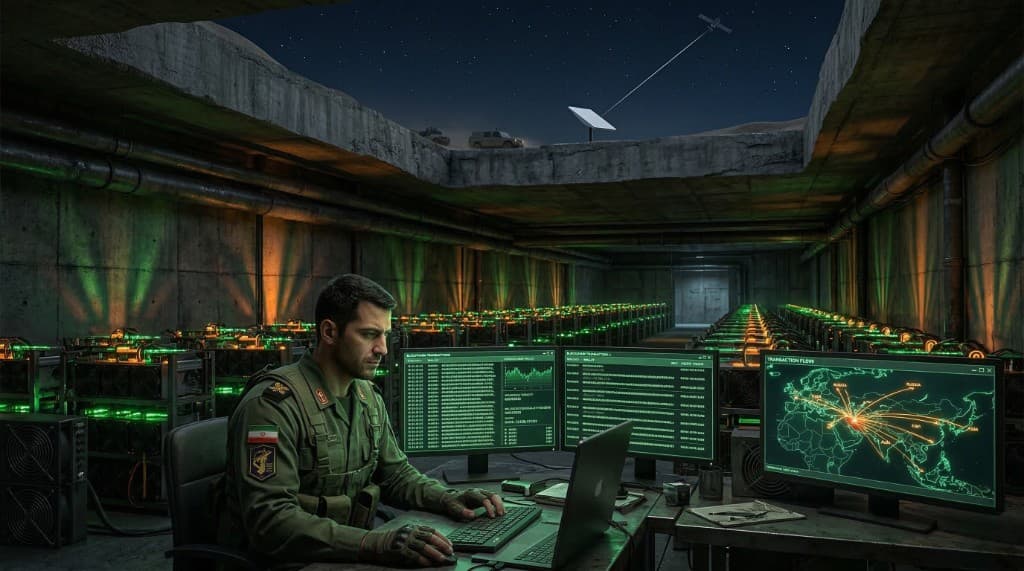
Iran's Shadow Crypto Empire: How the Revolutionary Guard Mines Bitcoin to Fund a War
Iran has built one of the world's most sophisticated crypto economies — not by choice, but by necessity. The Revolutionary Guard runs massive Bitcoin mining farms, operates its own exchange, and moves billions through crypto to evade sanctions. Even with 99% of internet connectivity destroyed, they kept transacting via satellite.
A crypto economy born from sanctions
Most countries adopt cryptocurrency gradually — through startups, ETFs, and regulatory frameworks. Iran's crypto economy was forged under pressure.
Decades of international sanctions have cut Iran off from the global financial system. No SWIFT access, no international bank transfers, no dollar-denominated trade. In response, Iran didn't just tolerate cryptocurrency — it built an entire parallel financial infrastructure around it.
The foundation: energy. Iran sits on some of the world's cheapest electricity, subsidized by its massive oil and natural gas reserves. Cheap energy is the single most important input for Bitcoin mining, and Iran has it in abundance.
The result is a mature crypto economy where:
- 95% of Bitcoin mining is illegal — carried out by ordinary citizens hiding mining rigs in basements, warehouses, and behind legitimate businesses
- The government officially discourages unauthorized mining while simultaneously running its own operations
- Cryptocurrency has become a primary mechanism for international trade that bypasses sanctioned banking channels
In most countries, crypto is an investment. In Iran, crypto is infrastructure — the financial plumbing that keeps an entire economy connected to the outside world.
The Revolutionary Guard's mining empire
While citizens mine in the shadows, the Islamic Revolutionary Guard Corps (IRGC) operates on an entirely different scale.
The Guard runs large, industrialized mining farms that dwarf civilian operations:
- Facilities are physically protected by military security, immune to the government crackdowns that target civilian miners
- The hardware is predominantly Chinese-manufactured ASICs — the same high-performance mining equipment used by the largest operations worldwide
- Before the current conflict, Iran's mining operations contributed a meaningful percentage of global Bitcoin hash rate
- Energy costs for Guard-operated farms are essentially zero, as they draw directly from state-controlled power infrastructure
This isn't a side project. The Revolutionary Guard treats Bitcoin mining as a strategic military asset — a way to generate hard currency that can't be frozen, seized, or sanctioned by Western governments.
The exchange that processes billions
Mining is only half the equation. The mined Bitcoin needs to be moved, converted, and deployed. For this, the Revolutionary Guard built its own infrastructure.
Iran has developed a major cryptocurrency exchange with a tiered access system. Regular Iranian citizens can trade on the platform, but the Guard maintains VIP-level access with capabilities far beyond what civilian users see:
- Direct transaction channels with Russia — facilitating arms purchases and oil trade settlements outside the dollar system
- Layered wallet structures designed to obscure the origin and destination of funds
- High-volume processing capable of handling the Guard's estimated $3 billion annual transaction volume
To put that in perspective: Iran's total crypto transaction volume is estimated at roughly $10 billion per year. The Revolutionary Guard controls approximately 30% of all cryptocurrency activity in the country — and that's the conservative estimate.
This exchange isn't a crude, makeshift tool. It's a sophisticated financial platform built specifically to operate in a sanctions environment, with the kind of operational security you'd expect from a military intelligence organization.
Israel's cyber counterstrike
The existence of Iran's crypto infrastructure didn't go unnoticed. In 2025, Israeli intelligence launched a major cyberattack against Iran's primary crypto exchange, gaining access to:
- Transaction records revealing the Guard's wallet addresses and fund flows
- Counterparty data showing who the Guard was transacting with internationally
- Operational patterns that could be used to track and potentially intercept future transfers
The hack was a significant intelligence coup. But the Guard adapted quickly:
- Funds were moved to new wallet addresses across multiple blockchains
- Transaction patterns were altered to avoid the signatures Israeli intelligence had identified
- New operational security protocols were implemented across the exchange
However, Israel countered with satellite-based tracking technology, following fund movements even after the Guard changed addresses. The crypto cat-and-mouse game between Israeli intelligence and the IRGC has become one of the most sophisticated cyber-financial conflicts in history.
Israel hacked the exchange. The Guard moved the money. Israel tracked it via satellite. The Guard switched to satellite transactions. It's a digital arms race where the battlefield is the blockchain.
When the internet goes dark, crypto survives
Perhaps the most remarkable detail from this conflict is what happened when Iran's internet connectivity was destroyed by 99% during the war.
For most digital activities, a 99% connectivity drop is a death sentence. No banking, no communication, no commerce. But the Revolutionary Guard had prepared for this scenario:
- Starlink satellite terminals — obtained despite US sanctions, likely through third-country intermediaries — allowed the Guard to maintain connectivity independent of Iran's terrestrial internet infrastructure
- Bitcoin transactions continued via satellite links, proving that cryptocurrency's fundamental value proposition — censorship-resistant, borderless transactions — works even under the most extreme conditions
- Mining operations with satellite connectivity could continue to both mine and broadcast transactions to the global Bitcoin network
This is a proof of concept that the broader crypto community has theorized about for years: Bitcoin works even when the state-level internet fails. Iran's Revolutionary Guard, of all actors, has provided the real-world demonstration.
What this means for Bitcoin's narrative
Iran's crypto economy, despite its controversial operators, reinforces several key aspects of Bitcoin's investment thesis:
Censorship resistance is real
When the most sanctioned military organization on Earth can transact via satellite during a war with 99% internet disruption, the "censorship-resistant money" thesis isn't theoretical — it's proven.
Nation-state adoption is accelerating
Iran isn't "adopting Bitcoin" in the way El Salvador did with a press conference. It's doing so out of strategic necessity, which is a far more durable form of adoption. Nations under pressure will increasingly turn to crypto infrastructure.
Hash rate is geopolitically distributed
Iran's contribution to global hash rate — even if reduced during the conflict — demonstrates that Bitcoin mining is distributed across geopolitical fault lines, making it resistant to any single nation's attempt to shut it down.
The $3 billion question
The Guard's annual crypto volume is significant, but it's a fraction of Bitcoin's daily trading volume globally. The market impact of Iranian military crypto activity is real but contained — it doesn't threaten Bitcoin's integrity, but it does complicate the regulatory narrative.
The uncomfortable reality
This story forces a difficult conversation. The same properties that make Bitcoin valuable to legitimate investors — decentralization, censorship resistance, borderless transfers — also make it valuable to sanctioned military organizations.
This isn't a flaw in Bitcoin. It's a feature of neutral, permissionless technology. The internet carries both educational content and propaganda. The banking system processes both legitimate commerce and money laundering. Bitcoin is no different — it's a tool whose moral character depends entirely on its user.
For investors, the practical implication is clear: regulatory scrutiny will increase, particularly around exchanges and on-ramp/off-ramp points. But the protocol itself — the mining, the blockchain, the peer-to-peer network — is beyond any single government's ability to control. Iran just proved that under the most extreme conditions imaginable.
What to watch
- Iran's hash rate recovery — post-conflict restoration of mining capacity will signal the Guard's operational status
- Blockchain forensics reports — firms like Chainalysis will likely publish analysis of Iranian transaction patterns
- Regulatory responses — Western governments may use Iran's crypto activity to justify stricter exchange regulations
- Starlink access controls — whether SpaceX tightens access in sanctioned regions affects future satellite-based crypto operations
- Basel III developments — Iran's use case paradoxically strengthens the argument for bringing Bitcoin inside the regulated banking system rather than leaving it in the shadows
This analysis is based on macroeconomic commentary by José Luis Cava (HOPLA Finance). CongressFlows synthesizes publicly available market analysis to help investors contextualize congressional trading data. This is not financial advice.
Explore the data
Check the latest congressional trades and active investment signals.