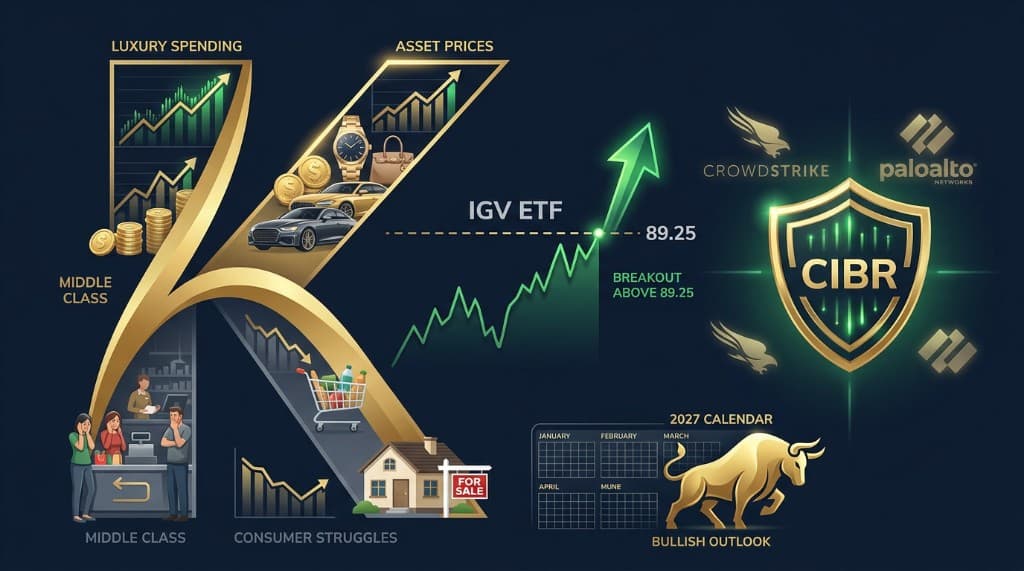
The K-Shaped Recovery, the IGV Breakout, and Why 2027 Could Be One of the Best Years in the Market
The US economy is recovering in a K-shape: the wealthy are spending more, the middle class is under pressure. That divergence has direct implications for Fed policy. Meanwhile, the software sector just cleared a critical resistance level. Tech companies have stopped selling Bitcoin. And the HOPLA team sees 2027 as potentially one of the best years in the market — with cybersecurity as the specific sector to own.
A recovery that is splitting in two
The US economic data presents an apparent paradox: consumer spending is holding up while economic anxiety remains high. The resolution is that both can be true simultaneously when the recovery is shaped like a K.
A Federal Reserve Bank of New York study confirms the dynamic: high-income consumers are increasing their retail spending. Consumers earning between $40,000 and $100,000 annually are under genuine financial stress. The aggregate numbers look acceptable because the top of the K is large enough to mask the bottom.
This bifurcation matters for monetary policy in a specific way. The Federal Reserve's dual mandate — price stability and maximum employment — is primarily calibrated to the broad economy, not its upper segment. When a significant portion of middle-income households are struggling, the argument for maintaining high interest rates becomes difficult to sustain politically and economically, regardless of what headline spending data shows.
The inflation path and the Warsh transition
Current inflation expectations are anchored in the upper range, with recent readings at approximately 2.62%. Actual inflation is running between 2.5% and 3%, closer to the top of that range. This is above the Fed's 2% target but not dramatically so.
The HOPLA team's projection for 2027: inflation stabilizes at 2%, which unlocks the conditions for Kevin Warsh — expected to assume the Fed chairmanship — to implement at least two rate cuts during the year.
A detail worth noting on the actual structure of monetary policy: the HOPLA analysis places the real control of liquidity with the Treasury Secretary rather than the Fed Chair. The Treasury determines when to issue short-term versus long-term debt, when to rebuild or drain its general account, and how to sequence refinancing operations. The Fed Chair executes policy within constraints largely set by the Treasury's decisions. This is not a new arrangement, but it is underappreciated in most market commentary.
The combined effect of Warsh rate cuts and Treasury liquidity management in 2027 creates the conditions for what the HOPLA team describes as potentially one of the best years for equity investors in recent memory.
The software sector signal: IGV breaks resistance
One of the more technically specific observations in the HOPLA analysis concerns the IGV ETF — a fund that invests in the software sector, with major holdings in cybersecurity companies (CrowdStrike, Palo Alto Networks, Fortinet) and large-cap technology (Microsoft, Oracle, Palantir).
The software sector had been facing pressure from a liquidity and solvency crisis in smaller companies — a hangover from the rate environment of 2022-2024. That pressure has cleared. IGV has broken above a key resistance level at 89.25, which the HOPLA team identifies as a structural inflection point for the sector.
When a sector ETF breaks a resistance level that has contained it for an extended period, it typically signals that the underlying fundamental or financial condition that created the resistance has been resolved. In this case: the liquidity stress in software companies is over.
The Bitcoin-tech correlation signal
A secondary observation connects the software recovery to crypto markets in a non-obvious way.
During the period of financial stress, many technology companies held Bitcoin on their balance sheets and were periodically forced to sell it to raise liquidity. This selling pressure was a consistent headwind for Bitcoin prices — corporate treasury liquidations arriving at unpredictable times.
That selling has stopped. The companies that were previously using Bitcoin as a liquidity reserve no longer need to. The result has been a simultaneous move upward in Bitcoin, in the broader tech sector, and in IGV. When the source of a structural headwind is removed, the assets affected by it tend to recover together.
The cybersecurity opportunity: CIBR
Within the software sector, the HOPLA team highlights cybersecurity as the specific subsector offering the most compelling risk-reward profile. The logic is structural: AI increases the attack surface for cyber threats, every company deploying AI infrastructure becomes a larger and more complex target, and the demand for cybersecurity tools scales with AI adoption rather than against it.
The recommended vehicle is CIBR — a cybersecurity ETF with exact European market equivalents. The ETF provides exposure to the sector's major players (CrowdStrike, Palo Alto, Fortinet) without the single-stock risk of choosing among them.
CIBR represents the middle path that the HOPLA team describes as strategically appropriate for most investors: more volatility and upside potential than a broad market ETF like the SP500, but with the diversification benefit of owning a sector rather than an individual company.
2026-2027: the outlook
The HOPLA projection is explicitly bullish for both years, with an important caveat:
- Earnings growth this year: approximately 25%
- Earnings growth in 2027: expected to moderate to 14-15%, which is still strong and above historical averages
- Rate environment by 2027: lower, with at least two cuts, supporting valuations
- The caveat: a correction or significant "scare" is possible along the way, particularly in the transition period before Warsh's rate cuts materialize
The characterization of 2027 as potentially one of the best years for investors is consistent with the Cava analysis of the broader liquidity cycle: lower rates, continued AI investment, resolving geopolitical risks, and a tech sector that has cleared its structural headwinds.
The direction is clear. The path will have turbulence.
Analysis based on a HOPLA Finance video by José Luis Cava, published May 22, 2026. For informational purposes only — not financial advice.
Explore the data
Check the latest congressional trades and active investment signals.