Markets Ignore the Panic — Why Wall Street Isn't Afraid and What It Means for Your Portfolio
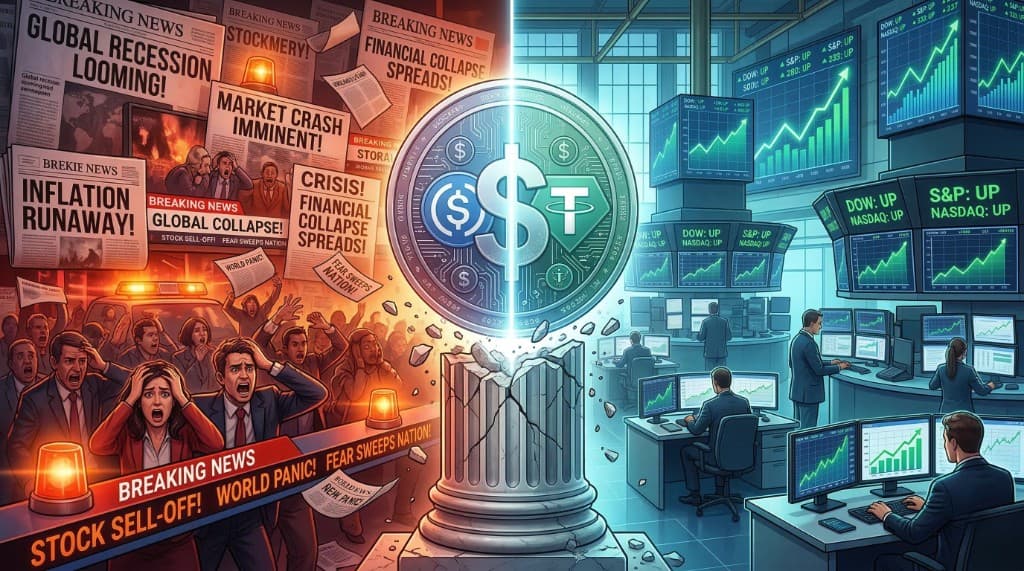
Media screams crisis. Markets shrug. The SP500 sits near highs while the public drowns in fear. Meanwhile, stablecoins quietly threaten to drain bank deposits, energy and fertilizer sectors surge, and the post-1971 debt machine keeps running on borrowed time.
The fear is real — but the market doesn't care
Turn on the news and you'll hear about energy crises, geopolitical catastrophe, and imminent market collapse. Open your brokerage app and you'll see the SP500 and Nasdaq trading near all-time highs.
This disconnect isn't an accident. It's information.
Fear indicators tell a split story:
- General public sentiment: extreme fear — surveys, social media, and retail positioning all reflect panic
- Financial market indicators: volatility indices remain stable, credit spreads are contained, and institutional flows are steady
- The exception: oil volatility, which remains elevated for the reasons we covered in our previous analysis — speculative "paper oil" trading, not physical shortages
The public is terrified. The market is calm. When those two diverge this sharply, historically, it's the market that's right.
This pattern has repeated throughout history. Markets bottomed during peak fear in March 2020, late 2022, and October 2023. The crowd panics at the bottom and celebrates at the top. The current setup, where fear is extreme but prices are resilient, suggests we're closer to a launchpad than a cliff.
The system that can't stop borrowing
To understand why markets behave this way, you need to understand the machine underneath them.
Since 1971 — when Nixon detached the dollar from gold — total debt has grown faster than GDP in every major economy. This isn't a bug; it's the operating system. The entire financial architecture requires perpetual debt expansion to function:
- Governments borrow to spend
- Central banks create money to buy government debt
- Banks lend against assets inflated by that money creation
- Asset prices rise, creating collateral for more borrowing
This cycle has one requirement: it can never stop. The moment debt growth stalls, asset prices deflate, collateral collapses, and the system seizes up — exactly what almost happened in March 2020 and was prevented by the largest monetary intervention in history.
The implication for investors is profound: in a system designed for perpetual monetary expansion, holding cash is a guaranteed loss over time. Not because cash goes to zero, but because everything priced in cash goes up. This is why Cava consistently recommends owning productive assets — SP500, real estate, gold, Bitcoin — rather than sitting in deposits.
Bitcoin: from speculation to strategic reserve
Bitcoin's role in this environment continues to evolve. The narrative has shifted decisively from "speculative asset" to "digital scarcity in an age of infinite money printing":
- Institutional accumulation continues despite price volatility — large holders are adding, not selling
- Bitcoin serves as a direct hedge against the monetary degradation described above
- With a fixed supply of 21 million coins, Bitcoin is mathematically the opposite of the debt-based system
As we noted in our analysis of Bitcoin's institutional era, the introduction of volatility indices and advancing regulatory clarity are creating the infrastructure for broader adoption. Bitcoin doesn't need to replace the dollar — it just needs to be a better savings vehicle than a bank deposit, and the math increasingly supports that case.
Stablecoins: the silent bank run
Perhaps the most underappreciated risk in financial markets right now isn't geopolitics or oil — it's stablecoins eating bank deposits.
Here's the mechanism:
- Regulatory clarity for stablecoins is advancing rapidly, making them legitimate financial instruments
- Stablecoins offer dollar-denominated digital accounts without the friction, fees, or limitations of traditional banking
- As adoption grows, deposits flow from banks to stablecoin issuers — who hold those dollars in Treasuries, not in the fractional reserve system
The impact on banks is potentially devastating:
- Deposit outflows reduce the base that banks lend against
- Regional banks are most vulnerable — they lack the scale and diversification to absorb deposit losses
- Financial sector ETFs are already showing weakness relative to the broader market
Banks survived the internet. Banks survived fintech. But stablecoins don't compete with banks — they replace the need for deposits entirely. That's a different kind of threat.
This isn't a future risk — it's happening now. Watch XLF (Financial Select Sector SPDR) and KRE (Regional Banking ETF) for signs of accelerating weakness. If stablecoin legislation passes in its current form, the deposit drain could accelerate sharply.
Energy and fertilizers: the trades that are working
While the media debates whether the sky is falling, two sectors are quietly delivering:
Energy
- Geopolitical tensions around Hormuz continue to support elevated oil prices
- US energy producers benefit from both higher prices and increased LNG export volumes
- The sector trades at reasonable valuations relative to cash flow generation
Fertilizers
- Supply disruption from the Hormuz closure has created a genuine supply squeeze
- India and Southeast Asia are scrambling for alternative supply at higher prices
- Fertilizer producers with non-Gulf supply chains are seeing margin expansion
Both sectors benefit from the same geopolitical dynamic: the Hormuz situation creates real supply constraints that translate into real earnings. Unlike "paper oil" volatility, the earnings impact on energy and fertilizer companies is tangible and shows up in quarterly results.
Key ETFs to watch:
- XLE (Energy Select Sector) — broad US energy exposure
- MOS, NTR, CF — major fertilizer producers
- XOP (Oil & Gas Exploration) — more leveraged to oil prices
What "complacency" actually means
The word "complacency" carries negative connotations — it implies markets are asleep at the wheel. But there's another interpretation: markets are correctly assessing that the situation is managed.
Consider:
- The Hormuz closure was premeditated, not chaotic
- Central banks have tools and willingness to intervene
- Corporate earnings remain solid
- Employment data hasn't deteriorated
Markets aren't ignoring risks — they're pricing them as contained. The SP500 near highs isn't complacency; it's a verdict that the geopolitical disruption is a redistribution of resources (LNG, fertilizers, agricultural exports), not a destruction of wealth.
That said, "contained" doesn't mean "risk-free." The scenarios to watch for are:
- Stablecoin legislation triggering visible deposit outflows from regional banks
- Oil above $100 sustained for more than 2-3 weeks, which would change the inflation calculus
- Bond yields breaking higher — as we discussed previously, flat bonds mean no inflation panic. If that changes, everything changes.
The portfolio playbook
Based on the current environment, the positioning that emerges from this analysis:
- SP500 (VOO/SPY) — Broad exposure to resilient economy. Risk: correction if geopolitics escalate
- Gold — Monetary degradation hedge, safe haven. Risk: already elevated, limited upside if tensions ease
- Bitcoin — Digital scarcity, institutional adoption. Risk: volatility, regulatory uncertainty
- Energy ETFs (XLE) — Geopolitical supply premium + earnings. Risk: oil price reversal if Hormuz reopens
- Fertilizer stocks — Real supply squeeze, rising margins. Risk: normalization if trade routes reopen
- Avoid: Regional banks — Stablecoin deposit drain risk. Could rally if legislation stalls
In a world where the money printer never stops, the only losing move is holding nothing. The debate isn't whether to invest — it's where.
This analysis is based on macroeconomic commentary by José Luis Cava (HOPLA Finance). CongressFlows synthesizes publicly available market analysis to help investors contextualize congressional trading data. This is not financial advice.
Explore the data
Check the latest congressional trades and active investment signals.