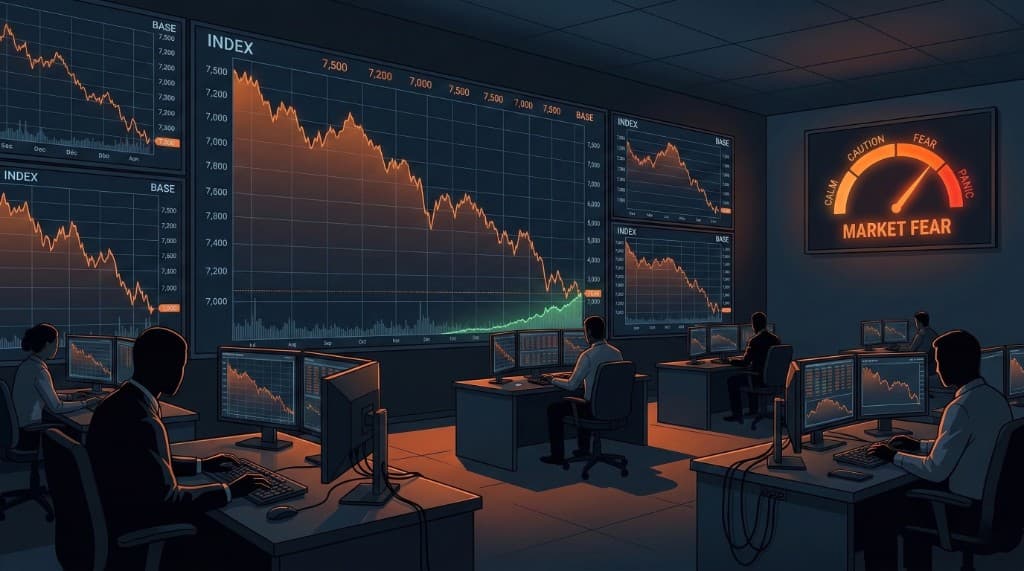
The Market Floor Is Close — Institutions Are Already Buying
Geopolitical risks are stable, private credit is showing signs of recovery, and institutional investors are quietly accumulating. The bottom isn't confirmed yet — but the smart money isn't waiting for confirmation.
Risk check: all indicators holding
The key risk indicators we've been tracking continue to hold within their manageable ranges:
- Crude oil: stable between $70 and $80, confirming that geopolitical tensions persist but aren't escalating. As noted in our previous analysis, a break below $70 would signal de-escalation; above $80 would raise inflation concerns. Neither has happened
- US 10-year Treasury yield: settled around 4.11-4.12%, comfortably below the 4.30% stress threshold. Bond markets remain defensive but not distressed
- Overall assessment: the risk environment is stable, not improving or deteriorating. This is precisely the kind of plateau that precedes directional moves
The fact that none of these indicators have worsened despite ongoing geopolitical conflict is itself a signal. Markets have digested the risk and are now focused on what comes next.
Private credit: the crack is stabilizing
One of the most encouraging developments is the stabilization of the US private credit market — the area we identified as the most vulnerable point in the financial system.
Two concrete signs of improvement:
- Blackstone fund redemptions have increased — counterintuitively, this is a positive signal. Orderly redemptions mean the system is processing stress normally, not freezing up. A credit crisis becomes dangerous when investors can't redeem, not when they choose to
- The software sector ETF is recovering, suggesting that the forced selling wave that triggered the credit stress is losing momentum
When the weakest link in the chain stops getting weaker, the whole structure gets stronger. Private credit is stabilizing — that's the signal that matters most right now.
This doesn't mean the danger has passed entirely. The HYG support level at 80 remains the critical threshold. But the trajectory has shifted from deteriorating to stabilizing, which changes the risk-reward calculation significantly.
Liquidity: contracted but backstopped
Liquidity conditions have tightened through two channels:
- The dollar index has risen, which mechanically reduces global dollar liquidity. A stronger dollar means fewer dollars circulating outside the US, creating headwinds for international assets and commodities
- Bond market volatility has increased, which forces market makers to widen spreads and reduce balance sheet exposure, effectively removing liquidity from the system
However, the critical backstop remains in place: the Federal Reserve. As discussed in our analysis of the Fed's impossible balancing act, the structural need to finance government deficits means the Fed will intervene if liquidity contraction threatens market functioning.
The current tightening is uncomfortable but not dangerous — it's the type of temporary squeeze that creates buying opportunities for those with patience and cash.
Sentiment: fear is high, but not at capitulation
The CNN Fear & Greed Index shows elevated fear, and the VIX remains above normal levels. But critically, neither has reached extreme readings:
- VIX remains below 30 — the threshold that separates "nervous" from "panicking"
- Sentiment surveys show fear but not the kind of wholesale capitulation that marks definitive bottoms
- The market has not yet experienced a true flush — the high-volume, indiscriminate selling that clears out the last weak hands
What this tells us: the bottom is near, but not yet confirmed. We are in the late stages of a correction, where most of the damage has been done but the final capitulation hasn't occurred. This is the hardest phase for investors — the temptation to sell is strongest just before the recovery begins.
The tell: institutions are buying into the fear
The most revealing signal isn't coming from any index or indicator — it's coming from institutional behavior. A pattern has emerged that seasoned traders call a "false break to the downside":
- The market drops below a key support level, triggering stop-losses and fear-driven selling
- Retail investors panic and sell
- Institutional buyers absorb the supply at discounted prices
- The market quickly recovers back above the support level, trapping shorts and leaving panic sellers behind
Institutions don't buy because the coast is clear. They buy because the price is right. War, fear, volatility — none of it matters when the discount is large enough.
This pattern has been observed in recent sessions: brief dips below key levels followed by swift recoveries on institutional volume. It's the footprint of large, conviction-driven buyers accumulating positions while headlines keep retail investors on the sidelines.
The message is clear: smart money is positioning for the recovery before it starts. They don't wait for confirmation — they create it.
The setup: close to the floor, but patience still required
Putting today's analysis together:
- Geopolitical risk: stable, not escalating → no new negative catalyst
- Private credit: stabilizing → the worst-case scenario is receding
- Liquidity: tight but backstopped → the Fed won't let it break
- Sentiment: fearful but not capitulated → the final flush may still come
- Institutional behavior: accumulating → the smart money sees value
The most likely scenario is a small additional decline — perhaps testing one more support level — followed by a confirmed bottom and the beginning of a recovery. The market may fall another 3-5% before the capitulation signal arrives, but the bulk of the correction is behind us.
For investors: this is not the time to panic sell. Nor is it the time to go all-in. It's the time to prepare shopping lists and be ready to act when the VIX spikes above 30 or when a high-volume reversal day confirms the floor.
What to watch
- VIX above 30: the capitulation threshold — when it spikes through and reverses, the bottom is likely in
- High-volume reversal days: a sharp intraday decline followed by a strong close on heavy volume is the classic floor signal
- HYG holding above 80: continued stabilization in credit markets is essential for the recovery thesis
- Fed commentary: any hint of emergency liquidity measures would accelerate the floor formation
- Institutional flow data: continued accumulation during dips confirms the "false break" pattern
This analysis is based on macroeconomic commentary by José Luis Cava (HOPLA Finance). CongressFlows synthesizes publicly available market analysis to help investors contextualize congressional trading data. This is not financial advice.
Explore the data
Check the latest congressional trades and active investment signals.