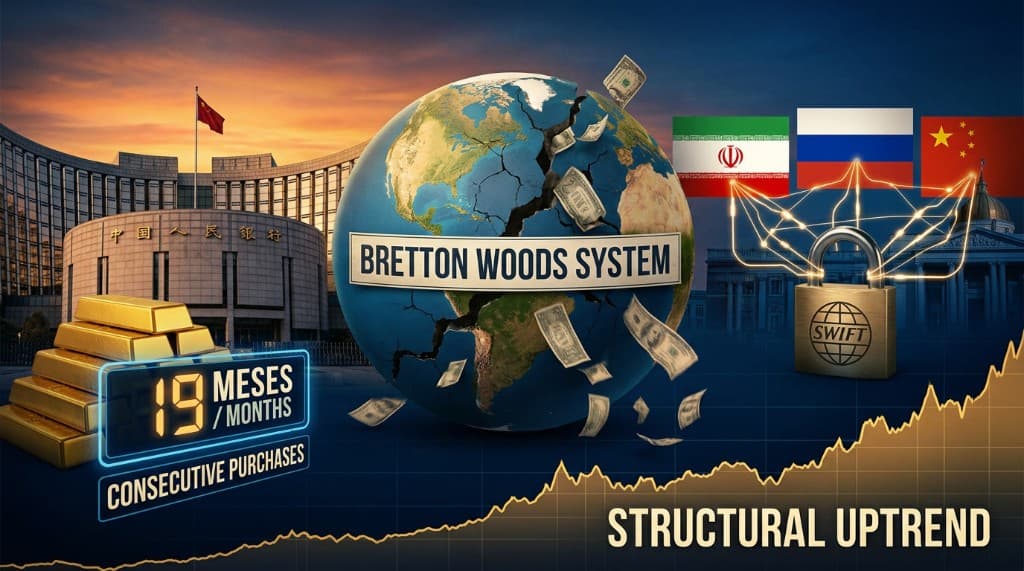
The End of Bretton Woods 2.0: How Sanctions Failures Are Building a New Monetary Order — and Why Gold Wins
José Luis Cava offers a sweeping analysis of the structural transformation underway in the global monetary system. US sanctions against Iran, Russia, and North Korea have not failed — they achieved realistic partial objectives. But they have accelerated a process that may prove more consequential than any of those targets: the construction of alternative financial architectures that reduce dependence on the dollar. China is the principal architect and beneficiary. And gold — which China has been buying for 19 consecutive months — is the asset that benefits most from this structural shift.
The nuanced truth about US sanctions
The Wall Street Journal and much of mainstream financial commentary have declared US sanctions a failure. The full truth, according to Cava, is more precise and more instructive.
The objective of completely subjugating a regime like Iran's through economic pressure alone was never realistic. A government that controls its population's information environment and security apparatus can absorb enormous economic pain before it falls. Measuring sanctions by that impossible standard produces the wrong conclusion.
Measured against realistic objectives, US sanctions have been considerably more successful. They delayed Iran's nuclear program and increased its cost substantially. Iranian nuclear material now sits in caves with partially destroyed tunnel access, significantly limiting operational capability. The United States maintained leverage over the Strait of Hormuz and, through it, over the oil price dynamics that constrain China's strategic freedom of action. These are not total victories — but they are real ones.
The more consequential question is not whether sanctions achieved their stated objectives but what they accelerated as a side effect.
China as the third actor — and the principal beneficiary
The dynamic that has fundamentally altered the strategic calculus is China's role as what Cava calls the decisive third actor. By providing Iran, Russia, and other sanctioned economies with a financial buffer — access to alternative payment systems, currency swap arrangements, and commodity trade denominated in yuan rather than dollars — China has dramatically reduced the effectiveness of US economic pressure while extracting significant strategic benefit.
The mechanism is elegant: China purchases Russian and Iranian oil at significant discounts from the market price, as these suppliers have no alternative buyers who can absorb large volumes outside the dollar system. The payments are made in yuan. The sanctioned countries, with limited alternatives, are effectively forced to use Chinese currency and Chinese financial infrastructure. Over time, more of their international trade, reserves, and financial planning migrates toward yuan-denominated systems.
This is not charity from Beijing. It is a deliberate strategy to expand the operational reach of the yuan and reduce the dollar's structural dominance in global commodity markets — the foundation of what economists call "dollar hegemony." Each barrel of Russian oil sold for yuan is a data point in a decades-long project to make the renminbi a credible reserve currency alternative.
The infrastructure of independence
The more significant structural development is the construction of alternative financial systems by countries that fear US sanctions — whether currently sanctioned or not. Iran has developed commodity-linked payment clearing systems through its stock exchange, with Russian and Chinese technical cooperation. These systems allow international trade to be settled outside the SWIFT network, the primary mechanism through which US financial sanctions are transmitted.
This is no longer a marginal phenomenon. As Cava frames it, we are witnessing a metamorphosis of the post-war monetary architecture built at Bretton Woods — the system that assigned the dollar its central role as the world's reserve currency, trade settlement mechanism, and store of value for central bank reserves. That system is not collapsing. It is eroding from the edges, as more transactions, more reserves, and more bilateral trade agreements find pathways that do not require dollar intermediation.
The United States still controls the dominant system. But the monopoly is weakening — and the direction is clear.
Trump's tipping point: oil down, stocks up
The practical consequence of the exhaustion of US strategic leverage — particularly the depletion of the Strategic Petroleum Reserve to 1983 lows — is that Trump's preferred policy outcome has become explicit: oil prices down, stock markets up. These two objectives are not unrelated; lower energy prices reduce inflationary pressure, allowing the Fed more room for accommodation and supporting equity valuations.
The Iran preaccord, in this reading, is not primarily a geopolitical achievement but an economic management tool. The Iranian regime, facing internal pressure from a population that has endured years of economic hardship while the nuclear program consumed resources, has also reached a cost-benefit inflection point. Voices within Iran are increasingly arguing that reconstruction and economic relief should take priority over the nuclear deterrent. Both sides arrived at the negotiating table with similar structural motivations.
Gold: 19 consecutive months and the structural case
The asset that most directly benefits from the long-term erosion of the dollar-centric monetary system is gold.
China's central bank has been acquiring gold for 19 consecutive months — a purchasing consistency not seen since 2015. The scale is significant: 10 tonnes in May, 8 tonnes in April. Importantly, these purchases have continued even through periods of gold price weakness, indicating that China is using price dips as acquisition opportunities rather than reacting to momentum. This is strategic accumulation, not trading.
The logic is straightforward: gold is the asset that no country can sanction, freeze, or block. It requires no counterparty. It cannot be excluded from a payment system. For central banks that have watched Russia's dollar reserves frozen overnight in response to the Ukraine invasion — a precedent that shocked the entire emerging market world — gold's properties as an uncensorable reserve asset have become suddenly concrete rather than theoretical.
The structural argument for gold does not require inflation or geopolitical crisis to persist at elevated levels. It requires only the continuation of the trend: more countries, more central banks, and more sovereign wealth funds deciding that an uncensorable reserve asset deserves a larger share of their portfolio than it received in the Bretton Woods era. That trend, driven by the structural incentives Cava describes, appears durable for decades.
Short-term price corrections remain possible — if geopolitical tensions ease temporarily, some of the risk premium embedded in gold prices will deflate. But the directional case for gold, built on a structural shift in the global monetary system, points consistently upward over the medium and long term.
The investor's position
The transformation Cava describes is not a short-term trading thesis. It is a multi-decade structural shift whose early stages are visible now. For long-term investors, the implications are:
Physical gold and gold ETFs, as the primary beneficiary of de-dollarization and alternative reserve accumulation, deserve a stable allocation in a long-term portfolio — not as a speculative position but as structural insurance against the monetary erosion that the emerging system represents.
Companies and assets that benefit from the continued functioning of the existing dollar system — technology, AI infrastructure, the US equity market — remain attractive because the transition is gradual, not abrupt. The dollar does not lose its reserve status overnight. But investors who hold only dollar-denominated assets and no real asset exposure are implicitly betting that Bretton Woods 2.0 persists indefinitely. The evidence suggests it will not.
Analysis based on José Luis Cava video published June 22, 2026. For informational purposes only — not financial advice.
Explore the data
Check the latest congressional trades and active investment signals.