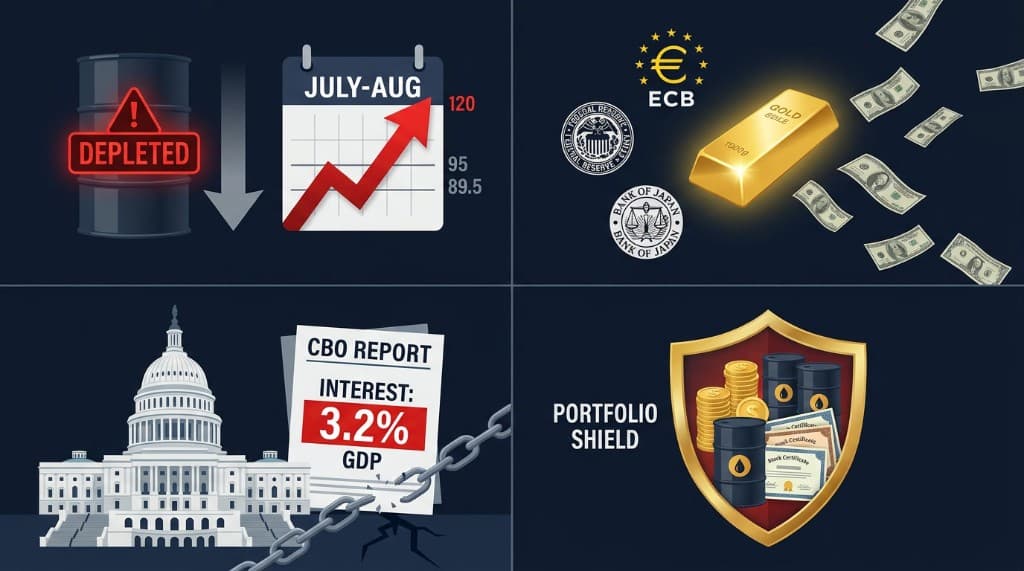
Oil Reserves Are at Historic Lows, Central Banks Are Buying Gold, and the US Budget Office Says the System Is Broken
Everyone is bearish on oil. Jet fuel is down 30%. The IEA is warning of future shortages and nobody is listening. Strategic reserves are below seasonal minimums with only 100 days of global consumption remaining. Cava sees a price spike toward late July or early August, with Brent technical levels at 89.5 support and 95 breakout toward 120. Meanwhile, central banks are buying gold while selling US bonds — and the Congressional Budget Office confirms that at 3.2% of GDP in interest payments, the system is technically insolvent.
Excessive complacency in oil markets
The consensus view on oil is firmly bearish. A recent tweet from Javier Blas — one of the most followed commodity journalists — highlighted a 30% decline in jet fuel prices as evidence of sustained energy market weakness. The market is priced for continued softness, and the prevailing narrative is that supply is ample and demand is fading.
Cava's read is the opposite. Extreme bearish consensus on a commodity is not a signal to join the consensus — it is a signal to examine whether the consensus is ignoring the supply fundamentals.
What the bearish sentiment is ignoring: the International Energy Agency has issued explicit warnings about future supply shortages. The IEA does not issue shortage warnings casually. When the agency that tracks global supply and demand in real time signals future scarcity while the market is focused on near-term price declines, the divergence is worth examining.
The mechanism that has suppressed prices while fundamentals deteriorated: governments — primarily the United States — have been selling their strategic petroleum reserves at scale. This created an artificial supply cushion that absorbed what Cava describes as the largest oil supply shock in history without allowing prices to reflect the underlying scarcity.
The reserve problem: 100 days of consumption remaining
The numbers on strategic reserves are stark.
Global strategic petroleum reserves are currently below seasonal minimums — the lowest level for this time of year in the data series. The estimated remaining global strategic reserve covers approximately 100 days of consumption.
The quality dimension adds complexity. The US Strategic Petroleum Reserve contains primarily light sweet crude — a specific grade of oil that affects refined products (gasoline, diesel) differently than the heavier crude from Gulf states. The mass sales of this grade have had downstream effects on distillate prices that are distinct from what headline Brent prices show.
The logical trajectory: strategic reserve depletion cannot continue indefinitely. At some point, the cushion is gone, and the oil market must price supply and demand without the artificial government backstop. When that repricing happens, it happens quickly.
Cava's timeline: late July or early August.
The technical roadmap for Brent
Two levels define the technical structure:
89.5 — support. This is the floor that Cava identifies as the zone where buying interest is concentrated and where a meaningful correction would find demand. A test of this level that holds confirms the base before the next move.
95 — the breakout signal. A decisive close above 95 on the Brent spot price would be the technical confirmation of a move toward the next resistance level. At that point, the target becomes 120.
The macro cascade from an oil price move to this level is direct:
- Higher oil → higher energy costs across the economy
- Higher energy costs → higher inflation
- Higher inflation → upward pressure on bond yields (the compressed spring releases)
- Higher bond yields → lower equity valuations
- Lower equity valuations → stock market correction
This sequence is not hypothetical. It is the same mechanism that drove the 2022 correction and that the HOPLA team identified as the primary risk in their bond market analysis from earlier this week.
Central banks are buying gold — and selling the bonds they used to hold
The gold market tells a different story than the one in financial headlines.
Standard financial planning advice for high-net-worth individuals recommends approximately 5% of total wealth in gold as a portfolio hedge. Current data shows that most large fortunes hold less than 3% — meaning there is significant latent buying demand from wealthy individuals who are underallocated relative to their own advisors' recommendations. That demand creates a structural floor under gold prices.
More significant: in 2025, central banks dramatically increased their gold purchases while simultaneously selling US Treasury bonds and reducing their holdings of fiat currency reserves.
The implication is direct and uncomfortable. The institutions that create and manage the global monetary system — the central banks themselves — are expressing through their own balance sheets that they do not trust the long-term value of the instruments they issue and hold. When the people who run the system are quietly moving out of it, that is information.
Central bank gold buying does not happen for speculative reasons. It happens because reserve managers are making multi-decade hedging decisions. The decision to sell US Treasuries while buying gold is a statement about the expected relative value of those assets over a 20-30 year horizon.
The Congressional Budget Office confirms: the system is broken
Cava closes with data from the Congressional Budget Office — the nonpartisan agency that produces official US fiscal projections.
The numbers for 2026: interest payments on the federal debt will represent 3.2% of GDP. In absolute terms, this exceeds the entire US defense budget. The projection for a decade from now: 3.6% of GDP, assuming no recession, no new crisis, and no significant policy change.
The condition that makes this trajectory unsustainable is the primary deficit. A primary deficit means that even before paying interest, the government is spending more than it collects in tax revenue. This forces continuous new debt issuance to cover both the deficit and the interest on the existing debt. Each new bond issued increases the interest burden. The cycle is self-compounding.
The mathematical definition of insolvency is when the interest rate on your debt exceeds your growth rate and you run a primary deficit simultaneously. Cava's conclusion, based on these CBO projections: the system is, under these metrics, technically broken.
This does not mean imminent collapse. It means that the resolution — whether through inflation, currency debasement, financial repression, or some combination — is a matter of when and how, not whether. For investors, the translation is the same one that underpins every element of the long-term portfolio thesis: own assets, not cash. Own gold. Own productive companies. The debt problem does not go away. It gets inflated away — and those holding the right assets benefit from the inflation.
Analysis based on a José Luis Cava video published May 29, 2026. For informational purposes only — not financial advice.
Explore the data
Check the latest congressional trades and active investment signals.