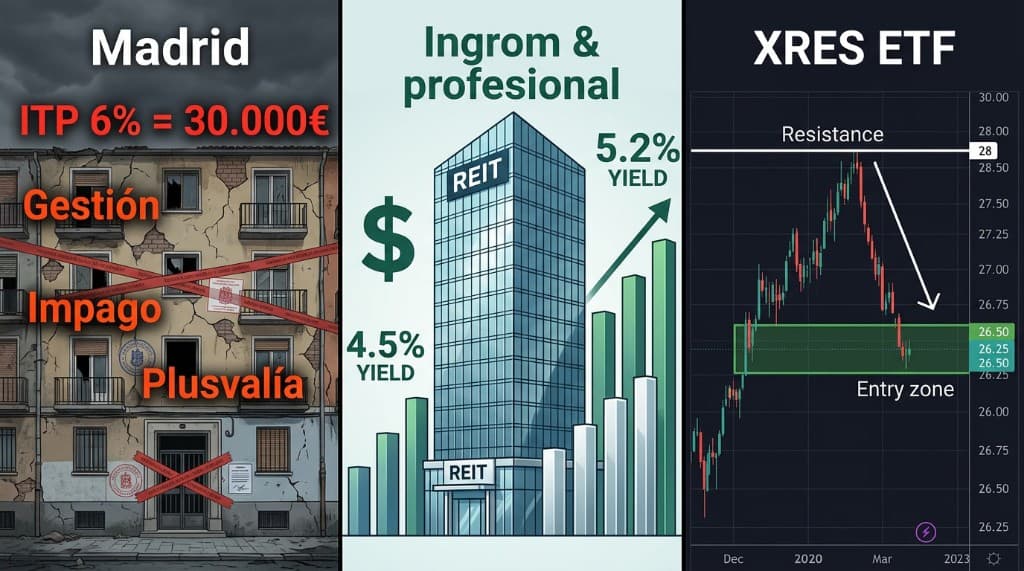
Why REITs Beat Physical Property: Cava's Framework for Selecting Real Estate Investment Trusts
In the latest installment of his bullish series, José Luis Cava makes the case for REITs (Real Estate Investment Trusts) over direct property ownership — and provides a precise selection framework for identifying which ones to buy and when. The criteria combine a minimum dividend yield threshold (10-year Treasury rate plus BBB corporate spread), technical trend analysis, and valuation discipline. For European investors, the XRES accumulation ETF offers tax-efficient exposure to the US REIT market, with an ideal entry zone at 26.25-26.50 after the current resistance at 28 resolves.
The case against physical real estate
The Spanish instinct toward property ownership as the foundation of personal wealth is deeply cultural — and, according to Cava, increasingly misaligned with financial reality. The numbers illustrate why.
A two-bedroom apartment in a mid-range Madrid neighborhood costs approximately €500,000. Before a euro of rent is collected, the buyer pays the Impuesto sobre Transmisiones Patrimoniales (ITP) — a transfer tax running to approximately 6%, adding €30,000 to the upfront cost. At the point of eventual sale, the municipal plusvalía tax — levied on the increase in land value — adds another layer of friction. None of this accounts for maintenance costs, property management, and the risks that make Spanish landlords acutely uncomfortable: non-payment and squatting, both of which require lengthy and expensive legal processes to resolve.
The result is an investment that requires a very large initial capital commitment, generates ongoing management burden and legal risk, and is subject to multiple layers of taxation at both entry and exit.
The REIT alternative
A Real Estate Investment Trust solves each of these problems structurally. The investor buys shares in a company that owns and manages a diversified portfolio of properties professionally. The company distributes approximately 100% of its profits as dividends to shareholders, as required by the REIT structure. The investor receives income without managing tenants, coordinating repairs, or navigating legal proceedings.
The advantages extend beyond operational simplicity. REITs offer protection against monetary degradation through two mechanisms: rental income is typically indexed to inflation, so cash flows grow as prices rise; and the underlying property values — which trend upward over time in productive markets — are eventually reflected in the company's market capitalization. The investor captures both the income stream and the asset appreciation, with full liquidity to sell at any moment.
Cava's geographic preference is the United States, where economic growth is more dynamic and inflation — while requiring management — has historically supported asset value appreciation more consistently than in stagnant European economies.
Selection criteria: how to filter the universe
The REIT universe is large and varied. Cava applies three filters before considering any position:
Dividend yield threshold. The minimum acceptable yield is calculated as the 10-year US Treasury rate plus the BBB corporate bond spread. At current market rates — approximately 4.6% on the 10-year plus 0.9% for BBB corporate spread — this sets the minimum bar at roughly 5%. This calculation ensures that the REIT pays meaningfully more than risk-free alternatives after accounting for the additional credit and market risk of equity ownership.
Technical trend. The REIT must show a strong uptrend on both weekly and monthly charts. This filter eliminates candidates that meet the yield criteria but are in secular decline — a trap for income investors who focus only on dividend yield without examining the underlying price trajectory.
Valuation discipline. The price-to-earnings ratio should be in line with the S&P 500 forward PER, generally between 21 and 24 times. REITs trading at extreme premiums to the broad market may have strong fundamentals but offer insufficient margin of safety for new entries.
Portfolio role: REITs sit in a hybrid position between fixed income and equities, providing income stability more characteristic of bonds while offering the capital appreciation potential of stocks. This combination reduces overall portfolio volatility without sacrificing long-term return.
Specific opportunities: wait for the pullback
Cava emphasizes a discipline that applies to every asset class: never buy at resistance. The correct entry is always after a pullback to a defined support level, where risk-reward is favorable.
First REIT — data centers and commercial properties. This selection carries a 4.10% dividend yield and combines exposure to the structural growth in data center demand (driven by AI infrastructure buildout) with established commercial real estate income. The entry zone following a pullback from current levels is the 207.5 to 209 range.
Federal Realty Investment Trust (FRT). FRT is a well-established REIT with a strong track record of dividend growth, focused on premium retail and mixed-use properties in high-barrier coastal US markets. Current dividend yield is 3.63%. The entry point Cava identifies is a pullback to 119.25, with an upside target toward 128 once the position is established.
XRES: the European investor's vehicle
For investors based in Europe who cannot easily access US-listed REITs directly, the XRES ETF provides a practical alternative. Several features make it particularly suitable:
Accumulation structure. XRES does not distribute dividends — it reinvests them internally. This defers all tax liability to the moment of sale, allowing the full compound growth of the dividend stream to work without annual tax friction. For investors in high tax jurisdictions, this structural advantage can be meaningful over long holding periods.
Low fees. The management cost is among the lowest available for the sector, preserving more of the return for the investor.
Current positioning. XRES is currently trading at resistance near 28. Cava's recommendation is to wait: the ideal entry zone after a pullback from this resistance is between 26.25 and 26.50. At that level, the risk-reward ratio becomes favorable and the entry aligns with technical support.
The broader portfolio logic
REITs occupy a role in a diversified portfolio that few other asset classes can fill: they provide regular income that grows with inflation, meaningful exposure to long-term asset appreciation, professional management, and full liquidity — all without the capital concentration, operational risk, and tax complexity of direct property ownership. For investors building wealth over time, the choice between buying a Madrid apartment and buying shares in a professionally managed portfolio of US data centers and premium retail properties is not as obvious as cultural instinct suggests.
Analysis based on José Luis Cava video published June 18, 2026. For informational purposes only — not financial advice.
Explore the data
Check the latest congressional trades and active investment signals.