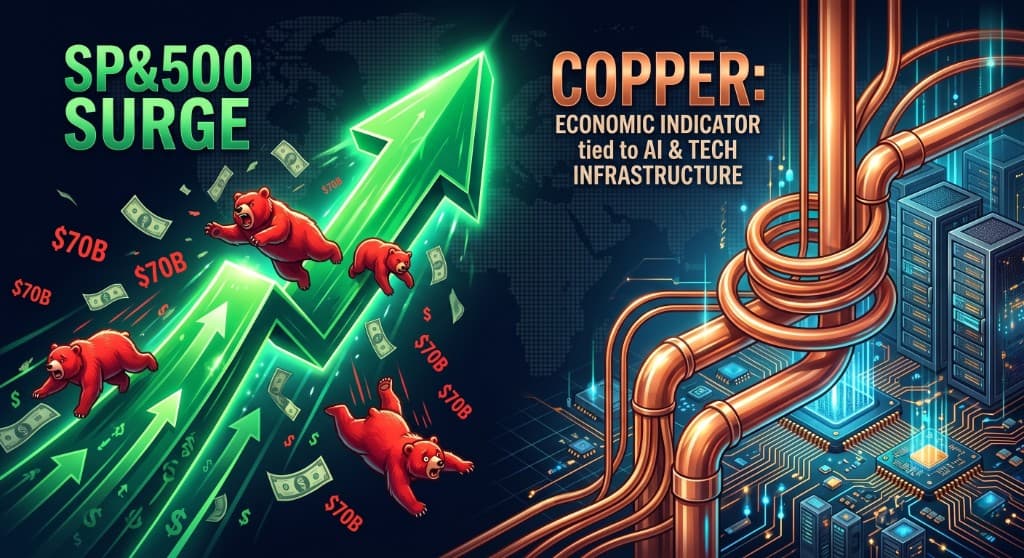
SP500 Surges on $70B Short Squeeze — And There's More Coming. Copper Confirms: The Economy Is Accelerating, Not Collapsing
The SP500 didn't rally because the economy suddenly improved. It rallied because bears were forced to cover $70 billion in short positions while trend-following CTAs pile in. And there's still more buying to come. Meanwhile, copper — the metal with a PhD in economics — bottomed in mid-March and is surging, confirming what the bears refuse to accept: global growth is accelerating. Sentiment remains stubbornly bearish, which paradoxically supports the rally.
The $70 billion short squeeze
The recent SP500 surge wasn't driven by a breakthrough in earnings or a sudden geopolitical resolution. It was driven by mechanics:
- Short sellers capitulating: As the SP500 pushed through resistance levels, traders who had bet against the market were forced to buy back their positions to limit losses. This forced buying accelerated the rally.
- CTA systematic buying: Commodity Trading Advisors — systematic, trend-following funds — flipped from short to long as momentum signals turned positive. Their algorithms buy when trends confirm, regardless of narrative.
The result: an estimated $70 billion in forced and systematic buying. And here's the key — Cava estimates there's still significant CTA buying left in the pipeline over the coming days.
When the market rises not because of optimism but because bears are being squeezed, the move is powerful but fragile. It feeds on itself until the forced buying exhausts.
This is textbook Cava. In his system, understanding who is positioned and how matters more than the news. Right now, the shorts are being destroyed, and the trend-followers are amplifying the move.
Bears are still bearish — and that's bullish
Here's the paradox: despite the SP500 and Nasdaq hitting new highs, individual investor sentiment remains stubbornly bearish.
- Surveys show elevated bearishness, comparable to previous market lows
- Social media narratives remain overwhelmingly negative
- Hedge funds have reduced equity exposure
From Cava's contrarian framework, this is actually supportive of further upside. Markets top when everyone is euphoric — not when half the crowd is still convinced the sky is falling. The persistent fear acts as fuel: every bearish investor who eventually capitulates becomes a buyer.
But — and this connects to yesterday's warning — Cava also noted that "everyone is becoming bullish." So we're in a transition zone: retail remains fearful, but institutional and systematic flows have turned decisively bullish. When retail finally follows, that's the exhaustion signal.
Copper: the economy's truth serum
While sentiment debates rage, copper is telling a different story entirely.
Copper prices bottomed in mid-March 2026 — exactly when media outlets were publishing their most apocalyptic forecasts about the Iran conflict destroying the global economy. Since then:
- Copper has staged a strong upward trend
- The COPX ETF (copper miners) has rebounded sharply
- The pattern is unmistakable: industrial demand is accelerating
Why does copper matter? Because copper goes into everything: construction, electronics, EVs, power grids, data centers, AI infrastructure. Unlike gold (which rises on fear), copper rises on real economic activity. It doesn't care about narratives — it responds to actual orders from actual factories.
Copper bottoming while media screamed recession is the clearest signal that the bears were wrong about the economy.
The economic backdrop (Cava's HOPLA analysis)
Cava published a detailed economic review that provides the fundamental support for these market moves:
Inflation: easing, not surging
- Energy prices (Brent, natural gas) have stabilized below recent highs
- 1-year inflation expectations: ~3%
- 5-year inflation expectations: ~2.6%
- The feared inflationary spiral from oil prices hasn't materialized
Labor market: stable
- Unemployment slightly decreasing
- Solid wage growth continues
- Private consumption remains the engine of US economic growth
- Military spending adds an additional fiscal stimulus layer
Economic growth: solid 2%
Despite volatile GDP estimates and pessimistic headlines, the US economy is growing at approximately 2%. Not spectacular, but far from the recession that bears have been predicting for months.
Credit markets: improving
- High-yield and corporate bond risk premiums have declined
- No contagion from software sector insolvency concerns
- Credit conditions are actually improving, not deteriorating
This is the fundamental floor under the market. Short squeezes and CTA flows provide the mechanics, but the economy provides the foundation.
What this means for positioning
Two timeframes, two strategies:
Short-term (days to weeks): The $70B CTA buying wave supports continued upside. Don't fight it. If you're in, stay in. This is not the moment to sell quality positions.
Medium-term (months): The contrarian warning still holds. When the remaining bears capitulate and retail sentiment finally turns bullish, the exhaustion phase begins. Iran reconstruction costs, potential Fed balance sheet reduction, and stretched valuations will eventually create the correction.
The play: Hold quality positions. Don't add at these levels. Keep cash ready. Let the CTA buying wave run its course. When sentiment finally flips from "still fearful" to "universally euphoric" — that's the signal to shift fully defensive.
Copper is telling us the economy is fine. The short squeeze is telling us the bears were wrong. But being right about the economy doesn't mean being right about buying stocks at all-time highs. Timing matters — and patience pays.
This analysis is based on Cava's market commentary from April 17, 2026, and his HOPLA economic review. For informational purposes only — not financial advice.
Explore the data
Check the latest congressional trades and active investment signals.