Why the SP500 Bull Case Is Still Intact: Liquidity, AI, and the Gold Signal Nobody Watches
José Luis Cava lays out his most complete technical and macro case for why the SP500 bull market that started in 2008 is still running. Two drivers dominate: the global liquidity cycle and the AI productivity revolution. The price target is 8,000 to 8,200 points. But the most important idea in the video is not the target — it is the specific signal that would tell you when to actually exit. It is not a market crash. It is what gold does at the same time.
The machine has been running since 2008
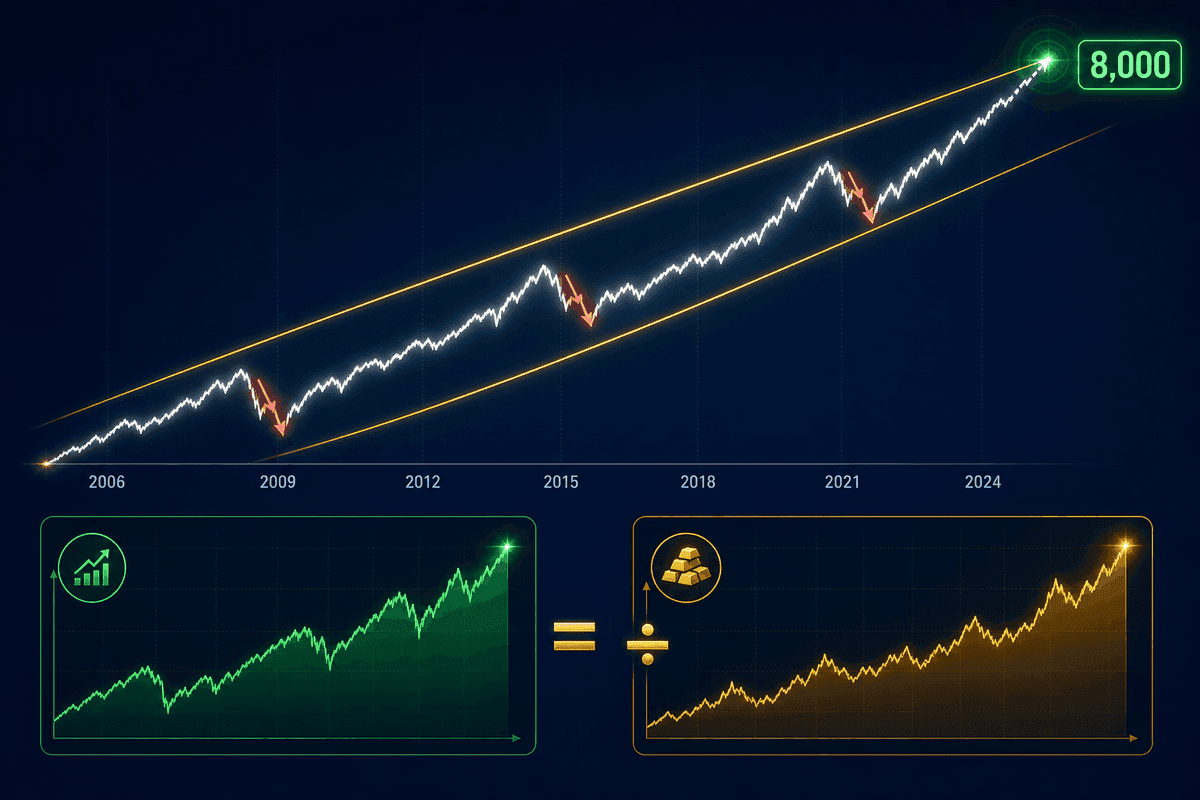
On a logarithmic weekly chart stretching back 18 years, the SP500 has multiplied its value nearly ninefold. The channel that contains this move — a rising trendline drawn through the major lows of 2008, 2020, 2022, and the April 2025 tariff shock — is one of the most consistent structures in modern market history.
José Luis Cava's latest analysis is a systematic explanation of why this channel is likely to continue, what the next price targets are, and — critically — what specific conditions would signal that it is genuinely over.
Two forces driving everything
Since 2008, two factors have dominated market behavior above all others.
The global liquidity cycle. Central banks discovered after the financial crisis that they could stabilize — and then inflate — asset prices through coordinated liquidity injections. Every major crash since 2008 has been met with the same tool: expand the balance sheet, lower rates, inject credit. The result is a structural floor under equities that institutional investors have learned to trust. The 10% corrections are not danger signals. They are buying opportunities.
The AI productivity revolution. Markets do not wait for economic data to confirm what they already believe is coming. The SP500 is pricing in the efficiency gains that artificial intelligence will deliver to the real economy — lower costs, higher margins, faster product cycles. This is not speculation about technology; it is the market's estimate of corporate earnings power over the next decade.
With both forces running simultaneously and liquidity still growing — albeit more slowly than in 2023 and 2024 — Cava's base case is a continuation of the bull channel toward 8,000 points initially, with 8,200 as the extended target.
Why central banks cause recessions
One of the more important reframings in Cava's analysis: recessions are not caused by businesses failing. They are caused by central banks restricting liquidity.
The 2008 crisis was not, at its core, a solvency crisis. It was a liquidity crisis — solvent companies with real assets and real revenues went bankrupt because credit disappeared overnight. When Bernanke's Fed and other central banks injected coordinated liquidity, the market recovered. The cause and the cure were both monetary.
2020 was different in origin — an exogenous shock, not a financial imbalance — but the mechanism was the same: panic compressed liquidity, massive fiscal and monetary stimulus restored it, and markets recovered faster than almost anyone predicted.
The implication for investors: the key variable to monitor is not GDP, unemployment, or earnings revisions. It is the direction of global liquidity. As long as liquidity is expanding — or even holding stable — the structural case for equities remains intact.
The exit signal most investors get wrong
This is the most practically important idea in the video.
A common mistake: interpreting any significant market decline as a signal to exit equities entirely and move to cash. This is wrong — and it is expensive, because recoveries from corrections are typically sharp and fast.
The correct signal, according to Cava, is not a falling SP500. It is a simultaneous fall in both the SP500 and gold.
In normal corrections, gold goes up while equities fall. Investors rotate to safety. This is exactly what happened in April 2025 during the tariff shock: stocks fell, gold hit all-time highs. That is not a liquidity crisis — it is fear. Institutions use those moments to buy equities at better prices.
The dangerous signal is when both fall together. That only happens when institutional investors — the "strong hands" — need cash urgently and sell whatever is most liquid. Stocks and gold are the two deepest, most liquid markets in the world. When both are falling simultaneously, it means liquidity is being withdrawn from the system by force, not by choice.
That is when Cava says to exit: reduce positions, hold cash, wait for the cycle to turn.
This happened in the first week of March 2020 (briefly, before the intervention) and in the autumn of 2008. These are rare events. They are not every correction.
Current reading (May 2026): gold at all-time highs, SP500 recovering from April lows. The exact opposite of the exit signal. The message is to stay invested and accumulate on pullbacks.
The Gold/SP500 ratio: where to put the money
When both gold and equities are in uptrends — as they broadly are now — the question becomes which one to overweight. Cava's tool is the ratio between the SP500 and the gold price, analyzed against a 200-week simple moving average.
The historical logic is clear:
- Between 2001 and 2012, the ratio was below its 200-week average for most of the period. Gold dramatically outperformed equities during those years.
- When the ratio breaks above key resistance — Cava identifies the 0.1590 level as the critical threshold — the SP500 accelerates relative to gold, and equities become the preferred allocation.
The practical strategy: use the ratio to tilt exposure toward whichever asset has the stronger relative momentum, rather than holding a fixed allocation regardless of market conditions.
How to implement this in a European portfolio
Cava adds exposure to this thesis through the SPYL ETF — an SP500 tracker he selects for three specific reasons: high liquidity, low fees, and euro denomination. That last point matters for European investors who would otherwise face currency conversion costs or exchange rate risk when holding dollar-denominated SP500 products.
The tactical framework:
- Stay invested while the SP500/gold ratio holds and liquidity remains abundant
- Use 10%+ pullbacks within the channel to accumulate
- Exit only when the gold-and-SP500-simultaneous-fall signal appears — and not before
Analysis based on a video by José Luis Cava from HOPLA Finance, published May 14, 2026. For informational purposes only — not financial advice.
Explore the data
Check the latest congressional trades and active investment signals.