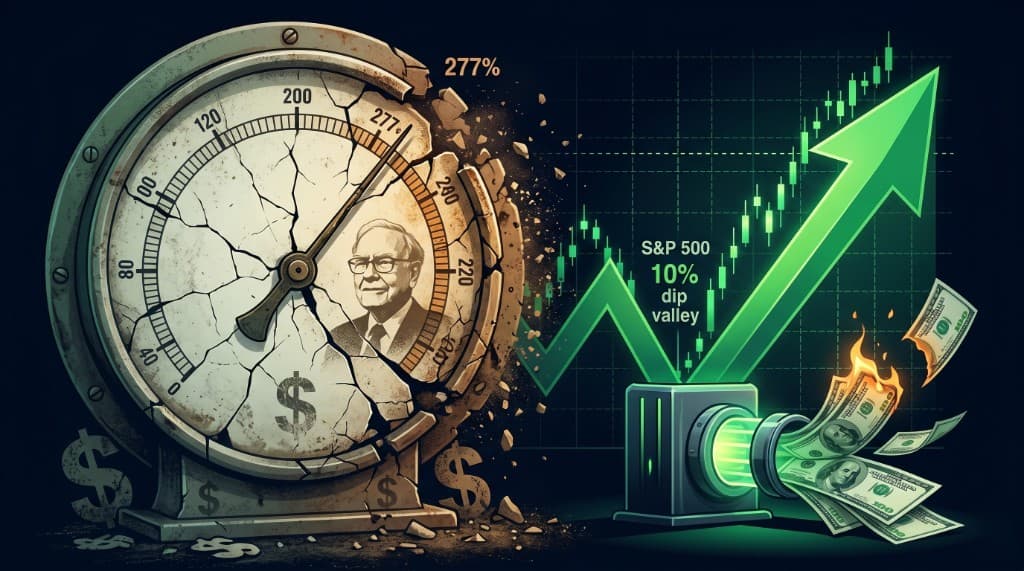
Stop Waiting for a Crash — Buy the SP500 After 10% Drops. The Buffett Indicator at 277% Means Nothing Anymore
Cava dismantles two common beliefs: that you should buy the SP500 at new highs, and that the Buffett Indicator at a record 277% means a crash is coming. The data shows that buying after 10%+ drops delivers far better returns than buying at highs. And the Buffett Indicator — once Buffett's favorite metric — is structurally broken in a world of monetary degradation, global revenue streams, and infinite QE. The real driver of the SP500 isn't earnings growth — it's the purchasing power of the dollar shrinking every year.
Don't buy at highs — buy after 10% drops
The SP500 just hit new all-time highs. Your instinct says: "I'm missing out, I need to get in." Cava says: stop.
The data is clear:
- Buying the SP500 immediately after a new high yields returns that are statistically similar to buying on any random day
- The real alpha comes from buying after drops of 10% or more — these are the moments that compound wealth over time
- The market always recovers. The question isn't if but when you buy during the recovery
This aligns perfectly with our current strategy. We're sitting on ~1,790 euros in cash, waiting for exactly this kind of opportunity. The CTAs and short-squeeze mechanics drove the SP500 to new highs last week, but mechanical buying isn't the same as fundamental strength. When the mechanics exhaust and the market pulls back 10%+, that's our entry.
The best returns don't come from chasing new highs. They come from having cash ready when everyone else is panicking.
The Buffett Indicator is dead
The Buffett Indicator — total US stock market capitalization divided by GDP — just hit 277%. That's the highest reading in history. Traditionally, anything above 100% signals overvaluation. At 277%, the bears are screaming that a catastrophic crash is imminent.
Cava's response: the indicator is structurally obsolete.
Here's why:
1. The economy has fundamentally changed since 2001
When Buffett popularized this metric, the US economy was predominantly domestic. Today, S&P 500 companies generate over 40% of their revenue internationally. Their market cap reflects global earnings, but the denominator (US GDP) only measures domestic output. The ratio is mathematically inflated by design.
2. Monetary degradation breaks the model
Since 2008, central banks have printed trillions of dollars. The SP500 isn't rising because companies are that much more valuable in real terms — it's rising because the dollar is worth less every year. When you divide an inflated numerator (market cap in devalued dollars) by a denominator that grows more slowly (GDP), the ratio explodes upward. It's not overvaluation — it's currency devaluation.
3. The Fed changed the rules permanently
Quantitative easing, zero interest rates, and now structural fiscal deficits mean that the monetary base is permanently larger. The old relationship between market cap and GDP assumed a stable monetary environment. That environment hasn't existed since 2008.
4. SP500 composition has shifted
Tech companies with near-zero marginal costs and massive scalability dominate the index. Their market caps are justifiably higher relative to the GDP they "generate" because their business models are fundamentally different from the industrial companies that dominated when Buffett created the metric.
A metric designed for a domestic, industrial, gold-standard-adjacent economy tells you nothing about a globalized, digital, QE-driven market. The Buffett Indicator at 277% isn't a sell signal — it's a broken thermometer.
Monetary degradation: the real engine
This is the core of Cava's thesis and it's worth repeating: the SP500 rises primarily because the dollar loses purchasing power.
Every year, the Fed and Treasury create more dollars through deficits, debt issuance, and monetary expansion. Those dollars flow into financial assets. Stock prices go up not because companies are necessarily better, but because the unit of measurement (the dollar) is shrinking.
This is why:
- The SP500 has gone up over every 20-year period in history
- Buying dips works — because the trend is structurally upward due to monetary debasement
- Holding cash for too long destroys wealth — but holding cash temporarily to buy dips is optimal
2026-2027 outlook
Cava remains bullish on the medium-term outlook despite short-term caution:
- Private consumption remains strong (healthy labor market, solid wages)
- Public spending continues to increase (military expenditure, infrastructure)
- These two engines will drive growth through 2026 and into 2027
The risk isn't a crash — it's a correction. And corrections are buying opportunities, not reasons to sell quality positions.
This analysis is based on Cava's market commentary from April 21, 2026. For informational purposes only — not financial advice.
Explore the data
Check the latest congressional trades and active investment signals.