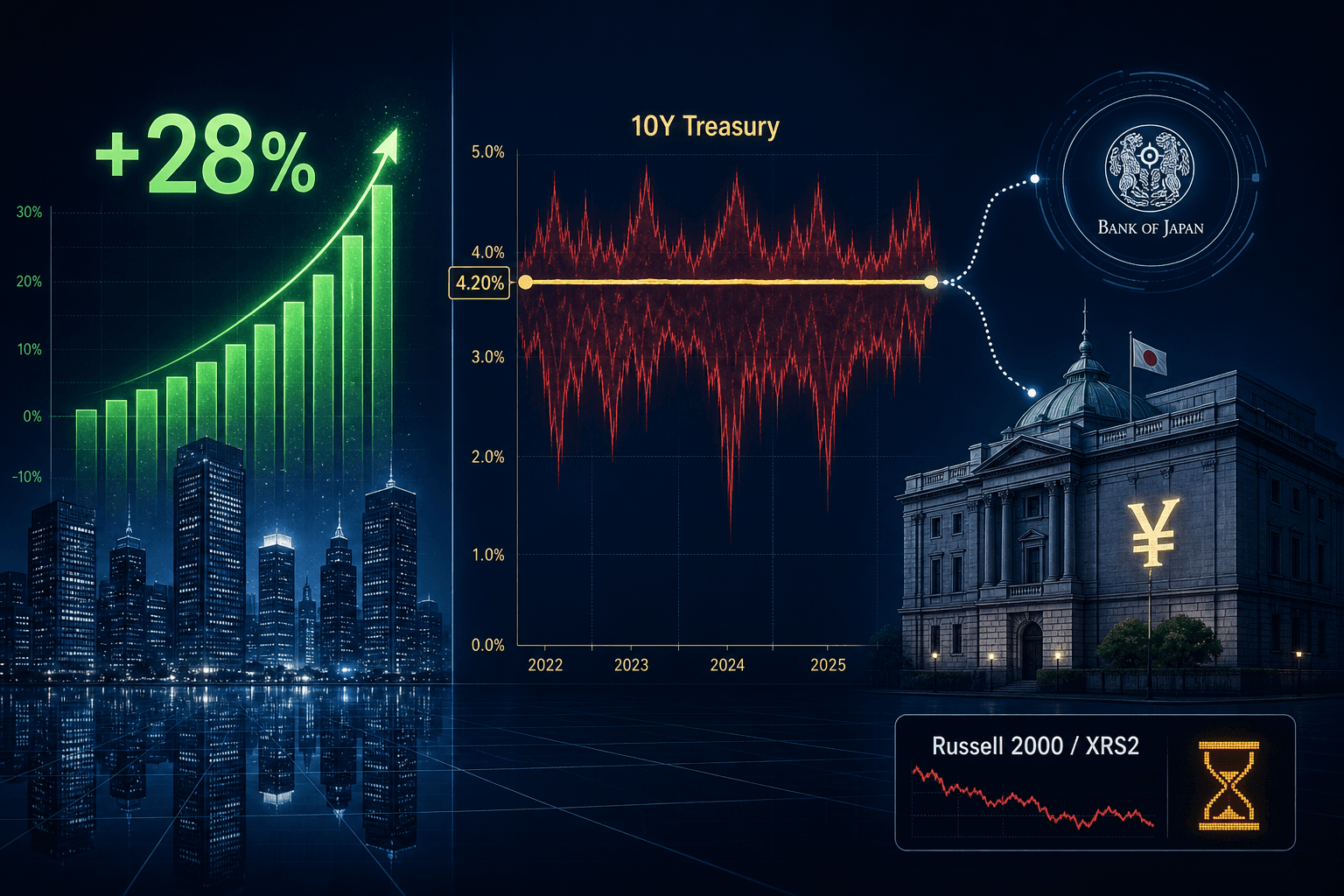
SP500 Earnings Up 28%, No Dot-Com Bubble, and Why the Bank of Japan Just Sent a Bullish Signal
SP500 companies just reported 28% earnings growth and 11% sales growth. Central banks are threatening rate hikes but HOPLA believes they will not follow through. The Bank of Japan sold 35 billion dollars in US Treasuries — and paradoxically, that is a bullish signal. And the dot-com bubble comparison that keeps appearing in financial media? The numbers show why it does not hold. Plus: why the Russell 2000 may be the next opportunity, and the specific ETF to watch.
The short-term threat: words, not actions
The most immediate risk to the current bull market is not an economic recession, not a geopolitical shock, and not corporate earnings deterioration. According to the HOPLA Finance team, it is central bankers and their language.
The strategy being deployed is deliberate: use verbal threats about potential rate hikes to manage consumer inflation expectations without actually raising rates. The reasoning is straightforward — the inflation currently running through the system is not driven by factors central banks can control. Tariffs and energy price increases from the Iran conflict are supply-side shocks. Raising rates does not make oil cheaper or reduce tariff impacts. It just slows down economic activity.
The HOPLA view: the Fed, the ECB, and the Bank of England will talk tough, but they will wait at least four months before making any actual policy decisions. The divergence between the US and Canada (strong growth) versus the EU and UK (weak growth) makes coordinated tightening particularly difficult to justify.
The implication for markets: the threat is noise, not signal. Act on the actual policy, not the press conference language.
The earnings picture: "absolutely insane"
Whatever concerns exist about macro headwinds, the corporate earnings season for Q1 2026 has been, in the HOPLA team's own words, extraordinary.
SP500 companies: earnings growth of +28%, sales growth of +11%. These are not the numbers of a market in distress. They are the numbers of an economy where large corporations — particularly in technology and AI infrastructure — are translating revenue growth into profitability at an accelerating pace.
Russell 2000 small caps: a different picture. Approximately 45% of companies in this index are currently unprofitable, which makes the aggregate earnings growth figures statistically unreliable. However, sales growth of +7% across the index suggests that the revenue base exists — the question is whether smaller companies can convert that revenue into margins as conditions normalize.
US GDP growth: estimated at approximately 2.35% — described as solid and strong. The US economy is not in recession, not approaching recession, and not showing the warning signs that would typically precede one.
The dot-com comparison that does not hold
Every time the market rallies on technology, someone publishes a chart overlaying the current SP500 on the Nasdaq of 1999-2000 and suggests history is about to repeat. HOPLA addresses this directly.
The fundamental difference is simple: the companies driving this market have real earnings.
In the original dot-com bubble, the companies with the largest valuations were burning cash with no path to profitability. Revenue multiples of 100x or more were applied to companies that had never generated a dollar of net income. The bubble was built on projected futures that never materialized.
The AI infrastructure companies leading this market — the names that appear repeatedly in congressional trading data, in institutional holdings, in analyst upgrades — are generating genuine earnings, expanding margins, and growing their backlogs with signed contracts. A company with a $600 billion revenue backlog is not speculative. It is a business with visibility.
The chart overlay looks similar. The underlying economics are not.
The Bank of Japan's surprising bullish signal
One of the more technical observations in the HOPLA analysis concerns the Bank of Japan, which recently sold approximately $35 billion in US Treasury bonds to purchase yen and stabilize its currency against a depreciating trend.
The instinctive interpretation: massive selling of US bonds → bond yields rise sharply → equities face competition from higher fixed income returns → bearish for stocks.
What actually happened: the 10-year US Treasury yield held stable and remained within its support zone. Yields did not spike.
Why is this bullish? Because it demonstrates that there is sufficient demand for US Treasuries that even a $35 billion sale from a major holder does not destabilize the market. And on the liquidity mechanics: when the BoJ sold US Treasuries, it received dollars. When it used those dollars to buy yen, those dollars circulated back into the global financial system. The net effect on global dollar liquidity was approximately neutral.
Stable yields despite large bond sales = strong underlying demand for US debt = no liquidity crisis = bullish for equities.
The Russell 2000: the next opportunity in waiting
Having established the case for continued SP500 strength, HOPLA identifies the Russell 2000 as a potentially significant opportunity — one that has not yet triggered for entry but deserves close monitoring.
The Russell 2000 is not what it used to be. The index now contains a meaningful proportion of technology and energy companies, including names in clean energy infrastructure (Next Power, Bloom Energy) that carry genuine growth characteristics. The 45% unprofitability figure reflects legacy composition more than the direction the index is moving.
The tactical approach: wait for the first meaningful correction before building a position. After recent historic gains in the index, HOPLA's algorithm has not yet confirmed the entry signal. The opportunity is identified; the timing is not yet right.
The vehicle: for European investors, the recommended ETF is XRS2 — a Russell 2000 accumulation ETF trading on the German Xetra exchange in euros. The euro denomination eliminates currency hedging costs, and the accumulation structure avoids dividend taxation drag. The same logic applied to the SP500 recommendation of SPYL applies here.
Analysis based on a HOPLA Finance video by José Luis Cava, published May 14, 2026. For informational purposes only — not financial advice.
Explore the data
Check the latest congressional trades and active investment signals.