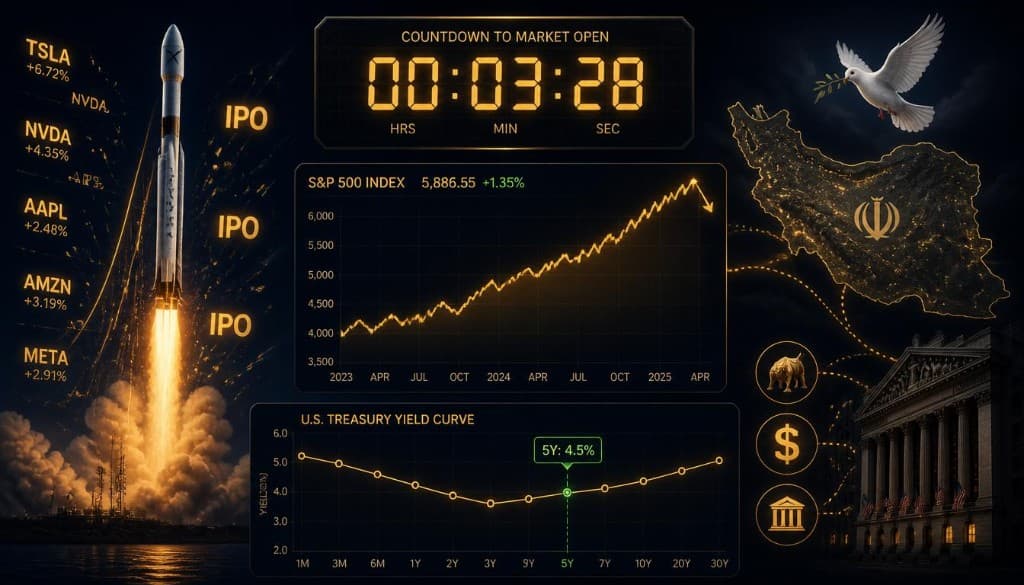
The SpaceX IPO, the Iran Peace Deal, and the Clock Counting Down to the Market Peak
José Luis Cava lays out what he calls the master plan: Trump will synchronize the Iran peace deal with the SpaceX IPO to create maximum market euphoria for the largest stock offering in history. Meanwhile, US debt sustainability hangs on a single equation — and right now, it holds. But once SpaceX goes public and Iran is priced in, the rally may have found its ceiling.
The master plan: choreographing euphoria
Cava describes a deliberate coordination that, if accurate, would represent one of the most consequential pieces of financial engineering in modern history.
The thesis: Donald Trump intends to synchronize the signing of an Iran peace agreement with the IPO of SpaceX — timing the two events to coincide and generate a surge of market optimism that would allow SpaceX shares to be sold at the highest possible price, to the largest possible pool of investors, in what could become the largest stock offering in history.
The mechanics are straightforward once you see the logic. A peace deal with Iran removes a significant geopolitical risk premium from energy markets and global equities. Bond yields on long-dated debt — 5 and 10-year maturities — would likely fall in response, as the perceived need for a risk premium diminishes. Lower long-term yields create a more favorable environment for equity valuations. Maximum optimism, maximum valuations, maximum IPO price.
Goldman Sachs is positioned to lead the offering and would collect commissions commensurate with the scale of the deal.
The one constraint on this optimism: the IPO would drain an estimated $70 billion in liquidity from the financial system into the real economy — a significant but manageable extraction from global capital markets, though one that would represent a genuine headwind for asset prices at the margin.
The debt question: sustainable or not?
Beneath the tactical maneuvering lies a more fundamental question that determines whether the entire structure holds: is US government debt sustainable?
Cava presents the analytical framework clearly. Debt is theoretically sustainable when:
Nominal GDP growth rate > Nominal interest rate on debt (assuming a primary surplus or balanced budget)
For the United States in 2026:
- Real GDP growth: approximately 2.4%
- Inflation: approximately 3.0%
- Nominal GDP growth: approximately 5.4%
The critical variable is which interest rate to use as the comparison. This is where the analysis becomes precise:
The 20-year bond yield is currently near 5.3%. If you use this as the benchmark, sustainability is in question — 5.4% nominal growth barely covers 5.3% interest costs, and any deterioration in growth or uptick in inflation tips the equation into danger. This is the number that generates panic headlines.
The average maturity of US debt is 5 to 6 years. The 5-year bond yield is approximately 4.5%. Using the actual weighted average cost of debt — rather than the longest maturity — the equation reads: 5.4% nominal growth against 4.5% interest cost. The debt is sustainable by approximately 90 basis points.
This distinction matters enormously. Media and bearish analysts consistently reference 20 or 30-year bond yields to argue unsustainability. The actual debt portfolio of the US government is weighted toward shorter maturities, which changes the calculus entirely.
Trump's toolkit for maintaining the narrative
Cava identifies the specific mechanisms the Trump administration is deploying to keep the sustainability equation in its favor:
Growth and AI productivity. Rather than cutting spending — which would be politically costly and economically contractionary — the bet is on accelerating nominal GDP growth. Artificial intelligence improving productivity across the economy would simultaneously boost real growth and reduce inflationary pressure, improving both sides of the sustainability equation.
Bessent's yield curve management. Treasury Secretary Bessent is issuing short-term debt and using the proceeds to purchase 5-year bonds — a form of yield curve control designed to prevent the 5-year rate from rising above the level where the sustainability calculation breaks. This is active management of the benchmark rate that actually matters for the debt stock.
Kevin Warsh at the Federal Reserve. Warsh is expected to take the Fed chairmanship shortly. His mandate, as Cava reads it: cut interest rates and ensure sufficient liquidity in the system to allow the enormous volume of existing debt to be refinanced at manageable costs. Lower short rates reduce the cost of rolling short-duration debt. More liquidity supports asset prices. Both are necessary for the plan to hold.
The scenario and its terminal condition
Cava's conclusion is perhaps the most actionable element of the entire analysis:
Markets could continue rising through the short-term noise — including any temporary corrections driven by interest rate fears — as long as the Trump administration successfully projects an image of debt sustainability. The combination of Bessent's yield management and Warsh's rate policy creates a credible floor under that narrative.
The bullish phase extends until two specific events are fully priced in by markets:
- The Iran peace deal
- The SpaceX IPO
Once both materialize — once the geopolitical risk premium is gone and $70 billion has been extracted into the SpaceX float — the market will have consumed its primary catalysts. At that point, Cava suggests, the conditions for a significant correction will be in place.
This is not a prediction of imminent collapse. It is a roadmap: the rally has fuel, the fuel has a name, and when the fuel is spent, investors should pay close attention.
For now, the direction remains up. The clock is running.
Analysis based on a José Luis Cava video published May 19, 2026. For informational purposes only — not financial advice.
Explore the data
Check the latest congressional trades and active investment signals.