SpaceX IPO: The Two-Phase Market Correction Nobody Is Talking About
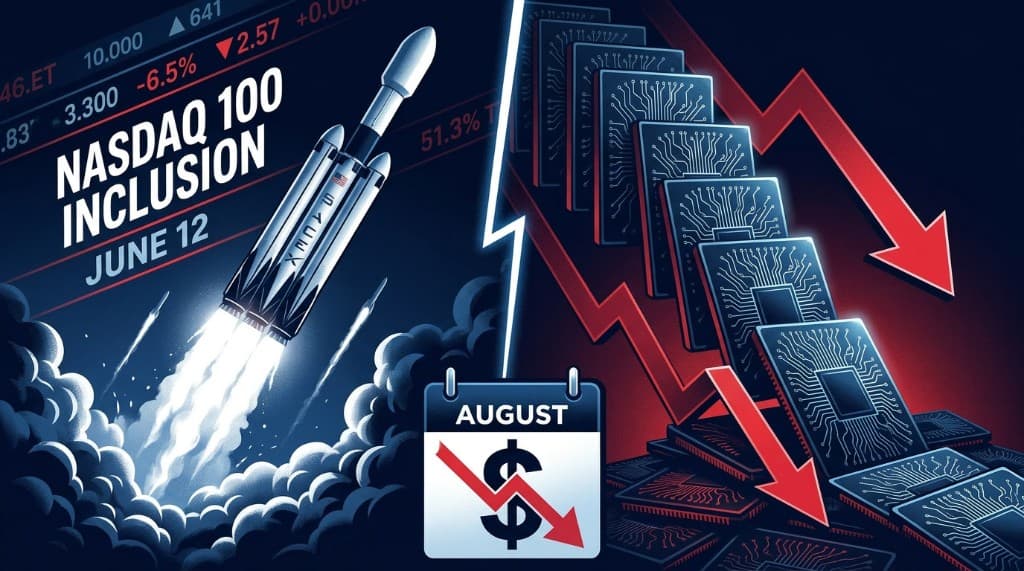
The SpaceX IPO on June 12 is not a single event — it is a two-phase market disruption. Phase one: institutions sell semiconductors to make room for SpaceX in the Nasdaq 100. Phase two: the staged lockup expires after Q2 results, deliberately timed for August when markets are thin and investors are on holiday. José Luis Cava maps the full mechanics, explains why DXYZ is his preferred vehicle for SpaceX exposure, and identifies the technical entry levels.
The strategic timing of the IPO
The conditions Elon Musk has chosen for the SpaceX listing are not accidental. The US economy is growing at approximately 3%. Inflation is trending lower, supported by falling oil prices. Inflation expectations remain anchored. Diplomatic progress toward a US-China framework agreement is reducing global risk premiums and potentially opening the door to Chinese investment on American soil.
This is the most favorable macro environment for a technology IPO in years. The target raise: $75 billion, which would make it one of the largest equity offerings in history. Cava notes that the valuation implied by the offering — between $1.75 and $2 trillion — cannot be assessed using traditional metrics. What is being priced is a discounted cash flow of future hyperspatial scalability: 15,000 satellites in three years, a communications infrastructure that would transform global connectivity. Musk's execution timeline for this plan is estimated by outside experts at ten years for any other operator. The premium in the pricing reflects the belief that Musk operates by different timelines.
The "extreme greed" in the valuation is real. But so is the business. The positive externality that Cava highlights: the existing SpaceX shareholders — employees, early investors, funds — who become millionaires through this offering will spend that wealth. The consumption effect of a $75 billion equity event flows into the real US economy.
Phase one: the semiconductor selloff
The Nasdaq 100 inclusion mechanics create the first disruption.
June 12 is the IPO date. Approximately 15 days later, SpaceX will be incorporated into the Nasdaq 100 index with a weighting that reflects its market capitalization — one of the largest in the index from day one. This is not optional for passive funds. Every ETF tracking the Nasdaq 100, every pension fund with a passive allocation, every index-linked product globally must buy SpaceX shares in proportion to its weighting.
To buy SpaceX, they need cash. To generate cash, they sell what has risen most. The sector that has risen most is semiconductors.
Cava's projection: by the end of June, the semiconductor sector enters a corrective phase. The selling is not driven by fundamental deterioration — NVIDIA's earnings remain extraordinary, SK Hynix's HBM contracts are intact, TSMC's capex plans are unchanged. It is mechanical portfolio rebalancing. Passive flows in, other things out.
The index-level effect: SpaceX's rise partially offsets the semiconductor decline in headline index numbers. The Nasdaq 100 and SP500 may appear relatively stable in late June while the sector rotation underneath creates significant individual stock moves. By early July, Cava expects a downward-lateral movement in the major indices.
Phase two: the staged lockup and the August trap
This is where the analysis becomes most precise — and most important.
Unlike the standard 180-day lockup that prevents early investors and employees from selling after an IPO, SpaceX has opted for a staged lockup structure. The first significant selling window — 20% of shares — opens after the publication of Q2 earnings results.
Cava's observation, delivered with characteristic directness: these results will almost certainly be published in late July or early August. When investors are on holiday. When market volumes are thin. When the institutional capacity to absorb large selling is at its seasonal minimum.
If SpaceX's stock falls during this period — and the combination of a 20% insider selling window with thin summer markets creates significant downside pressure — the effect on the Nasdaq 100 will be amplified by its weighting. A 10% decline in a stock representing 5-7% of the index creates direct index downside, triggering further passive selling across all index constituents.
This is the second phase. Not June, but July-August. Cava describes it as an opportunity — a deeper correction than the June phase, occurring in a low-liquidity environment that maximizes both the fear and the buying opportunity for those who are prepared.
DXYZ: the technical vehicle for SpaceX exposure
Rather than participating in the IPO directly — where retail investors typically receive allocations at unfavorable prices — Cava identifies Destiny Tech100 (ticker: DXYZ) as his preferred vehicle for SpaceX exposure.
DXYZ is a closed-end fund that holds stakes in private technology companies. Its current composition gives it approximately 0.03% of SpaceX shares, which represents between 20% and 25% of its net asset value. Additionally, it holds approximately 2% in OpenAI and 22% in Anthropic — two of the most valuable private AI companies globally.
The technical analysis of DXYZ:
Resistance at $71-72: Aggressive institutional selling has been identified in this zone. The price has repeatedly failed to sustain above this level, indicating significant overhead supply.
Real value at approximately $30: Based on the volume profile — the price level where institutions have historically accumulated the largest positions — the underlying net asset value of the fund is estimated at approximately $30. This represents the structural floor where informed buyers have demonstrated sustained interest.
Entry target: $48. After a sweep that clears the buyers who entered at $66 and $52 — the two most recent significant entry levels — the price would approach the midpoint between the structural value and the current trading range. At $48, the risk-reward ratio becomes favorable: potential upside toward $70+ against a structural floor at $30.
Cava's strategy: do not chase the IPO. Do not buy DXYZ at current levels. Wait for the mechanical correction that Phase one and Phase two will create, and enter DXYZ at $48 with a defined technical structure.
The roadmap for investors
The full timeline that Cava maps:
June 12: SpaceX lists. Initial market euphoria. Late June: Nasdaq 100 forced inclusion. Passive funds sell semiconductors to buy SpaceX. Semiconductor sector enters correction. Early July: Indices show lateral-to-downward movement. SP500 and Nasdaq absorb the rotation. Late July - August: Q2 results published. Staged lockup opens 20% selling window. Summer thin markets amplify the move. Second and deeper correction phase.
For investors who have been accumulating reserves — who resisted the temptation to be fully invested at index highs — both correction phases offer entry opportunities. The June phase is the first signal. The August phase may offer the more attractive prices.
The June 12 date matters not as the day to buy, but as the day the process begins.
Analysis based on a José Luis Cava video published June 4, 2026. For informational purposes only — not financial advice.
Explore the data
Check the latest congressional trades and active investment signals.