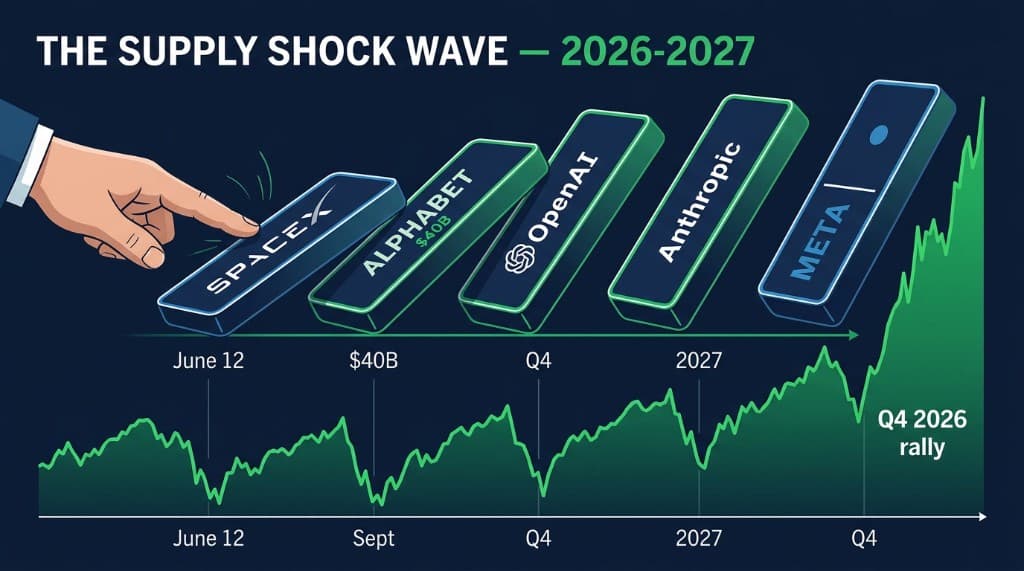
SpaceX Is Just the Beginning: The Equity Supply Shock That Will Define Markets Through 2027
The SpaceX IPO on June 12 is not an isolated event — it is the first wave of a massive equity supply shock that will run through early 2027. Alphabet is preparing a $40 billion share issuance before September. OpenAI and Anthropic have filed confidentially with the SEC. Meta will issue shares to fund AI. Each listing requires the market to stay high enough to place the paper. José Luis Cava maps the precise timeline, explains why the current correction is algorithmic and temporary, and identifies the window when the real buying opportunity arrives.
The rotation has a name and a date
The sell-off in semiconductors that began in late May and accelerated through June has a precise mechanical cause: fund managers are generating cash to purchase SpaceX shares on June 12. The semiconductor index had doubled — a 100% gain — between March and June 2026. It is the sector with the largest recent gains and therefore the most liquid source of capital for portfolio rebalancing.
The demand for SpaceX is extraordinary. The offering is estimated to be oversubscribed four times. This means the majority of institutional buyers who wanted shares in the initial allocation will not receive their full allocation — and will be forced into the secondary market immediately after listing to purchase what they could not obtain at the IPO price. This secondary market buying creates additional upward pressure on SpaceX's price in the days following the listing.
The algorithmic dimension: trading systems continuously monitor institutional order flow and detect the selling pressure from fund managers needing to raise cash. They accelerate the move downward, pushing prices toward technical support levels before the institutional buying — for SpaceX and for the rotation back into other assets — begins. This is not manipulation in the legal sense. It is the automated exploitation of predictable institutional behavior.
Why this is not a bubble bursting
The current narrative in parts of the financial media frames the correction as confirmation that the AI-driven tech rally was overextended. Cava's position is direct: this is a technical correction and portfolio rotation, not a trend reversal.
The distinction matters because it requires no systemic trigger to reverse. The Fed is still injecting approximately $8 billion per week into the financial system through Treasury bill purchases. There is no Federal Reserve withdrawal of liquidity — the condition that Cava identifies as necessary for a genuine bear market to begin. The current weakness is created by the mechanics of the SpaceX listing, not by a deterioration in the underlying monetary environment.
Once the rotation completes — once fund managers have purchased their SpaceX allocation and rebalanced — the capital flows stabilize and the market can resume its upward trajectory.
The Treasury factor: who really controls liquidity
One of the less-discussed but operationally significant points in Cava's analysis: the Federal Reserve is not the primary manager of short-term market liquidity. That role belongs to the US Treasury.
The Treasury maintains an account at the Federal Reserve with a current balance exceeding $875 billion, which increased by approximately $45 billion in the prior week. When the Treasury increases this balance — by drawing down on its cash holdings rather than spending — it effectively removes dollars from the financial system. When it draws down the account to fund spending, it injects dollars.
This mechanism operates independently of Fed rate decisions and quantitative easing programs. The practical implication: watching Treasury cash flows provides an additional real-time indicator of system liquidity that the Fed alone does not capture.
The monetary reality and the inflation calculation
The FOMC meeting scheduled for June 16-17 will be watched closely, particularly in the context of Kevin Warsh's anticipated leadership of the Federal Reserve. The policy dilemma is structural: Cava estimates that real US inflation, measured accurately, lies between 5% and 10% — significantly above the official figures.
The policy response being considered is not to address this inflation directly, but to change the methodology by which it is measured, creating the statistical basis for rate cuts in 2027 regardless of actual price behavior. This is the same approach that Cava and Fernando Sánchez have both identified as part of the broader monetary debasement dynamic — the slow erosion of purchasing power through a combination of actual inflation and its statistical underrepresentation.
For investors in real assets — equities, gold, hard assets — the implication remains the same regardless of which inflation figure the government adopts: cash loses purchasing power, and productive assets that generate real returns are the only durable store of value.
The supply shock timeline: June 2026 through early 2027
What makes the current period structurally different from previous corrections is not just the SpaceX listing — it is the wave of equity supply that follows it over the next 12 to 18 months:
June 12, 2026 — SpaceX: The initial listing. Semiconductor selling to fund allocation. Immediate secondary market buying as oversubscribed demand flows into the open market.
August 2026 — SpaceX lock-up: The first staged lock-up window opens after Q2 results are published. An estimated 20% of shares held by early employees and founders becomes available for sale. In thin summer markets, this creates additional downward pressure.
August-September 2026 — Alphabet: Alphabet is planning to issue approximately $40 billion in new shares before September. A primary share issuance of this magnitude creates direct selling pressure on Alphabet's price as the new shares are absorbed by the market. For investors waiting for Alphabet at lower prices, this issuance is a catalyst — not a negative event.
Q4 2026 — OpenAI and Anthropic: Both companies have filed confidentially with the SEC. OpenAI's IPO is anticipated between Q4 2026 and early 2027. Anthropic will follow on a similar timeline. These listings will require the same rebalancing mechanics as SpaceX — institutional selling of existing positions to fund new allocations.
Q4 2026 — Meta: Also planning a share issuance to fund AI infrastructure investment.
Early 2027 — Anthropic and follow-ons.
The market's self-interest in staying high
Here is the critical structural insight: every one of these listings requires the market to remain at elevated levels to succeed. Goldman Sachs, Morgan Stanley, and the other banks managing these offerings need high equity prices to place the paper at maximum valuations. The companies themselves need high prices to minimize dilution.
This creates a self-reinforcing dynamic: the institutional machinery that profits from these listings has a strong financial interest in preventing a bear market through the end of 2026. That does not mean volatility is impossible — we are experiencing it now. But it does mean that a sustained bear market beginning before the OpenAI and Anthropic listings would be contrary to the financial interests of the most powerful participants in the market.
Cava's conclusion: the correction of May-June is a short-term algorithmic move to flush weak hands before the next advance. August-September brings a second, deeper correction driven by the SpaceX lock-up and the Alphabet issuance. Q4 2026 must be — and in Cava's view will be — bullish, because the IPO pipeline requires it.
The calendar for patient investors
The pattern that emerges from this analysis is precise:
- Now through July: Technical correction completes. Algorithms flush remaining weak hands. Entry opportunities in semiconductors, broad index ETFs, and quality tech.
- August-September: Second correction wave from lock-up release and Alphabet issuance. Potentially deeper. Second and better entry window.
- Q4 2026: Rally required by the IPO pipeline. Strongest seasonal period for equities.
- 2027: OpenAI and Anthropic listings complete the wave. After this, the supply shock resolves and the market enters a new phase.
For investors who have preserved capital and are not currently overextended, this timeline offers multiple defined entry points with clear catalysts for recovery. The key is not to exhaust available capital in the first correction when a deeper one follows eight weeks later.
Analysis based on a José Luis Cava video published June 10, 2026. For informational purposes only — not financial advice.
Explore the data
Check the latest congressional trades and active investment signals.