The Speculator's Identity: How the Crowd Was Expelled From a 56% Rally
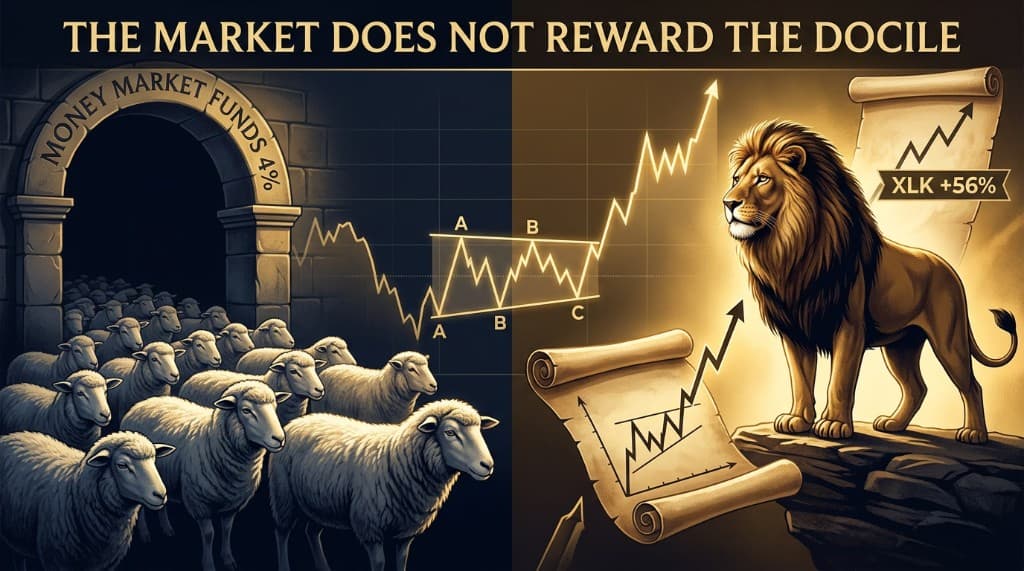
XLK, the technology sector ETF, rose 56.5% from its late March 2026 lows. On April 1st — the exact bottom — 51.4% of investors were bearish. Today, despite the 56% gain, bullish sentiment has only increased by 3%. Most retail investors missed the entire rally sitting in money market funds. José Luis Cava explains the psychology behind this systematic expulsion, the flat pattern technical structure that signals more upside ahead, and the mindset required to not be part of the herd.
The data that explains everything
On April 1, 2026, 51.4% of investors surveyed held a bearish outlook on markets. That date corresponds, almost precisely, to the lows of the XLK technology ETF before it began a rally that would take it up 56.5% through June 3.
Today, after that 56% gain — with the Nasdaq and Dow Jones at all-time highs — bullish sentiment has increased by approximately 3 percentage points. Bearish sentiment has fallen by 14 points, but the majority of those investors have not moved into equities. They have moved to the sidelines, into money market funds, collecting the interest rates that monetary policy offers while the market they were afraid of compounded at 56% per year.
This is not an accident. This is the mechanism that Cava calls "la maldad" — the systematic expulsion of retail investors from markets precisely when the risk-reward ratio is most favorable.
The three pillars of the good speculator
Cava's framework for what he calls the "good speculator" is not primarily technical. It is attitudinal. Three pillars define it:
Combativeness. The market is not a cooperative environment. It is a system in which professional participants actively work to dislodge retail investors from their positions at the worst possible moments — the bottoms — so that the recovery happens without them. Accepting this reality requires not submissiveness but the opposite: a combative disposition that does not capitulate to narrative pressure.
Willpower and non-negotiable effort. Michael Jordan's framework, cited by Cava: failure is acceptable, but not making the attempt is not. And making the attempt without genuine will to succeed and genuine effort compounds the failure rather than creating resilience. The speculator who does not study the tools — technical patterns, behavioral data, market structure — is attempting without effort.
Awakening rather than following. The Milei reference — "I have not come to guide sheep, but to awaken lions" — is applied directly to the financial context. The dominant narrative in markets is consistently constructed to benefit those who create it. Questioning that narrative, studying independently, and forming one's own analysis is the only defense against the systematic extraction of retail capital.
These three pillars are completed by what Cava calls "mansedumbre de espíritu" — a concept from the Catholic tradition that combines external humility with controlled inner strength. The speculator who confuses humility with weakness loses. The one who combines genuine humility (knowing what you don't know, respecting the market) with controlled inner strength (acting on studied conviction) reaches the combination that produces consistent results.
The sentiment trap in numbers
The April 1 data is worth dwelling on. When more than half of surveyed investors are bearish, it means more than half of those who were going to sell have already sold. The selling pressure that would push prices lower has, by definition, mostly been spent. The remaining sellers are weak hands who will capitulate on the next move down.
This is not a prediction system. It is a probabilistic framework. When the majority is positioned for decline, the capital required to drive a significant further decline is absent. When the majority is positioned for growth, the capital required to sustain that growth is already deployed.
The April data represented maximum bearish positioning. It was also, in retrospect, the maximum buying opportunity of 2026 to date.
What is the situation now? Despite the 56% gain, bullish sentiment has barely moved. The investors who sold in fear have not returned. They are sitting in money market funds, receiving 4-5% annually in nominal terms while the market they abandoned has returned 56% in approximately two months. They will return — but likely at the top, not the bottom. This is how retail capital is systematically destroyed over market cycles.
The technical structure: more upside ahead
The XLK chart, analyzed through the lens of Elliott Wave and pattern analysis, shows what Cava identifies as a flat pattern — an A-B-C corrective structure.
A flat pattern occurs when a market undergoes a sideways-to-corrective phase that does not break the underlying trend. The A wave declines, the B wave recovers to near the starting point, and the C wave completes the correction without reaching new lows. Following a flat pattern completed within an underlying uptrend, the market typically deploys a new impulsive move in the direction of the primary trend.
The current XLK structure shows this pattern completed at the March-April lows. The 56% recovery is the beginning of the impulse wave that follows. According to Cava, this pattern is "the most reliable in existence" and is detailed in his book Sistemas de especulación en bolsa, page 220.
The historical precedent he cites is precise: the Nasdaq between 1998 and 2000 deployed three flat patterns before reaching its final top in March 2000. That top was not random — it was caused by the Federal Reserve withdrawing liquidity from the system. The structural parallel to the current situation is explicit: markets can continue higher through multiple corrective phases before the conditions for a genuine top materialize.
The implication: we are likely in the first or second flat pattern of the current cycle. The market top that Cava estimates for October 2027 through January 2028 requires additional time and additional patterns before it arrives.
What this means for investors sitting in cash
The practical message is uncomfortable for those who have been cautious: the cost of waiting for certainty is the rally itself.
Money market funds are not a safe alternative to equities in a monetary debasement environment. They are a slow loss — their nominal returns eroded by inflation, their real purchasing power declining each year while assets compound. The investor who waits for sentiment to turn positive, for the news to become good, for the uncertainty to resolve — arrives precisely when the easy gains are over and the risk-reward has deteriorated.
The lesson of the April 1 data is not that investors should ignore risk. It is that sentiment extremes are more useful than economic forecasts for timing entries. When more than 50% of investors are bearish, that is the signal. It is not comfortable — the news is terrible, the narratives are dire, the uncertainty is maximal. That is precisely the point.
Cava closes with a message particularly directed at young investors: the choice between the security of guaranteed employment and the work of building genuine financial intelligence is not a neutral one. The first protects against a specific downside while capping the upside structurally. The second requires effort, study, and the willingness to be wrong — but produces asymmetric outcomes over time.
The market does not reward the docile. It rewards the prepared.
Analysis based on a José Luis Cava video published June 5, 2026. For informational purposes only — not financial advice.
Explore the data
Check the latest congressional trades and active investment signals.