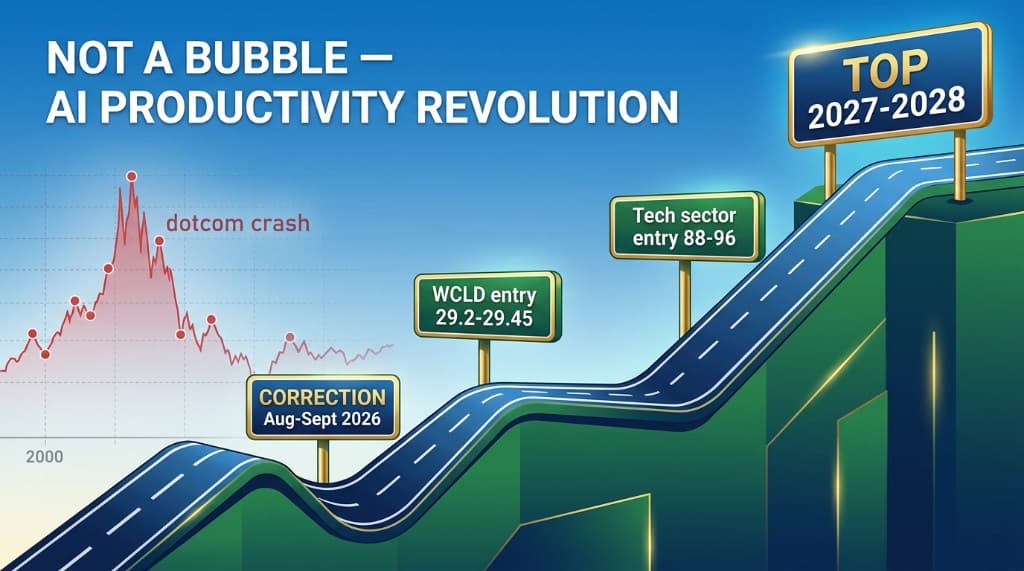
18 to 24 Months of Tech Gains Ahead: Why This Is Not 2000 and Where to Enter
The technology sector is not in a bubble — it is in a correction within a structural bull market that José Luis Cava projects will run for 18 to 24 months after the August-September 2026 bottom. Unlike 2000, today's tech companies are profitable, self-financing with operating cash flow, and building infrastructure that will compress inflation through productivity gains. Cava maps the specific entry levels for the tech sector and introduces WCLD (WisdomTree Cloud Computing) as a vehicle for small and mid-cap cloud exposure with a defined entry zone.
Why this is not the year 2000
The comparison between the current AI infrastructure buildout and the dotcom bubble of 2000 is superficially appealing and analytically wrong. Three structural differences separate the current situation from 2000:
Profitability. In 2000, the companies building internet infrastructure were burning cash at extraordinary rates with no clear path to positive operating income. The valuation of those companies was disconnected from any realistic earnings scenario. Today, the hyperscalers funding AI infrastructure — Alphabet, Amazon, Meta, Microsoft — generate ROIC above 20% and finance their capital expenditure from operating cash flows. They are not borrowing to build. They are reinvesting profits.
Self-financing. The 2000 bubble required external financing to sustain itself. Companies were continuously returning to capital markets to fund operations. When sentiment turned and that external financing dried up, the companies collapsed because they had no internal cash generation to fall back on. The current tech leaders have the opposite problem — they generate more cash than they can productively deploy, which is why they are funding AI infrastructure internally.
The productivity mechanism. The investment case for AI is not purely about the companies building it. It is about what AI does to the rest of the economy. When AI reduces the cost of software development, customer service, data analysis, and administrative work across every industry, it compresses costs, increases margins, and drives productivity growth. This productivity growth puts downward pressure on prices, reduces inflation expectations, and creates the conditions for central banks to lower interest rates. Lower rates increase the present value of all future cash flows. The self-reinforcing dynamic of AI → productivity → lower inflation → lower rates → higher valuations is the structural engine of the multi-year bull market thesis.
The correction context: why the sector has been weak
The technology sector experienced six consecutive months of decline between October 2025 and April 2026. This extended correction served a specific function: it systematically removed weak-handed investors from the sector. Stop-losses were triggered, retail positions were liquidated, and institutional capital was redeployed away from tech into other sectors.
The result is a sector that has been cleaned of speculative excess. The investors who remain are those with conviction and longer time horizons. The investors who were shaken out have already taken their losses and are sitting in cash or money market funds.
When the next advance begins — after the current correction driven by the SpaceX IPO rotation completes in August-September — it will start from a base of committed holders, not a crowded trade full of weak hands waiting to sell. This structural setup is one of the reasons Cava is bullish for the 18-24 month period ahead.
Additionally, the technology sector has underperformed semiconductors and the Nasdaq in the recent advance. Sectors that lag during rallies typically accelerate when the broader market continues higher — catching up the relative performance gap creates additional upside momentum beyond what the index delivers.
The institutional inflow signal
May 2026 saw a significant entry of institutional capital into the technology sector — the largest monthly inflow in several years. This is a structurally bullish signal: it means professional investors are positioning for the next phase of the advance.
However, in the short term, extreme positive sentiment readings have historically preceded brief corrections before the primary trend resumes. After four consecutive months of positive fund flows into the sector, some degree of consolidation or pullback is technically expected before the next major advance.
This is the current moment: a technically justified correction within a structurally bullish trend.
The technical levels to watch
For the broader technology sector ETF, Cava identifies a tiered support structure that defines the risk-reward for entry:
Resistance zone: 111.5, with a recent pivot area at 108. These levels must be overcome on the recovery to confirm the next advance.
Major support floor: 75.96 — the level that has held as support across 2024, 2025, and 2026. A decline to this level would represent an extreme correction that would likely coincide with a broader market crisis. Not the base case.
Intermediate entry zones:
- 96.00: A gap left unfilled from the last impulsive advance. Markets frequently return to fill gaps before continuing in the direction of the trend.
- 92.97: The origin of the last major bullish move. A retrace to this level would constitute what Cava calls "a very good cleaning" — expelling remaining weak hands before the real advance.
- 88.90: A significant support level validated multiple times during the March-April 2026 correction.
These three levels — 88.90, 92.97, and 96.00 — define the range within which the correction is expected to find its floor and establish the base for the 18-24 month advance.
WCLD: the cloud computing vehicle
Within the broader technology theme, Cava identifies WCLD (WisdomTree Cloud Computing ETF) as a specific vehicle worth monitoring for the next phase. WCLD focuses on small and mid-cap cloud computing companies — businesses that sit in the middle of the AI infrastructure buildout as service providers, enabling platforms, and application developers.
The technical structure of WCLD:
Structural support at 23.23: The lowest level the ETF has traded since 2023. This represents the absolute floor of the valuation range — the level where the most patient institutional capital has historically been willing to accumulate.
Ideal entry zone: 29.2-29.45. This is the origin of the last bullish advance — the level from which the most recent impulsive move upward began. In Cava's framework, this zone is the likely target of an algorithmic sweep: the price will probably be pushed to this level to trigger stop-losses and force out investors who bought above it, before the next advance begins. Entering here means buying at the same price as the institutional investors who built their positions before the last advance — with the benefit of knowing the technical structure.
First target: 37.20. A resistance level that, once broken, opens the path to a significantly higher advance. The risk-reward from 29.2 to 37.2 represents approximately 27% upside against a defined stop below 29.2.
The risk-reward framework: Cava emphasizes that the selection of entry criteria depends on the investor's expected accuracy rate. At 29.2-29.45 with a stop below that level, the risk is defined and the reward target is clear. For investors who accept that they will not catch every move but want favorable odds on the moves they do take, this setup offers the ratio that justifies entry.
The 18 to 24 month window
After the August-September 2026 correction — driven by the SpaceX lock-up, the Alphabet share issuance, and the broader supply shock from the IPO pipeline — Cava projects a period of 18 to 24 months of strong gains in technology.
This projection aligns with the broader market top estimate of October 2027 through January 2028, at which point the combination of elevated valuations, extreme bullish sentiment, and a potential Federal Reserve policy tightening could create the conditions for a genuine trend reversal.
The current correction is not that reversal. It is the last major entry opportunity before the final phase of the bull market.
Analysis based on a José Luis Cava video recorded June 4 and published June 11, 2026. For informational purposes only — not financial advice.
Explore the data
Check the latest congressional trades and active investment signals.