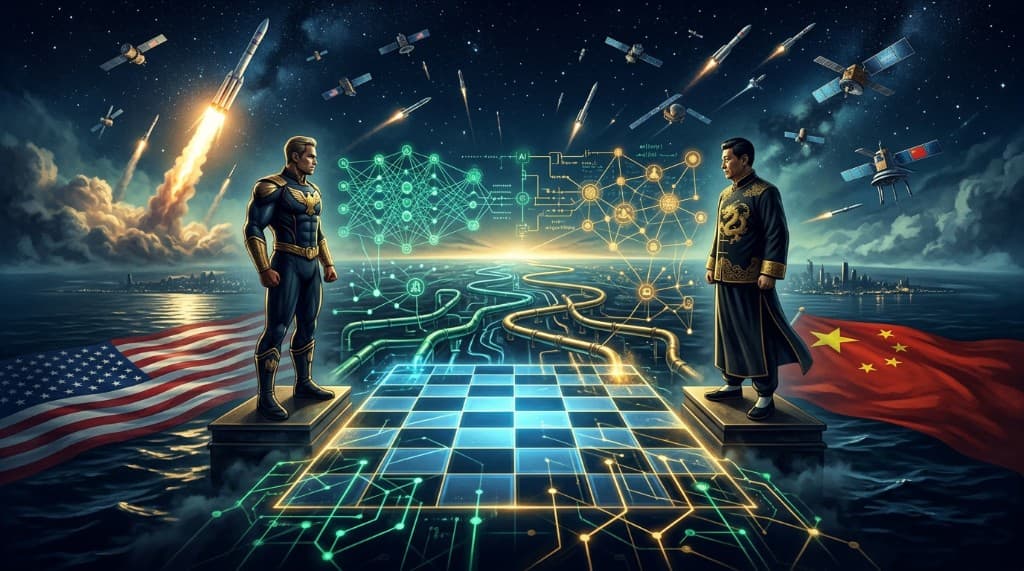
Trump Meets Xi, the AI War Heats Up, and the Space Sector Is Being Ignored
The Trump-Xi meeting is not about trade tariffs. It is about energy and artificial intelligence — the two resources that will define the next decade of global power. José Luis Cava argues Trump arrives from a position of strength, a deal is imminent, and the consequences for markets in 2026 and 2027 could be extraordinary. He also identifies the space sector as the most undervalued growth opportunity right now, and delivers a hard message to younger generations about why learning to speculate is no longer optional.
This is not about tariffs
When the President of the United States travels to China for the first time in nearly a decade — accompanied by the CEOs of NVIDIA, Apple, Tesla, BlackRock, Goldman Sachs, Boeing, Citigroup, Mastercard, Visa, and a dozen others — the conversation is not about soybean tariffs.
José Luis Cava's reading of the Trump-Xi summit is clear: this is the opening negotiation in the war for artificial intelligence supremacy. Energy is the front line. Computing power is the prize.
Trump's hand — and why it is stronger than it looks
Cava argues that Trump arrives at the table from a position of genuine strategic strength, for two reasons that most Western media underplays:
First: the US has degraded China's energy security. China's dependence on Middle Eastern oil — particularly Iranian oil — has been constrained by the pressure campaign on Iran. A weakened Iranian regime, facing internal collapse from inflation and scarcity, is a China with a more vulnerable energy supply chain.
Second: the US has reduced Iran's offensive capacity to the point where the Iranian government now fears internal implosion more than external confrontation. This removes a major geopolitical wildcard from the board.
The result: China is negotiating from a position of economic deterioration. The outcome Cava anticipates is a deal in the short term — and with it, a fall in oil prices and a compression of global risk premiums.
The market consequence: a scenario he describes as "wonderful" for 2026 and 2027.
The real war: AI needs cheap energy
The deeper thesis is not new to regular Cava followers, but the Trump-Xi meeting makes it concrete. Artificial intelligence at scale requires enormous amounts of cheap energy. Every large language model, every data center running inference at scale, every GPU cluster training the next generation of models runs on electricity — and lots of it.
The country that controls cheap, abundant energy controls the pace of AI development. That is what the geopolitical competition is actually about. Not chips directly — chips are the symptom. Energy is the cause.
A deal between the US and China that reduces Middle Eastern tensions → lower oil prices → cheaper energy globally → accelerated AI development → the companies building AI infrastructure benefit disproportionately.
Jensen Huang did not fly to Beijing for optics.
The opportunity nobody is looking at: space
In the context of a market where AI stocks have absorbed most of the attention and capital, Cava identifies the space sector as the most undervalued growth opportunity currently available.
The argument is structural: space companies have extremely low market capitalization relative to the size of the opportunity and relative to adjacent sectors like traditional aerospace. The growth drivers are compounding:
Defense spending — every major Western government is increasing its space defense budget. Satellite-based intelligence, communication, and navigation are now core military infrastructure.
Space tourism — moving from billionaire novelty to nascent commercial market. The economics improve with each launch as reusability becomes standard.
Zero-gravity pharmaceutical manufacturing — arguably the least discussed but most transformative application. Certain drugs and biological compounds can only be manufactured in microgravity with the purity required for commercial use. This is not science fiction — it is already in early commercial trials.
Specific names Cava highlights:
- SpaceX IPO — the most anticipated private-to-public event in the sector. Cava flags it as something to watch closely for timing and valuation.
- UFO ETF — a space industry ETF. Cava's condition: only relevant as long as it holds above the $49 support level. Below that, the thesis weakens.
- Rocket Lab — small satellite launch specialist with a growing manifest and commercial contracts.
- Planet Lab — Earth observation satellites, commercial data applications for agriculture, logistics, and government intelligence.
The system trapping young people — and the exit
Cava opens with what he calls the "pincer" closing around the younger generation.
On one side: a university system that, in his view, teaches the past rather than the future — training students to enter salaried employment where, in most cases, their income will cover rent and little else. On the other side: a pension system built as a pyramid scheme, where today's young workers fund today's retirees without any realistic expectation of receiving equivalent benefits when their time comes.
The exit he proposes is speculation — not as a get-rich-quick mechanism but as a discipline that restores individual economic freedom. He is explicit that this knowledge is not taught in universities deliberately: a population that understands how to manage capital independently is harder to control.
The timeline he gives for reaching profitable speculation: 18 to 24 months of consistent, committed practice — provided you start immediately and do not waste time.
This is worth sitting with honestly. Learning to speculate is not simple. It requires capital to start with, time to understand how markets work, the psychological resilience to tolerate early losses, and access to the right sources of knowledge. Most people face at least two or three of those barriers simultaneously. The fact that Cava himself keeps HOPLA's coaching program closed to new members — and does not use his videos to sell anything — is part of what makes his message credible. But credible does not mean easy.
The message is not that everyone will succeed. It is that those who do not try have already accepted a future defined by someone else's decisions.
Analysis based on a video by José Luis Cava from HOPLA Finance, published May 13, 2026. For informational purposes only — not financial advice.
Explore the data
Check the latest congressional trades and active investment signals.