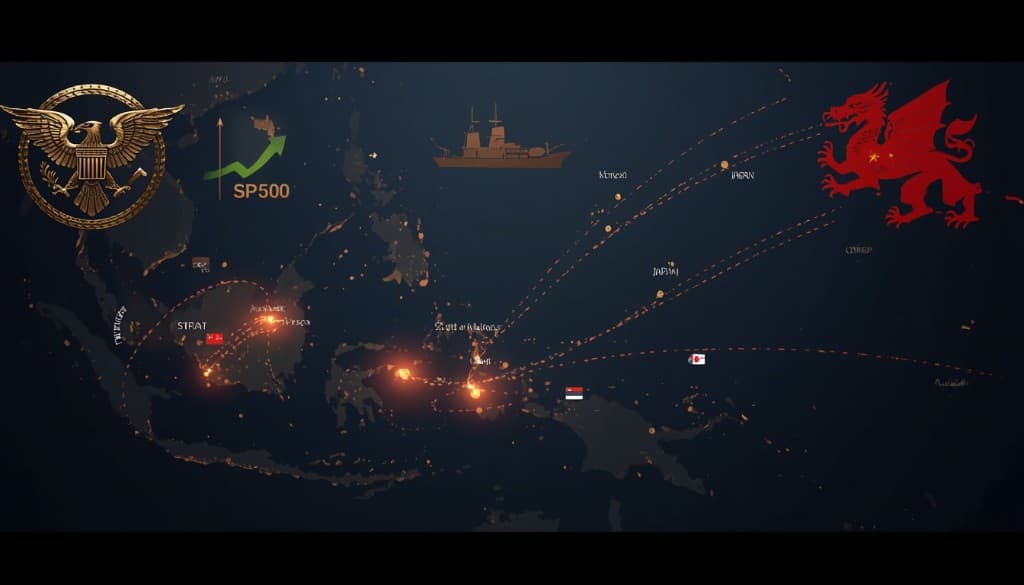
The Thucydides Trap and the Periclean Blockade: Why the US-China Confrontation Is Bullish for the SP500
Xi Jinping has invoked the Thucydides Trap — a historical concept that predicts conflict when a rising power challenges an established one. José Luis Cava interprets this as a sign of weakness, not strength. Meanwhile, Trump is applying a strategy straight from ancient Athens: encircle, control the supply lines, and avoid direct confrontation. The implications for the SP500 are unambiguously bullish.
A change in rhetoric that reveals a change in confidence
Between 2020 and 2025, China's official stance toward US pressure could be summarized in two words: patient and assured. Xi Jinping's messaging consistently projected long-term confidence — the idea that China's trajectory was inevitable and that patience would outlast American political volatility.
That narrative has shifted. Xi has now invoked the Thucydides Trap, a concept coined by political scientist Graham Allison to describe the dangerous tendency for conflict to arise when a rising power threatens to displace an established one. Of the sixteen historical cases Allison examined, twelve ended in war.
José Luis Cava's reading of this shift is direct: invoking the Thucydides Trap is not a position of strength. It is the language of a leader who senses that the strategic window is closing and who needs to prepare his domestic audience for an era of confrontation. Cava interprets it as a threat of military conflict on a roughly four-year timeline — and as a symptom of diminished confidence, not a declaration of capability.
China's internal deterioration since 2020
The confidence deficit has structural roots. China has faced a convergence of serious internal pressures since 2020 that collectively constrain its strategic options:
Real estate collapse. The implosion of the property bubble — concentrated in heavily indebted developers — has destroyed household wealth for millions of Chinese citizens whose savings were tied up in real estate. The sector has not recovered.
Debt accumulation. Both public and private debt have expanded sharply as the government has attempted to stimulate its way out of the slowdown.
Youth unemployment at 20%. A generation entering the workforce without adequate opportunities is a destabilizing force for any political system, particularly one that derives legitimacy partly from economic performance.
Shrinking labor force. Demographic trends are compressing the working-age population precisely when economic dynamism is most needed.
Excessive state intervention. The increasing encroachment of the Communist Party into private enterprise has dampened entrepreneurial activity and deterred foreign investment. The entrepreneurs who built China's technology champions have largely retreated from public life.
External pressure on critical inputs. The United States has implemented stringent export controls on advanced semiconductors, cutting off China's access to the most powerful chips needed for AI development. Simultaneously, the US is reducing its dependence on Chinese rare earth minerals through supply agreements with countries including Brazil — a deliberate effort to deny China the leverage its rare earth dominance previously provided.
The Periclean strategy: encircle, do not engage
Cava frames Trump's approach not as impulsive trade aggression but as a historically coherent strategy — one with a direct parallel in the Peloponnesian War.
When Athens, under Pericles, faced the Spartan military machine, the Athenian strategy was not to meet Sparta on the battlefield where Sparta was dominant. Instead, Pericles chose to use Athenian naval supremacy to control trade routes, deny Sparta's allies access to resources, and outlast the opposition through economic suffocation rather than direct combat.
Trump's China strategy, as Cava describes it, follows the same logic:
Control the energy chokepoints. China imports approximately 20% of its oil through the Strait of Hormuz and 80% through the Strait of Malacca. The United States has systematically reduced Chinese influence at Hormuz and maintains control of the security perimeter around Malaca. An energy-dependent manufacturing economy is acutely vulnerable to disruption at these points.
Build the peripheral alliance. The US has deepened defense and economic ties with South Korea, Japan, the Philippines, and Australia — a strategic arc that encircles China's eastern and southern exposure. This is not a collection of bilateral relationships; it is a coherent containment architecture.
Deny access to the inputs of future power. Advanced chips, rare earths, and the AI research ecosystem are the raw materials of 21st-century industrial dominance. The US export controls are not primarily about trade balance — they are about denying China the capability to build the next generation of military and economic infrastructure.
Graham Allison's historical analysis, which Cava cites, reinforces the logic: when an established power faces a rising challenger, the strategies that have historically succeeded involve indirect pressure and supply constraint rather than direct military confrontation. The US appears to have absorbed this lesson.
Strengthening from within: AI and reindustrialization
The external strategy requires a parallel internal component: ensuring that the United States itself does not become dependent on the very inputs it is denying China.
Artificial intelligence investment. The US is committing to a sustained, multi-decade investment in AI infrastructure — data centers, chip fabrication capacity, research talent. The goal is not simply near-term competitive advantage but structural dominance over a 10 to 15-year horizon. The capital flowing into this buildout is visible in the earnings reports of every major technology company.
Reindustrialization. The broader project of reshoring manufacturing — incentivized through tariffs, industrial policy, and direct subsidies — is designed to reduce the vulnerability that decades of outsourcing created. Semiconductor fabrication in Arizona, pharmaceutical manufacturing in the southeastern US, and defense supply chain domestication are all components of this strategy.
The market implication: structurally bullish for the SP500
Cava's conclusion for investors is clear: this strategic confrontation is net positive for the SP500 over the medium and long term.
The reasoning: the industrial policy required to win a technological and economic competition with China requires corporate investment at scale. Companies that build the infrastructure, manufacture the hardware, develop the software, and manage the supply chains of a reindustrializing America will generate more revenue and more profit. That flows directly into earnings — and earnings drive equity prices over time.
The path will not be linear. Volatility and corrections are inherent features of equity markets and geopolitical uncertainty amplifies them. But the underlying direction, as Cava frames it, is upward — because the strategic imperative to maintain US economic and technological dominance requires exactly the kind of corporate investment that has historically driven equity returns.
The SP500 is, in a very real sense, a stake in America's answer to the Thucydides Trap.
Analysis based on a José Luis Cava video published May 18, 2026. For informational purposes only — not financial advice.
Explore the data
Check the latest congressional trades and active investment signals.