The Warsh Era Begins: Less Communication, Oil at $70, and AI as the Fed's Deflationary Ally
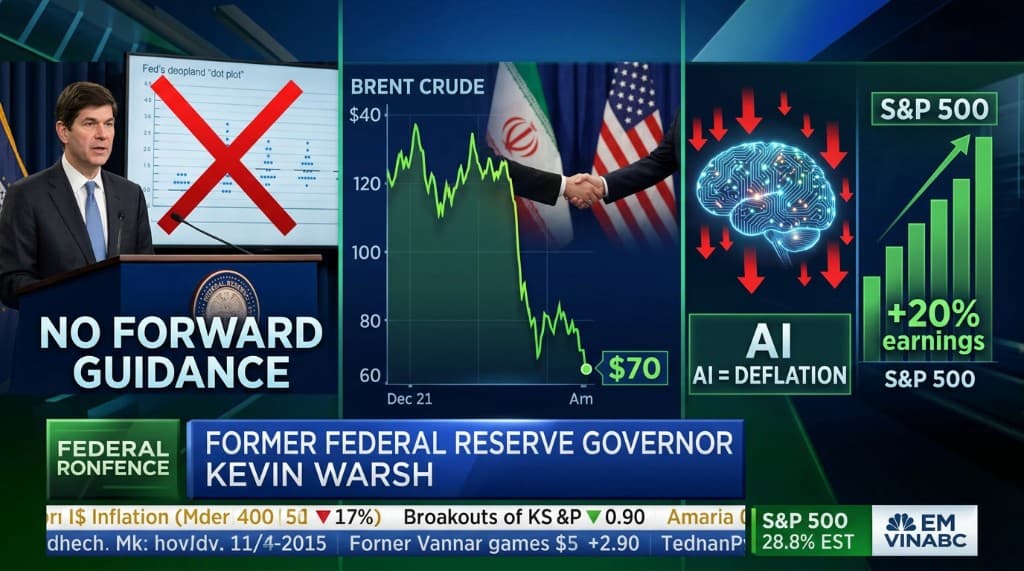
Kevin Warsh has taken over the Federal Reserve and the first meeting delivered no surprises on rates — but a radical shift in communication philosophy. Forward guidance is effectively dead; the dot plot may follow. The market sold off on day one, as it has done in six of the last nine Fed leadership transitions. Fernando Sánchez argues this is the wrong reaction: with Brent crude collapsing to $70 following the US-Iran preaccord, the inflationary pressure that justified hawkish fears has diminished sharply. Add Warsh's own thesis that AI will be structurally deflationary, and the medium-term case for equities — built on 20%+ S&P earnings growth and 2.1% GDP — remains intact.
A new Fed, a new communication doctrine
When Jerome Powell ran the Federal Reserve, investors knew his approach: proactive, detailed communication designed to reduce market uncertainty. The forward guidance — explicit projections of future policy direction — and the dot plot — where each governor plotted their expectation for interest rates over the coming years — were the tools that allowed markets to price in Fed decisions months in advance.
Kevin Warsh, who assumed the chairmanship in June 2026, has a different philosophy entirely. Where Powell sought to reduce uncertainty through communication, Warsh believes that over-communication creates its own distortions — guiding markets in ways that can undermine the Fed's actual flexibility to respond to data. His operating principle is direct: "We are not going to say as much about what we will do. We will watch the data and decide."
The first practical consequence is that forward guidance, as investors have known it for years, is effectively suspended. Warsh has suggested eliminating the dot plot altogether, arguing that projections which change significantly from meeting to meeting do more to confuse markets than orient them. For investors accustomed to treating Fed projections as a roadmap, this represents a genuine adjustment period.
The first meeting: rates held, internal division revealed
At his first FOMC meeting, Warsh held the federal funds rate unchanged in the 3.5%-3.75% range. The decision itself was not the story. What was revealing was the dot plot that accompanied it — potentially one of the last under his tenure — which showed a Fed more divided than it has been in years.
Approximately half of the governors project rate cuts before year end. The other half believe at least one additional hike will be necessary. This is not a close call with clear direction; it is a genuine analytical disagreement about where inflation is heading, which itself reflects the unusual combination of factors currently shaping price dynamics in the American economy.
Oil at $70 and the inflation equation
The external factor that most directly affects Warsh's calculus is the collapse in energy prices. Brent crude has fallen to approximately $70 per barrel — a decline of 30-40% from its recent highs — following the signing of the US-Iran preaccord under the Trump administration.
The significance for monetary policy is direct. The recent uptick in headline inflation was driven primarily by energy prices. With Brent at $70 and the supply dynamics of the Iran deal gradually normalizing oil markets, the energy component of inflation is set to decline substantially. This removes one of the primary arguments for additional rate hikes and creates the conditions for a genuinely more patient Fed approach — even under a hawkish chairman.
It is worth noting the broader geopolitical context: the preaccord, as Cava has analyzed in detail, is a memorandum of understanding rather than a binding treaty. Sixty days of subsequent negotiations on the nuclear framework and fund releases will keep energy markets volatile. But the directional signal — from elevated geopolitical risk premium to a normalization trajectory — is now established.
Warsh's original thesis: AI as a deflationary force
The most intellectually significant aspect of Warsh's appointment is his stated view on artificial intelligence. Drawing on principles of economic productivity theory — including adaptations of Jevons' paradox — Warsh argues that AI will dramatically increase worker productivity across the economy.
The macroeconomic implication of broadly distributed productivity gains is deflationary: when the same number of workers produces significantly more output, unit costs fall, competitive pressures intensify, and price levels across the economy tend toward stability or decline rather than expansion. Warsh believes this dynamic will assert itself meaningfully over the next two years, providing a structural counterweight to inflationary pressures and allowing monetary policy to be less restrictive than a purely backward-looking inflation analysis would suggest.
This thesis aligns with the investment case for AI infrastructure companies. If AI is both an extraordinary growth driver for technology revenue AND a deflationary force for the broader economy, then the current generation of AI hyperscalers — the companies building and deploying the infrastructure — occupy a structurally advantaged position: they capture the revenue upside while their operations help suppress the inflation that would otherwise force the Fed to restrain the growth environment.
Day one red: historical context and the correct response
The market's immediate reaction to Warsh's first meeting was negative — equity indices fell on the session. Fernando Sánchez frames this in historical context: in six of the last nine Federal Reserve leadership transitions, markets declined on the first day of the new chairman's tenure. The pattern is not driven by fundamentals but by adaptation anxiety — investors recalibrating to a less predictable communication environment.
The fundamental case has not changed. US GDP growth is projected at 2.1%. S&P 500 earnings are expected to grow in excess of 20% in the coming quarters, driven by the leading companies of the AI revolution. These are not projections that justify sustained market declines.
Fernando Sánchez's operative conclusion is consistent with his broader investment philosophy: fear-driven price dislocations, when fundamentals remain intact, are buying opportunities — not warnings. The ability to calculate the intrinsic value of a business independently of market sentiment is what allows an investor to buy confidently when the market is selling for reasons that will not matter in twelve months.
What changes for long-term investors
The Warsh era introduces genuine short-term volatility. Without forward guidance, every piece of economic data — inflation reports, employment numbers, energy prices — will be interpreted by markets as a potential policy trigger. Volatility will be higher quarter to quarter than it was under Powell.
What does not change is the multi-year growth trajectory. The AI infrastructure buildout has multi-year contracts signed and capital committed. The geopolitical improvement in the Middle East is structurally positive for energy stability. And the very factor Warsh identifies as his challenge — productivity-driven disinflation from AI — is simultaneously the primary catalyst for the 20%+ earnings growth he is navigating around.
For patient investors who can distinguish between short-term policy noise and long-term fundamental strength, the environment remains favorable. The Warsh transition is an adjustment, not a reversal.
Analysis based on Fernando Sánchez video published June 19, 2026. For informational purposes only — not financial advice.
Explore the data
Check the latest congressional trades and active investment signals.